
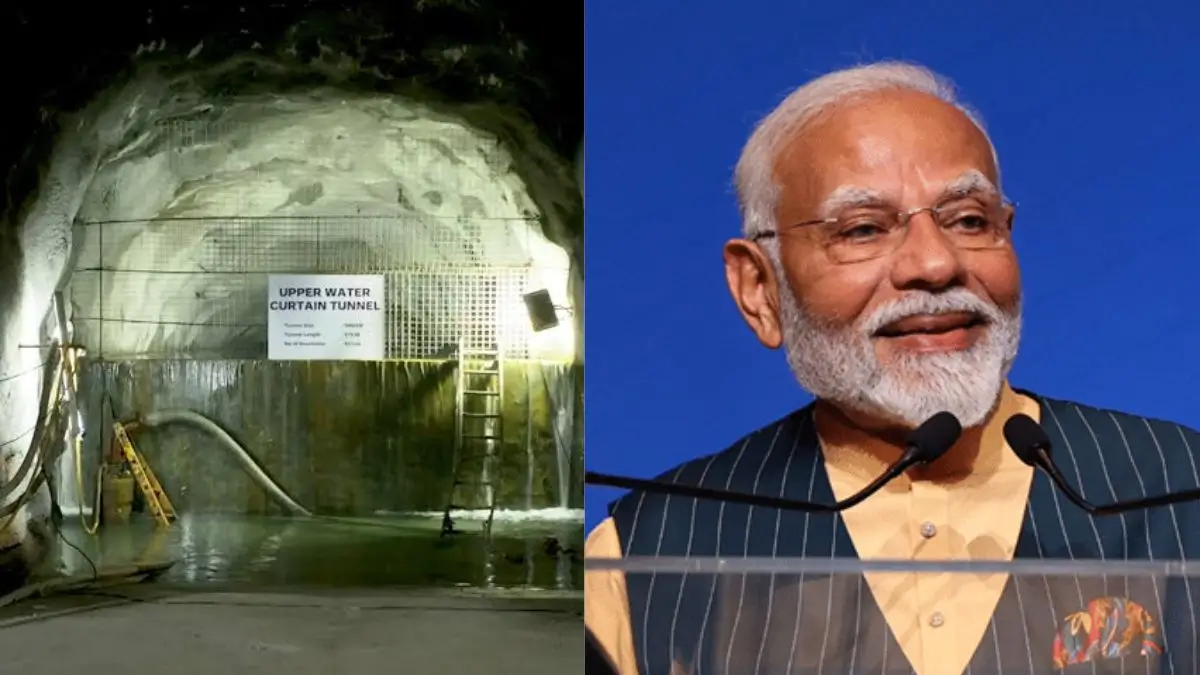
The Prime Minister Narendra Modi dedicated India’s largest underground Liquefied Petroleum Gas (LPG) cavern to the nation at Mangaluru in Karnataka. The cavern, which was developed for Hindustan Petroleum Corporation Limited (HPCL) has a storage capacity of 80,000 metric tonnes and was constructed with an outlay of over ₹850 crore. This will be the second underground LPG storage cavern in the country and will improve energy security by increasing the storage capacity and providing reliable LPG supply.
Key Information about the Mangaluru LPG Cavern
This underground cavern was developed by Megha Engineering & Infrastructures Ltd (MEIL) for HPCL. Construction of the project commenced in 2019 after approval in 2018.
- Project type: Underground LPG storage cavern
- Location: Mangaluru, Karnataka
- Date Dedicated to Nation: 13th November, 2026
- Inaugurated by: Prime Minister Narendra Modi
- Storage Capacity: 80,000 metric tonnes
- Outlay: Over ₹850 crore
- Project Owner: HPCL
- Developed by: Megha Engineering & Infrastructures Ltd
- Pipeline: 9.4km
- Port: New Mangalore Port
Engineering Details of the Cavern
The cavern has been constructed deep within a rock body to provide large storage for LPG. The cavern is an underground facility.
Key details of the cavern include,
- 2 underground tunnels. One tunnel is approx. 1220m long. Another tunnel is approx. 225m long.
- Access tunnel. The cavern is accessed via an access tunnel that is longer than 1km.
- Depth. The cavern is approx. 120m underground.
- Pipeline. The cavern is connected to the main terminal via a 9.4km pipeline to New Mangalore Port.
- Testing. Between 9th May to 6th June 2026, the cavern was tested to ensure safe operations using the Cavern Acceptance Test.
The cavern has a storage capacity of approx. 80,000 metric tonnes of LPG (approx. 6 lakh barrels).
Comparison Between Mangaluru and Visakhapatnam LPG Caverns
Prior to the Mangaluru cavern, the only LPG cavern in India was at Visakhapatnam in Andhra Pradesh. This cavern has increased storage capacity.
| Feature | Mangaluru | Visakhapatnam |
| State | Karnataka | Andhra Pradesh |
| Storage Capacity | 80,000 metric tonnes | 60,000 metric tonnes |
| Significant | Largest LPG cavern in India | First LPG cavern in India |
| Owner | HPCL | South Asia LPG Company (SALPG) |
The cavern at Visakhapatnam is operated by South Asia LPG Company Private Limited (SALPG). This is a joint venture between HPCL and TotalEnergies.
Why the Mangaluru LPG Cavern is Important
India relies on both domestic production and imports of LPG. Underground storage facilities are used to assist keeping storage on hand.
The cavern will be very important for the following reasons,
- Energy Security. It will add additional 80,000 metric tonnes of LPG storage to the country.
- Import Infrastructure. The cavern is connected to New Mangalore Port using a pipeline.
- Storage. The cavern will help manage temporary supply issues.
- Buffer Stock. This will improve the country’s ability to hold buffer stocks of a key cooking fuel.
Underground LPG Cavern and Strategic Petroleum Reserve
This cavern at Mangaluru will prove very important for the underground crude oil storage in India. However, it is unrelated to the country’s Strategic Petroleum Reserve.
India have underground crude oil storage facilities managed by the Indian Strategic Petroleum Reserves Limited (ISPRL). These are at three locations across the country.
| Location | State | Capacity (crude oil) |
| Visakhapatnam | Andhra Pradesh | 1.33 million metric tonnes |
| Mangaluru | Karnataka | 1.5 million metric tonnes |
| Padur | Karnataka | 2.5 million metric tonnes |
| Total | — | 5.33 million metric tonnes |
It should be noted that the LPG cavern at Mangaluru will store liquefied petroleum gas whereas the underground caverns stored crude oil for strategic reserves.







 57th International Film Festival of Indi...
 India Records 38% Decline in TB Mortalit...
 India Receives First Railway Propulsion ...