
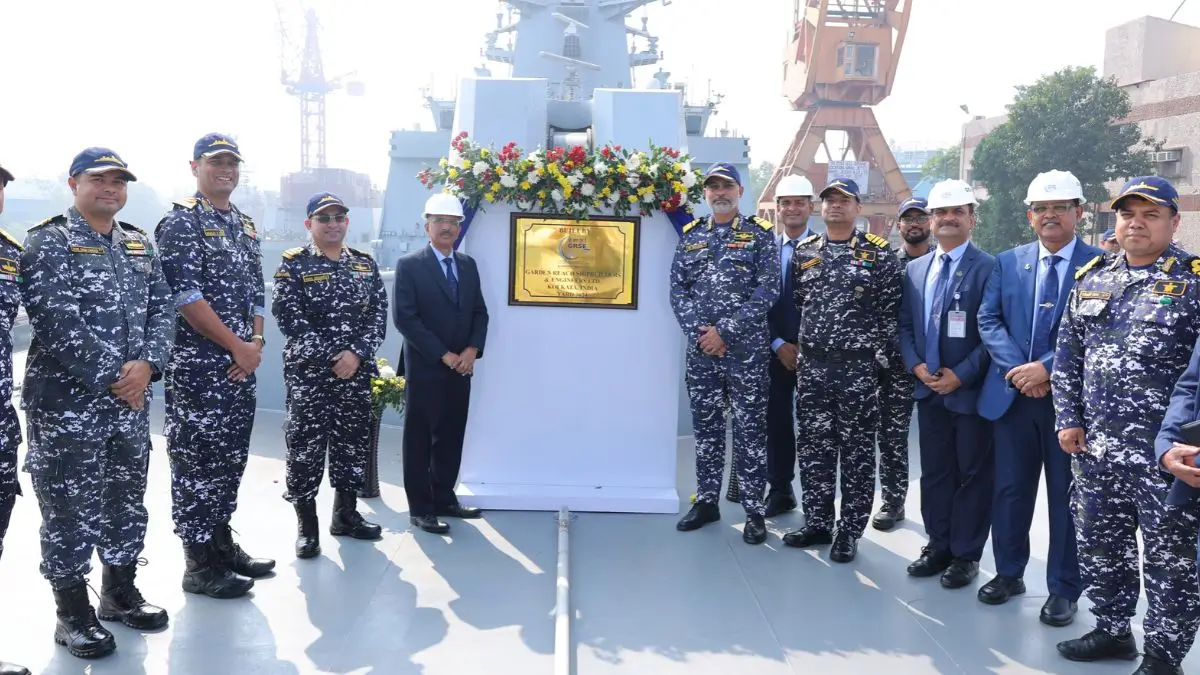
The Indian Navy had received Vindhyagiri (Yard 3024) the seventh and final ship of the Nilgiri class under Project 17A from Garden Reach Shipbuilders and Engineers Limited (GRSE) in Kolkata on November 27, 2026. The delivery completes the handover of all seven Project 17A frigates to the Navy. Designed for multi-dimensional maritime operations, Vindhyagiri incorporates advanced stealth features, weapons, sensors and automation systems. The project also highlights India’s indigenous warship-building capabilities, with 75% indigenisation and participation from more than 200 MSMEs.
Vindhyagiri: Key Details
| Particulars | Details |
| Ship Name | Vindhyagiri |
| Yard Number | Y 3024 |
| Ship Class | Nilgiri class |
| Project | Project 17A |
| Serial Number | Seventh and final ship |
| Shipbuilder | Garden Reach Shipbuilders and Engineers Limited (GRSE) |
| Delivery Date | 27 November 2026 |
| Delivery Location | GRSE, Kolkata |
| Design | Organisation Warship Design Bureau (WDB) |
| Indigenisation Content | 75% |
| MSME Participation | Over 200 MSMEs |
| Direct Employment | Approximately 4,000 personnel |
| Indirect Employment | More than 10,000 personnel |
What Is Project 17A?
Project 17A is an Indian Navy programme to build seven advanced stealth frigates for strengthening the country’s maritime defence capabilities. These ships are the successors to the Project 17 (Shivalik) class and feature improvements in indigenous design, stealth, survivability, automation and combat systems.
The frigates are designed as multi-mission platforms capable of operating across three major warfare domains:
- Anti-surface warfare: Engaging hostile surface vessels.
- Anti-air warfare: Detecting and countering airborne threats.
- Anti-submarine warfare: Detecting and engaging enemy submarines.
The ships were designed by the Warship Design Bureau (WDB), with construction overseen by the respective Warship Overseeing Teams.
Key Features and Technologies of Vindhyagiri
Vindhyagiri incorporates advanced propulsion, platform management, weapons and sensor systems to improve its operational capabilities.
1. CODOG Propulsion System
- The Project 17A frigates use a Combined Diesel or Gas (CODOG) propulsion arrangement. It combines a diesel engine and a gas turbine, which can be used in different operating conditions.
- The propulsion system drives the Controllable Pitch Propeller (CPP) on each shaft. This arrangement supports the ship’s propulsion requirements during the different operational conditions.
2. Integrated Platform Management System
- The frigate is equipped with an Integrated Platform Management System (IPMS). It supports the monitoring and management of important onboard platform systems that contributing to automation and operational efficiency.
3. Advanced Weapons and Sensors
Compared with the earlier Project 17 (Shivalik) class, these Project 17A frigates feature an advanced suite of weapons and sensors.
These systems strengthen the ship’s ability to conduct,
- Anti-surface warfare
- Anti-air warfare
- Anti-submarine warfare
The combination of advanced sensors and weapons improves the frigate’s multi-dimensional combat capabilities.
Project 17A Completed with Delivery of All Seven Frigates
The delivery of Vindhyagiri marks the completion of all seven Project 17A frigate deliveries to the Indian Navy.
The first ship of the class, INS Nilgiri, was delivered on December 20, 2024. With Vindhyagiri’s delivery on November 27, 2026, the Navy received all seven ships within approximately 23 months of the first delivery.
The construction period of Vindhyagiri was also reduced to 68 months, compared with 84 months for the first-of-class INS Nilgiri. This improvement reflects the experience gained during the construction of the preceding six frigates.







 Bhargavastra: India’s Indigenous Count...
 India–Nepal Joint Military Exercise SU...
 Exercise Suryakiran 2026: 20th India-Nep...