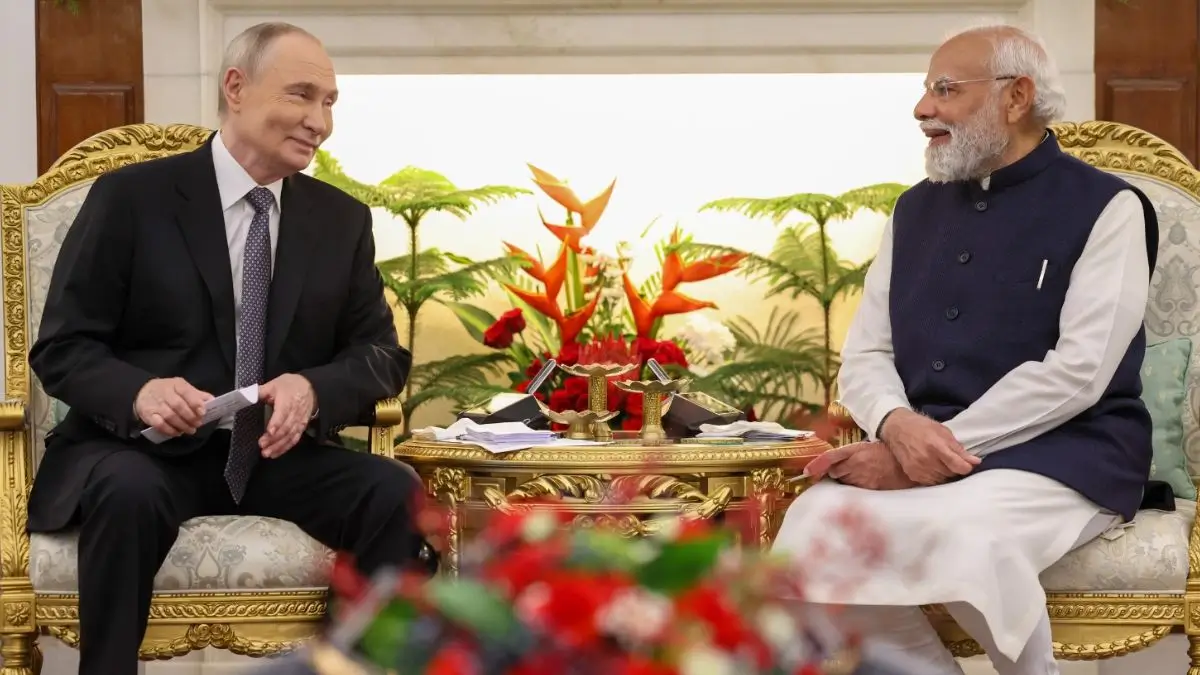
On 4–5 December 2025, the President of the Russian Federation, Vladimir Putin, paid a state visit to India for the 23rd Annual Bilateral Summit. The visit resulted in a comprehensive set of agreements and announcements that reflect the growing multi-dimensional partnership between the two countries. The outcomes signal a clear push toward long-term strategic cooperation, moving beyond traditional areas like defence and energy into labour mobility, healthcare, maritime training, academia, media, and wildlife conservation.
India–Russia Bilateral Ties
India and Russia share a Special and Privileged Strategic Partnership. Key pillars of this relationship include,
- Defence cooperation: India imports significant defence equipment from Russia.
- Energy security: Russia is a major supplier of crude oil and fertilizers to India.
- Space, nuclear, and science ties: Cooperation spans ISRO-Roscosmos and nuclear energy.
- Trade & investment: Both nations aim to boost bilateral trade to $50 billion by 2030.
Migration and Labour Mobility
Agreements Signed
- Temporary Labour Activity Agreement: Enables citizens to work legally in each other’s territory for temporary periods.
- Combating Irregular Migration Agreement: Joint measures to tackle illegal migration, ensure worker safety, and enhance data sharing.
Significance
- India becomes a formal labour-sending partner to Russia, creating employment opportunities.
- Enhanced migration control systems for both countries.
Healthcare and Food Safety Cooperation
Agreements Signed
- MoU between Indian and Russian Health Ministries on medical education, public health, and research.
- MoU between FSSAI (India) and Russia’s consumer health watchdog on food safety cooperation.
Context
- Shared concerns post-COVID-19 about public health systems and disease surveillance.
- Strengthens mutual recognition of health standards and facilitates pharmaceutical collaboration.
Maritime and Polar Waters Collaboration
Agreements Signed
- MoU for training Indian specialists for navigating polar waters — a strategic Arctic initiative.
- MoU between shipping ministries to strengthen maritime links and infrastructure cooperation.
Relevance
- As Arctic shipping routes open due to climate change, India aims to gain expertise in polar navigation.
- Helps in developing future trade corridors and logistics hubs.
Trade, Fertilizers, and Customs Cooperation
Agreements Signed
- MoU between Russian company UralChem and Indian PSUs for fertilizer supply assurance.
- Customs agreement on pre-arrival information exchange to speed up trade logistics.
- Agreement between India Post and Russian Post for smoother parcel and logistics services.
Benefits
- Ensures steady supply of fertilizers for Indian agriculture.
- Modernizes customs procedures, reducing trade delays and increasing transparency.
Academic and Media Collaboration
Academic MoUs
- Collaboration between DIAT Pune and Tomsk State University for defence and scientific research.
- Tripartite agreement between Mumbai University, Moscow State University, and a Russian investment fund.
Media MoUs
- Multiple MoUs signed between Prasar Bharati and Russian media houses including TV BRICS, Gazprom Media, National Media Group, and others for content sharing and cultural broadcasting.
Significance
- Boosts research cooperation, joint publications, and student exchange.
- Strengthens soft power and people-to-people ties through co-produced media content.
Strategic Announcements and Cultural Exchanges
Major Announcements
- India–Russia Economic Cooperation Roadmap till 2030: A future-looking framework to expand trade, investment, and sectoral cooperation.
- Russia joins International Big Cat Alliance (IBCA): Supporting India’s global initiative on wildlife protection.
- India–Russia cultural exhibition agreement: “India. Fabric of Time” exhibition to be held in Moscow.
- Free 30-day e-Tourist Visa for Russian citizens visiting India on a reciprocal basis.
Context
- The economic roadmap formalises future trade and economic goals.
- Russia’s IBCA entry boosts India’s conservation leadership.
- Free visa rollout will enhance tourism, cultural ties, and business visits.
Other Notable Points
- India and Russia have also agreed to accelerate Free Trade Agreement (FTA) negotiations with the Eurasian Economic Union (EAEU).
- Discussions also focused on defence supplies, energy infrastructure projects, and space cooperation.
Key Takeaways
- The 23rd India–Russia Summit took place on 4–5 December 2025 in New Delhi.
- Over a dozen MoUs and agreements were signed in sectors like labour, health, shipping, media, and trade.
- Russia officially joined the International Big Cat Alliance (IBCA).
- Both sides unveiled a 2030 Economic Cooperation Roadmap to guide future trade and development.
- India granted gratis 30-day e-tourist visas to Russian nationals.
- Agreements in fertilizers, customs, education, and broadcasting highlight multi-sector expansion.
- Maritime cooperation now includes training for polar navigation — significant due to Russia’s Arctic access.

 France Hosts One Health Summit Under G7 ...
 Newcastle Disease Spread in Europe 2026:...
 Mongolia Gets New Prime Minister Amid Po...