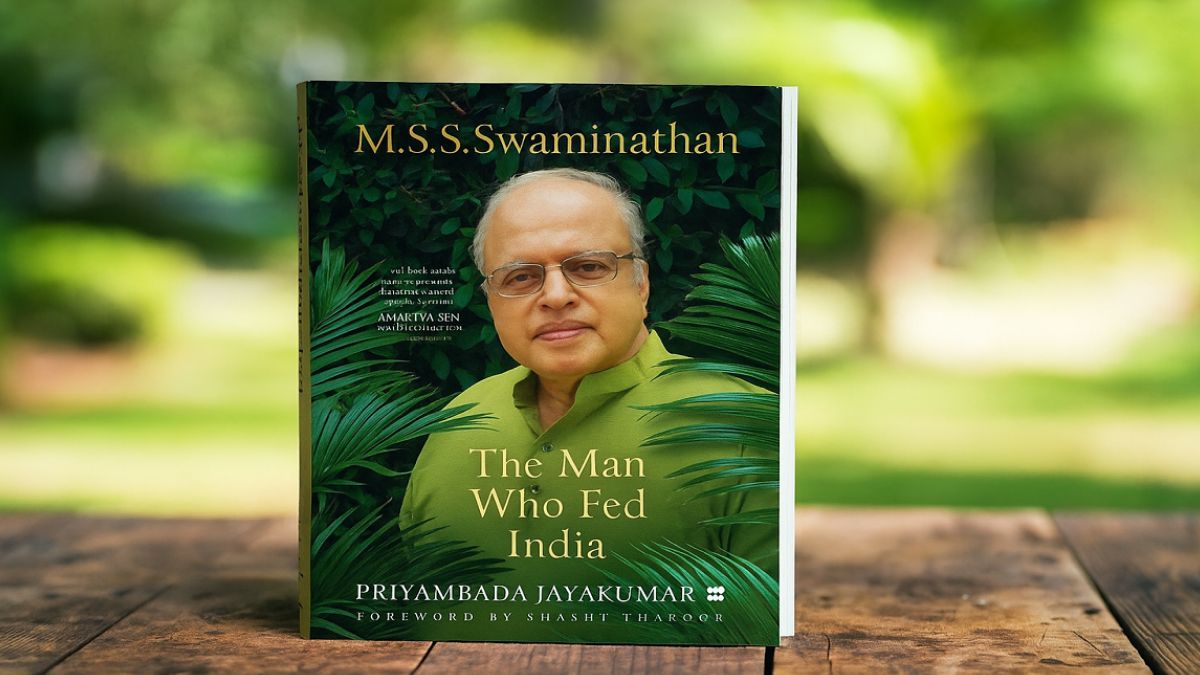
The year 2025 marks the birth centenary of M.S. Swaminathan, the visionary scientist hailed as the “Father of India’s Green Revolution” and celebrated as “The Man Who Fed India.” His leadership in adapting high-yielding wheat varieties to Indian conditions helped India overcome crippling food shortages of the 1960s and achieve self-sufficiency in food grains. A new biography, M.S. Swaminathan: The Man Who Fed India by Priyambada Jayakumar, highlights his extraordinary contributions and enduring lessons for India’s agricultural future.
India’s Food Crisis Before the Green Revolution
Dependency on Food Imports
In the 1960s, India faced acute food insecurity and relied heavily on U.S. wheat imports under Public Law 480 (PL 480). This created a “ship-to-mouth” existence, where food availability depended on grain shipments from abroad. U.S. leaders, including President Lyndon B. Johnson, often used these supplies as political leverage, such as pressuring India over the Vietnam War.
The Famine Lesson
The Bengal famine of 1943 had already demonstrated that national security is impossible without food security. By the mid-1960s, India urgently needed a domestic agricultural breakthrough.
Scientific Breakthrough: The Dwarf Wheat
Early Failures and Persistence
Swaminathan experimented with mutagenesis (radiation-based genetic modifications) to strengthen Indian wheat but failed, underscoring the role of failure in scientific innovation.
Discovery of Norin 10
In 1958, Swaminathan learned of Norin 10, a Japanese dwarf wheat variety with short, strong stalks capable of supporting heavy grains. He connected with Norman Borlaug in Mexico, who was developing high-yielding wheat suited to tropical conditions. With Swaminathan’s persuasion, Borlaug sent seeds to India, which showed promising results.
Adaptation and Field Trials
Despite bureaucratic delays, Borlaug arrived in India in 1963, and with Swaminathan’s leadership, large-scale trials began. By 1966, India imported 18,000 tonnes of Mexican wheat seed, marking the largest seed shipment in history. Prime Minister Lal Bahadur Shastri and Agriculture Minister C. Subramaniam provided crucial political support, ensuring the program’s success.
Success and Legacy of the Green Revolution
- By 1968, India witnessed a record wheat harvest, reducing dependence on U.S. imports.
- India’s food production surged, lifting millions out of hunger and ensuring food self-sufficiency.
- Swaminathan emphasized that “Atmanirbharata (self-reliance) does not mean isolation, but adaptation and collaboration.”
However, he also foresaw the environmental consequences—excessive fertilizer use, soil degradation, and water over-extraction—warning that corrections were necessary for a sustainable Green Revolution.
Lessons from Swaminathan’s Journey
1. Science and Political Leadership Must Work Together
- Technical decisions require direct access of scientists to policymakers, avoiding over-reliance on bureaucracy.
- Example: Shastri personally visited the Indian Agricultural Research Institute (IARI) fields and supported the seed import despite opposition.
2. Decisive Risk-Taking is Essential
- Importing wheat seeds worth ₹5 crore was a calculated risk amid skepticism from the Finance Ministry, Planning Commission, and political Left.
- Decisive leadership ensured success.
3. Scientific Autonomy and Institutional Strength Matter
- India’s agricultural research leadership has declined: China now has 8 of the world’s top 10 agricultural research institutions, while India has none in the top 200.
- India invests only 0.43% of its agricultural GDP in R&D, half of China’s share.
- Stronger institutions and autonomy are crucial for future breakthroughs.


 Raja Ravi Varma Painting Breaks Records ...
 Shah Rukh Khan Debuts in Hurun Global Ri...
 A Tribe With No Word for "Time"? Inside ...