
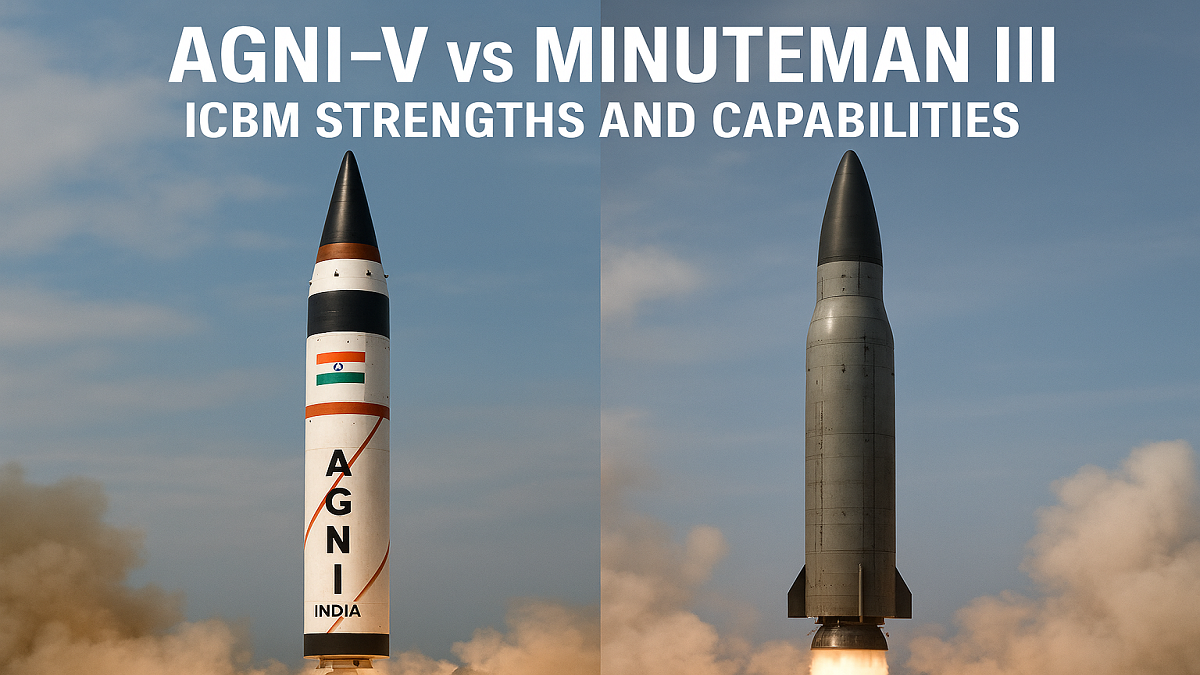
Intercontinental Ballistic Missiles (ICBMs) represent the pinnacle of strategic military strength for any nuclear-capable nation. Two prominent examples are India’s Agni-V and the United States’ Minuteman III. While both are ICBMs, they differ significantly in technology, range, payload, and operational history. Let’s compare their strengths and capabilities in detail.
What is Agni-V?
- Origin: Developed by India’s Defence Research and Development Organisation (DRDO).
- Type: 3-stage, solid-fuelled ICBM.
- Range: Approximately 5,000–5,500 km.
- Status: Successfully tested multiple times, inducted into the Strategic Forces Command.
- Key Highlight: Equipped with MIRV (Multiple Independently Targetable Re-entry Vehicles) capability, allowing it to hit multiple targets with a single missile.
Strengths of Agni-V
- Covers almost all of Asia, including China, and parts of Europe.
- Road- and rail-mobile, increasing survivability against first strikes.
- Incorporates advanced navigation, guidance, and countermeasure systems.
- Symbolizes India’s step into the elite club of true ICBM powers.
What is Minuteman III?
- Origin: Developed by the United States; operational since 1970.
- Type: Solid-fuelled, silo-based ICBM.
- Range: Over 13,000 km (truly intercontinental).
- Status: Still operational, with more than 400 missiles deployed. Modernized continuously over the decades.
- Key Highlight: The world’s oldest and most battle-ready ICBM system, central to the U.S. nuclear triad.
Strengths of Minuteman III
- Capable of delivering MIRVs with up to three warheads.
- Can carry nuclear payloads of 1.2 megatons combined yield.
- Very high accuracy (CEP under 200 meters).
- Backed by the U.S. satellite and missile defense infrastructure.
- Tested and upgraded consistently for reliability.
Agni-V vs Minuteman III: Comparative Table
| Feature | Agni-V (India) | Minuteman III (USA) |
|---|---|---|
| Range | 5,000–5,500 km | 13,000+ km |
| Payload | ~1,500 kg | ~1,150 kg |
| Warheads | MIRV capable | Up to 3 MIRVs |
| Deployment | Mobile (road/rail) | Fixed (silo-based) |
| Guidance | Ring laser gyroscope, micro-navigation | Inertial + GPS-aided |
| Status | Recently inducted | In service since 1970 |
Key Insights
- Range Advantage: Minuteman III far exceeds Agni-V in range, covering any target worldwide. Agni-V, however, is sufficient for India’s regional deterrence doctrine.
- Deployment Strategy: Agni-V’s mobility gives it survivability, while Minuteman III relies on hardened silos and the U.S.’s global defense network.
- Modernization: Agni-V represents India’s modern leap into advanced ICBM capability. Minuteman III, though older, has remained relevant through continuous upgrades.
- Geopolitical Role: Agni-V is a deterrence weapon primarily against China and regional threats, while Minuteman III underpins the U.S. global nuclear deterrence posture.


 Who is known as the Father of Mobile Pho...
 Which is the Highest Airport in the Worl...
 Which Country is the Largest Exporter of...











