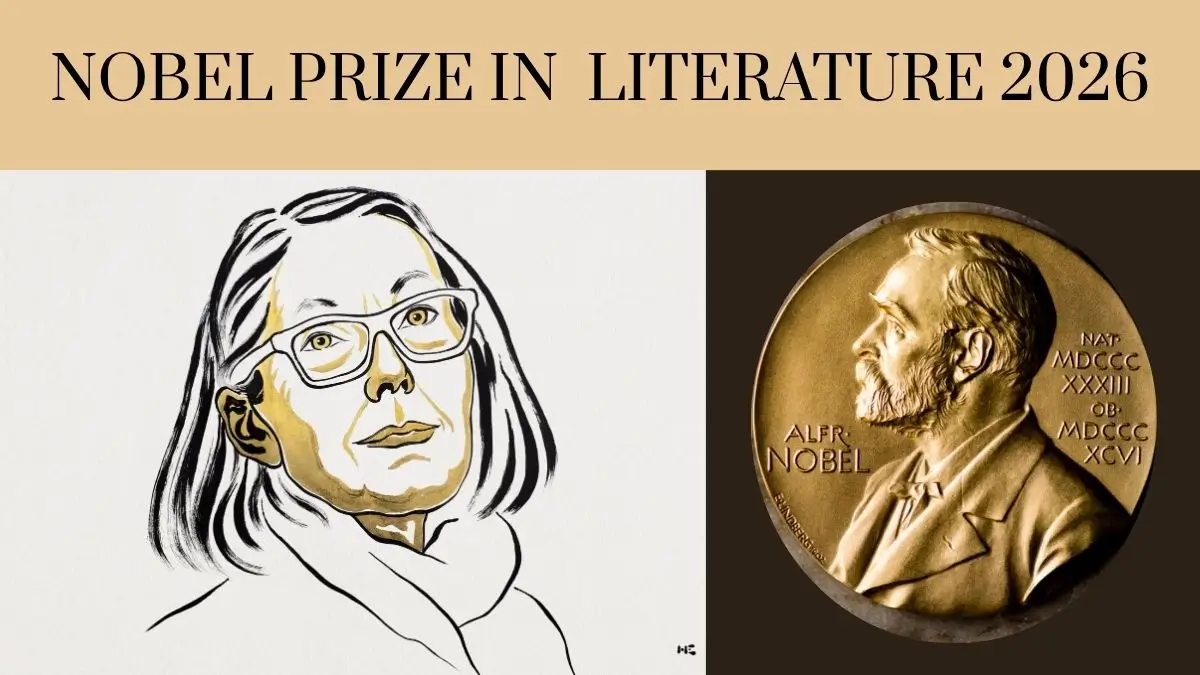
Canadian writer, Anne Carson who won several awards in her lifetime, has been chosen as the recipient of the Nobel Prize in the Literature for the year 2026 for her unique literary creations which have connections with the classical literary heritage. The Nobel Committee said about Carson, “For her pioneering and original oeuvre, characterized by her playful interplay with the classical tradition, which has created new forms of literature.” Anne Carson was born on 21 June 1950 in Toronto, Canada. She is a famous poet, essayist, translator and a literary critic of classical literature.
Who Is Anne Carson?
Anne Carson is a writer who combines poetry, translation and teaching in her work. The influence of her education as a Classicist has shaped her creative activity.
Carson’s writings concern themselves with the interplay of language, meaning and literary tradition. In many cases, she considers the etymology of words as a key starting point for her work.
An important feature of her writing is the engagement with Classical Greek literature. Instead of reproducing old literary pieces, she tries to rework and interpret them through contemporary voices.
This approach allowed her to freely experiment in poetry, essays, fiction, translation and other artistic expressions.
Citation of the Nobel Prize for Anne Carson
The Nobel Prize in Literature 2026 was awarded to Anne Carson for the following reason: “for her daring and innovative literary production, which through playful interaction with the classical tradition, has developed new forms of contemporary literature.”
From the citation, it is evident that the two key aspects of the writer’s production include her relationship with the classical literary tradition and the development of new literary forms.
Her works tend to merge various genres and voices.
Some Major Works of Anne Carson
Eros the Bittersweet
- This work was published in 1986, and discusses the topic of desire and its connection with poetry.
- The book relies quite a bit on the Greek poet Sappho and her definition of Eros as an experience that is a mixture of pleasure and pain.
- Carson analyzes the tension that exists between the lover and the beloved and explains how it contributes to poetic language.
- This book laid down some topics that were going to stay important for the author’s later work.
Glass, Irony, and God
- This work was published in 1995 and contains the long poem called “The Glass Essay.”
- The author shows her skills in combining poetry, narrative and essay and discussing such topics as grief, abandonment and lost love using the works by Emily Brontë as a background.
Autobiography of Red
- This book was published in 1998, and in it, Carson reworks aspects of classical literature.
- The fragments of poems related to the Greek poet Stesichorus of the sixth century BC and the mythical character Geryon were used.
- The author made a contemporary version of the mythological creature, who became a protagonist, which is referred to as a modern Bildungsroman in verse.
Economy of the Unlost
- This book was published in 1999, and in it, Carson put the Greek poet Simonides of Keos of the sixth century BC beside Paul Celan.
- This comparison of poets who lived far apart is typical of her style.
Anne Carson and Classical Literature
One of the characteristics of Anne Carson’s writing is that it involves an interaction with Classical Greek literature.
Carson has translated the following authors,
- Sappho
- Sophocles
- Euripides
- Stesichorus
Examples of these include If Not, Winter, which contains some of Sappho’s fragments, and other translations of Greek tragedies, including Electra, Antigone and Bakkhai.
Carson’s translations are considered to be literary pieces themselves, due to the way in which she blends both academic and creative approaches in her translations.
Academic Education
Carson has been studying Classics, and has even written her doctorate dissertation, titled Odi et Amo Ergo Sum, in 1981.
Her academic education has always been closely connected with her creative writing.
It is precisely this connection between philology and poetry which defines Anne Carson’s style of writing.
Philology is a science of literary texts and language, in terms of historical and comparative studies.








 2026 Nobel Prize Winners: Categories Wis...
 Nobel Prize in Chemistry 2026 Awarded to...
 Indian Mathematician Mahesh Kakde Wins 2...