
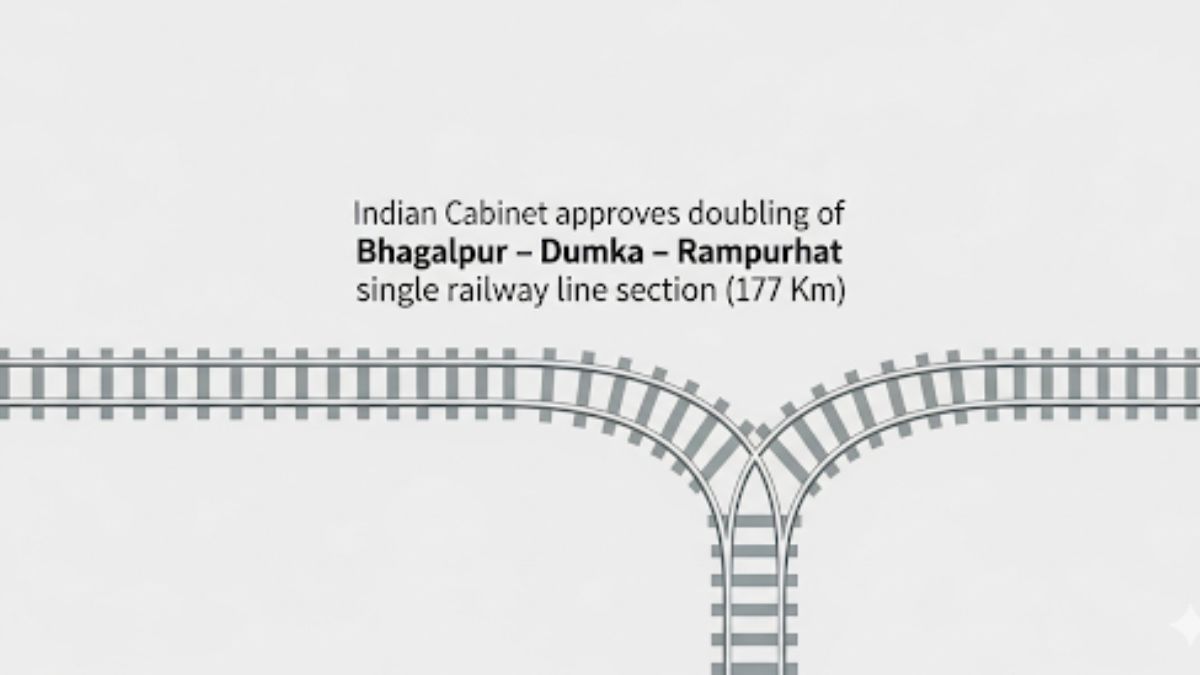
In a significant infrastructure push, the Union Cabinet chaired by Prime Minister Narendra Modi has approved the doubling of the Bhagalpur–Dumka–Rampurhat railway line, covering 177 km across Bihar, Jharkhand, and West Bengal. The project, with an estimated cost of ₹3,169 crore, aims to strengthen rail connectivity, enhance freight movement, and promote regional development, particularly in underdeveloped and aspirational districts.
Key Objectives and Benefits of the Doubling Project
The doubling of the line is part of the government’s broader PM Gati Shakti National Master Plan, which focuses on multi-modal connectivity and logistics efficiency. This decision will significantly ease operations in one of Indian Railways’ busiest corridors, ensuring better service reliability and mobility for both freight and passenger trains.
Some of the critical benefits include,
- Decongestion of existing single-line routes
- Faster movement of goods and people
- Improved punctuality of trains
- Reduced logistics cost for industries
Enhanced Connectivity for 28.72 Lakh People and 441 Villages
The railway line expansion will benefit around 28.72 lakh people residing in 441 villages across five districts in the three states. Notably, it includes three Aspirational Districts: Banka, Godda, and Dumka, identified by NITI Aayog for focused development.
The route also connects prominent religious destinations such as,
- Deoghar (Baba Baidyanath Dham) in Jharkhand
- Tarapith (Shakti Peeth) in West Bengal
- This will likely boost religious tourism and improve transport access for pilgrims.
Freight Potential and Environmental Impact
The Bhagalpur–Dumka–Rampurhat section plays a vital role in bulk commodity transport. Once doubled, it is expected to handle additional freight traffic of 15 MTPA (Million Tonnes Per Annum), including,
- Coal
- Cement
- Fertilizers
- Bricks and Stones
The project is also a step forward in India’s green infrastructure mission,
- Estimated savings of 5 crore litres in oil imports
- Reduction of 24 crore kg CO₂ emissions
- Equivalent to planting 1 crore trees
This makes Indian Railways not just a cost-efficient but also an eco-friendly mode of transport.
Static Facts and Takeaways
- Project Approval Date: September 10, 2025
- Length of Line to be Doubled: 177 km
- States Covered: Bihar, Jharkhand, West Bengal
- Total Project Cost: ₹3,169 crore
- Districts Covered: Banka, Godda, Dumka, and others
- Tourist Sites Connected: Deoghar (Jharkhand), Tarapith (West Bengal)


 India Withdraws Its Plan to Host COP33 S...
 IIM Rohtak Wins BIMTECH's 'Hermes' Dialo...
 Gurgaon Tops the List of India's Most Po...











