
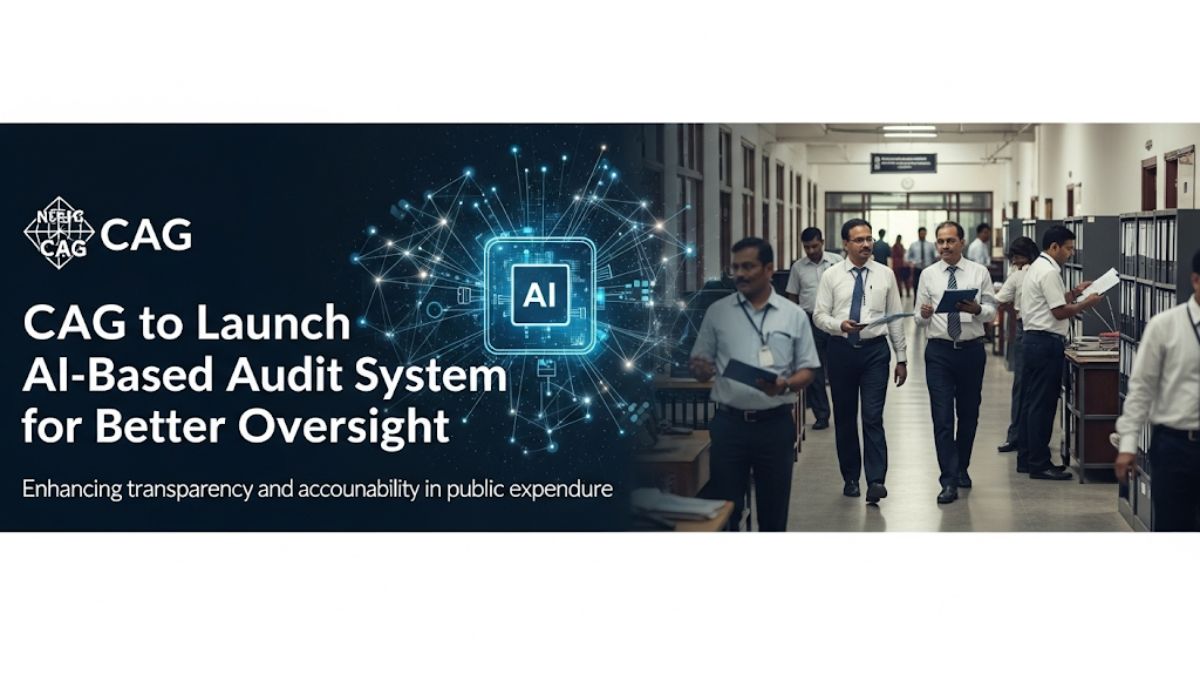
In a significant move towards digital governance and administrative reform, the Comptroller and Auditor General of India (CAG) is set to launch an AI-powered Large Language Model (LLM) to strengthen public auditing systems. The initiative is aimed at enhancing efficiency, consistency, and risk detection in auditing vast and complex government transactions.
As India’s constitutional auditor, the CAG plays a critical role in ensuring financial accountability and transparency. With the growing digitisation of public records, integrating artificial intelligence (AI) into auditing marks a paradigm shift in how oversight institutions adapt to the digital era.
Why a Digital Audit System Is Needed
The traditional auditing process involves extensive field visits, manual scrutiny of records, and time-consuming documentation. However, government transactions today generate massive digital data, which remains underutilized in the absence of automated tools.
Key Drivers for AI Integration
- Exponential growth in data volume across government departments
- Increasing complexity in public financial management
- Need for cost-effective auditing using remote and hybrid methods
- Demand for faster, risk-sensitive assessments over manual inspection
This shift aligns with the broader goal of transforming governance through technology, particularly under frameworks like Digital India and e-Governance initiatives.
What is a Large Language Model (LLM)?
A Large Language Model (LLM) is a form of artificial intelligence that uses deep learning to understand, generate, and summarize language-based content. It works on probabilistic modeling of unstructured text data, allowing it to,
- Recognize patterns across vast datasets
- Summarize documents
- Predict likely outcomes
- Generate reports based on learned precedents
Such models are trained on millions of documents, enabling them to grasp context and improve decision-making in domains like public auditing.
Broader Governance Implications
This reform is more than a technical upgrade—it represents a step toward data-driven governance and real-time accountability. It could also influence similar innovations in,
- Internal audits within ministries
- Regulatory compliance audits
- Local government and Panchayati Raj audits
Further, it aligns with global trends where Supreme Audit Institutions (SAIs) are adopting AI-based tools to monitor public spending, procurement, and fraud risks.
Key Facts to Remember
- Institution involved: Comptroller and Auditor General of India (CAG)
- Technology used: AI-powered Large Language Model (LLM)
- Purpose: Improve efficiency, consistency, and risk detection in public audits
- Advantages: Faster audits, better anomaly detection, wider coverage, reduced field dependency


 Meet MAI-Transcribe-1: Microsoft’s Fast,...
 What is Outer Space Treaty 1967? Princip...
 What Is Mission Mitra? ISRO’s New Experi...











