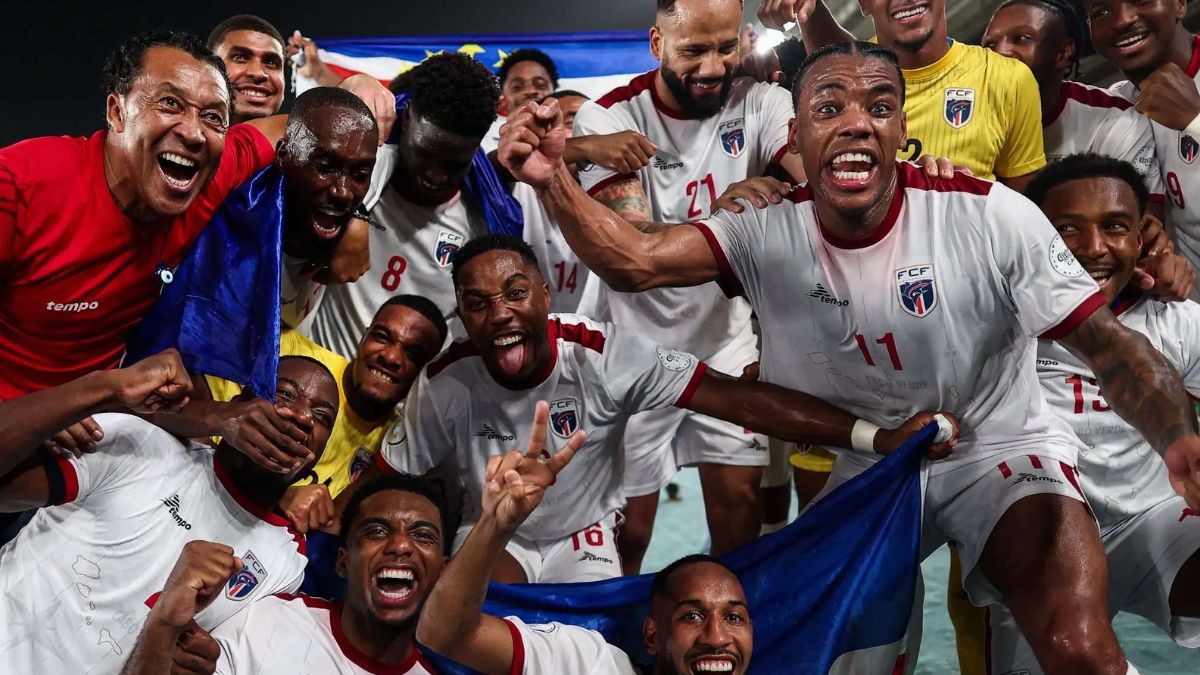
In a landmark sporting achievement, Cape Verde has become the second-smallest nation (after Iceland in 2018) to qualify for the FIFA World Cup. This accomplishment has put the spotlight on this little-known Atlantic island nation, highlighting both its global sporting rise and unique geopolitical identity. While Cape Verde basks in global attention, India’s national football team faced an embarrassing defeat to 158th-ranked Singapore in Goa, failing to make it to the 2027 AFC Asian Cup. The contrast underscores how even small nations with focused investment and talent nurturing can make global sporting breakthroughs.
Where is Cape Verde?
- Cape Verde, officially known as Cabo Verde, is an island country in the central Atlantic Ocean, situated about 620 km off the west coast of Africa. It is named after the Cap-Vert peninsula in Senegal, the nearest point of mainland Africa.
- The country comprises 10 volcanic islands, divided into two groups:
- Barlavento (windward) islands: Santo Antão, São Vicente, Santa Luzia, São Nicolau, Sal, and Boa Vista.
- Sotavento (leeward) islands: Maio, Santiago, Fogo, and Brava.
- Its capital city, Praia, is located on Santiago Island.
A Snapshot of Cape Verde’s Economy
- Cape Verde’s economy is primarily service-oriented, with tourism, trade, transport, and remittances forming its backbone. Since the mid-1990s, the country has been gradually transitioning toward a market-based economy.
- The tourism sector, especially eco-tourism and beach resorts, plays a critical role in GDP.
- Remittances from the Cape Verdean diaspora, especially in Europe and the U.S., are a key financial source.
- Despite limited natural resources, the country has maintained political stability and made strong strides in human development indicators.
- Mindelo, on São Vicente island, is home to the country’s largest port and has a notable deepwater harbor, historically significant for transatlantic shipping routes.
Cultural Blend and Global Presence
- Cape Verde’s culture is a unique fusion of Portuguese and African influences, due to its history as a Portuguese colony until independence in 1975. The country’s language, cuisine, music, and architecture all reflect this blend.
- The national music genre, Morna, popularized by singer Cesária Évora, is internationally acclaimed.
- The cultural hub of Mindelo is known for vibrant arts, music festivals, and colonial-era architecture.
- Cape Verde’s small population of around 550,000 has strong links with the diaspora, making it a globally connected microstate with significant soft power.


 Sunil Narine Sets New Record with Most M...
 Gurjant Singh Bids Farewell to Internati...
 IPL 2026: Full Schedule, Teams, Format a...