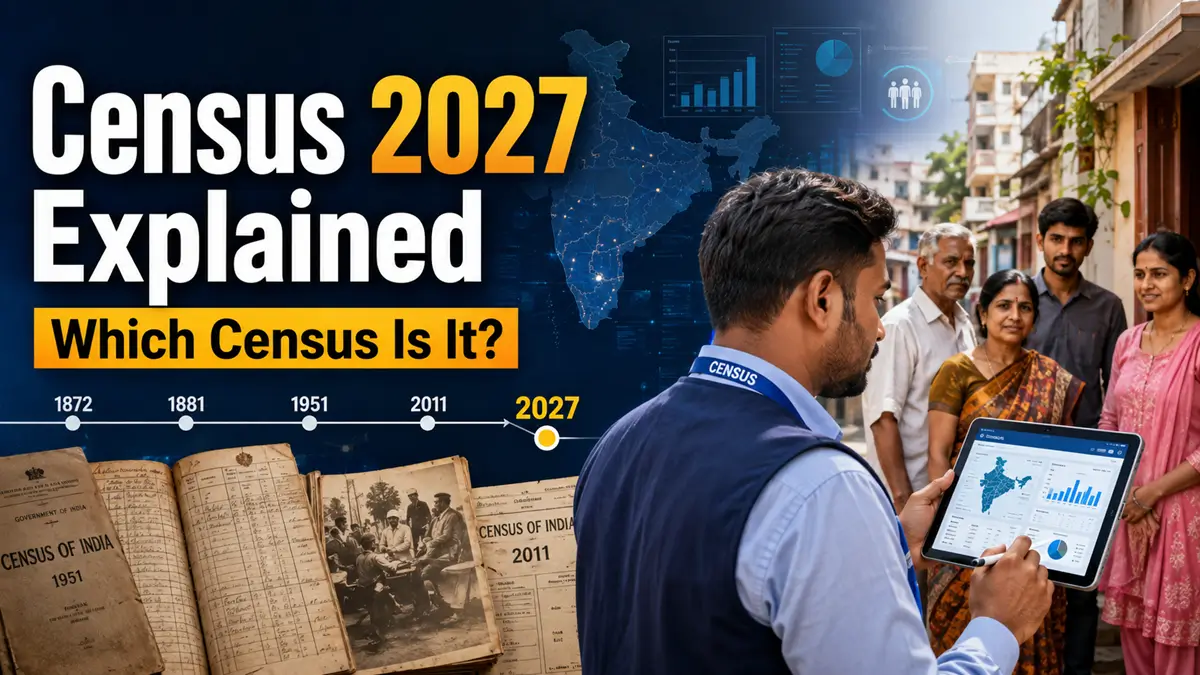
The Census of India 2027 marks an important milestone in the country’s demographic history. It will be India’s 16th Census overall and the 8th Census since Independence.
The upcoming census is particularly significant because the 2021 Census could not be conducted as scheduled due to the COVID-19 pandemic. The 2027 exercise also introduces major technological changes, including digital data collection and self-enumeration, while incorporating caste enumeration.
Which Census Is the 2027 Census of India?
The Census 2027 is the 16th Census of India and the 8th Census after Independence.
India’s first census exercise was conducted in 1872, although it was not carried out simultaneously across the entire country. The first synchronous census took place in 1881. Since then, census operations have generally been conducted every ten years.
The 2027 Census will be conducted under the Census Act, 1948, by the Office of the Registrar General and Census Commissioner, India, under the Ministry of Home Affairs.
The exercise will be conducted in two broad phases:
- Phase 1 – Houselisting and Housing Census: This phase focuses on collecting information about houses, housing conditions and household facilities.
- Phase 2 – Population Enumeration: This phase records demographic, social and economic information about the population.
Key Facts About Census 2027
| Particular | Details |
|---|---|
| Census Year | 2027 |
| Census Number | 16th Census of India |
| Since Independence | 8th Census |
| Previous Census | 2011 |
| First Census Exercise | 1872 |
| First Synchronous Census | 1881 |
| Conducted Under | Census Act, 1948 |
| Conducting Authority | Office of the Registrar General and Census Commissioner, India |
| Ministry | Ministry of Home Affairs |
| Major Feature | Digital census and self-enumeration |
| Caste Enumeration | Included in Census 2027 |
History of Indian Census: Year-Wise List
The history of India’s census operations stretches back more than 150 years. From the early non-synchronous exercise in 1872 to the technology-driven Census 2027, the process has evolved significantly.
| Census Year | Census Number | Key Highlight |
| 1872 | 1st | First census exercise in India; conducted non-synchronously in different regions. |
| 1881 | 2nd | First synchronous census conducted across India. |
| 1891 | 3rd | Census operations expanded with greater demographic and social detail. |
| 1901 | 4th | Introduced more systematic classification of population characteristics. |
| 1911 | 5th | Census covered the population amid changing administrative boundaries. |
| 1921 | 6th | Known as the “Year of Great Divide” because of the population decline recorded during the decade. |
| 1931 | 7th | Last complete Census of British India to provide detailed caste-related data. |
| 1941 | 8th | Conducted during World War II, with some detailed tabulation and publication affected by wartime conditions. |
| 1951 | 9th | First Census of independent India; population was around 36.1 crore. |
| 1961 | 10th | Greater focus on employment, migration and economic characteristics. |
| 1971 | 11th | Included questions relating to fertility among married women. |
| 1981 | 12th | Expanded information on migration and socio-economic characteristics. |
| 1991 | 13th | Literacy was counted for the population aged 7 years and above. |
| 2001 | 14th | Technology was increasingly used, including Intelligent Character Recognition for data processing. |
| 2011 | 15th | Last completed population census; India’s population crossed 121 crore. |
| 2027 | 16th | First Census after the 2011 exercise, with major digital features and caste enumeration. |
Census During the British Era: 1872 to 1941
1872: First Census Exercise
The 1872 census was the first major attempt to collect population information systematically across different parts of India. However, it was not a synchronous, all-India census because enumeration took place at different times in different regions.
1881: First Synchronous Census
The 1881 Census was a major turning point. It was the first synchronous census of India, with enumeration carried out simultaneously across the country.
From this point, census operations developed into a more regular decennial exercise.
1891 to 1931: Expansion of Census Data
Over the following decades, census operations became increasingly detailed. Information relating to religion, language, literacy, occupation, migration and other demographic characteristics was collected.
The 1931 Census is particularly important in India’s census history because it was the last census conducted under British rule to provide detailed caste-related information.
1941: Census During World War II
The 1941 Census was conducted during the Second World War. Wartime conditions affected the processing and publication of some census information.
Post-Independence Census: 1951 to 2011
1951 Census: First Census of Independent India
The 1951 Census was the first population census conducted after India became independent. It recorded a population of approximately 36.1 crore.
It was an important administrative exercise for a newly independent country dealing with the aftermath of Partition and major demographic changes.
1961 Census
The 1961 Census expanded the scope of demographic data collection. Greater attention was given to employment, migration and economic characteristics.
1971 Census
The 1971 Census introduced questions related to fertility patterns among currently married women, adding greater depth to population studies.
1981 Census
The 1981 Census further expanded information on migration and socio-economic characteristics, helping policymakers understand changing population patterns.
1991 Census
The 1991 Census followed a more standardized approach to literacy, with literacy being considered for people aged 7 years and above.
2001 Census
The 2001 Census marked an important technological shift. Digital technologies, including Intelligent Character Recognition (ICR), were used to process census forms and improve data handling.
2011 Census
The 2011 Census was the 15th Census of India and the last completed population census before the upcoming 2027 exercise.
India’s population was recorded at more than 121 crore. The census also involved the house-listing exercise associated with the National Population Register (NPR).
Why Is Census 2027 Important?
Census 2027 is significant not only because it follows a long gap after the 2011 Census but also because of its technological and methodological changes.
1. India’s First Digital Census
The 2027 exercise is designed around a digital framework, with mobile applications and digital systems being used to support field-level data collection and monitoring.
2. Self-Enumeration Facility
One of the major changes is the introduction of self-enumeration, allowing eligible residents to provide certain information through an online system before field verification.
This is expected to make the census process more technology-driven and accessible.
3. Caste Enumeration
Census 2027 also includes caste enumeration, making it particularly significant from a demographic and policy perspective.
The last census conducted in British India that included detailed caste data was the 1931 Census.
4. Two-Phase Census Exercise
The census will be carried out through two major stages:
Phase 1: Houselisting and Housing Census
Phase 2: Population Enumeration
Together, these phases will provide updated information about India’s population, households and socio-economic characteristics.
Census 2027 vs Census 2011
| Feature | Census 2011 | Census 2027 |
| Census Number | 15th | 16th |
| Status | Last completed Census | Upcoming Census |
| Digital Technology | Used in selected processes | Expanded digital framework |
| Self-Enumeration | Not available in the current form | Introduced |
| Caste Enumeration | Not part of the regular population census | Included |
| Population Data | More than 121 crore | Updated population data to be collected |
| Data Collection | Predominantly traditional field enumeration | Greater use of mobile and digital systems |
Important Census Facts for Competitive Exams
For SSC, Banking, Railway, UPSC and other competitive examinations, the following facts are particularly important:
- Census 2027 is the 16th Census of India.
- It will be the 8th Census after Independence.
- 1872 was the first census exercise in India.
- 1881 was the first synchronous Census.
- 1921 is known as the “Year of Great Divide.”
- 1931 was the last British-era census with detailed caste-related data.
- 1951 was the first Census of independent India.
- 2011 was the 15th and last completed Census.
- 2027 is the next Census after 2011.
- The Census is conducted under the Census Act, 1948.
- The Office of the Registrar General and Census Commissioner, India conducts the Census under the Ministry of Home Affairs.
- Census 2027 introduces digital data collection and self-enumeration.
- Census 2027 includes caste enumeration.








 UNESCO World Heritage Sites of India - D...
 Jamnagar Refinery: Why India's Oil Hub M...
 UNESCO World Heritage Sites of India - D...