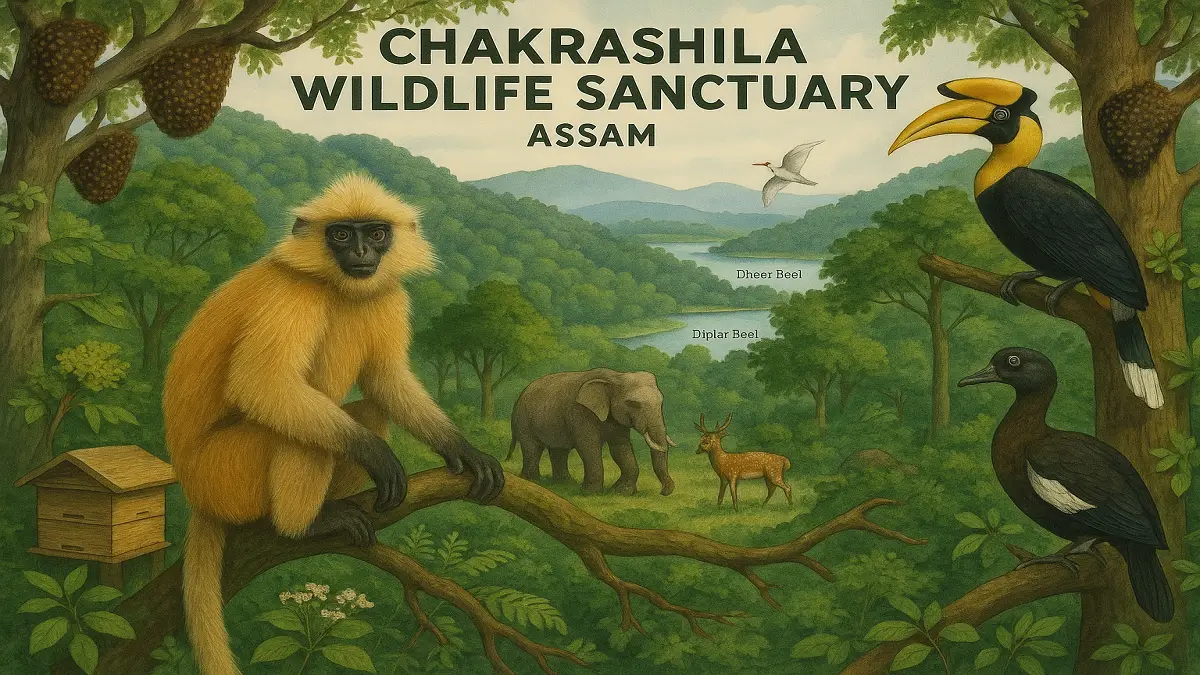
The Chakrashila Wildlife Sanctuary in Assam has recently come into focus due to successful community-led conservation efforts that have restored wild honey bee colonies and revitalised the surrounding ecosystem. This initiative highlights how local participation can play a crucial role in biodiversity conservation while supporting ecological balance.
Latest News: Community-Led Conservation Success
Local communities around Chakrashila Wildlife Sanctuary have actively worked to:
- Restore wild honey bee colonies
- Protect natural nesting sites
- Reduce habitat disturbance
The revival of honey bees has had a positive cascading effect on the ecosystem, improving pollination, strengthening forest regeneration, and supporting other wildlife species. This initiative is being seen as a model of sustainable conservation, combining livelihood awareness with environmental protection.
About Chakrashila Wildlife Sanctuary
- Location: Kokrajhar and Dhubri districts, Assam
- Area: 45.5 square kilometres
- Terrain: Hilly landscape with dense forest cover
- Established: Declared a wildlife sanctuary to protect regional biodiversity
Chakrashila is particularly famous as the second protected habitat for the endangered golden langur in India.
Ecological Significance
Golden Langur Habitat
- Home to over 600 golden langurs
- One of the most important conservation sites for this endangered primate
- The species is endemic to parts of Assam and Bhutan
This makes Chakrashila a highly exam-relevant protected area, often asked in relation to endangered species.
Important Wetlands
Two lakes are integral to the sanctuary’s ecosystem:
- Dheer Beel
- Diplai Beel
These water bodies:
- Support aquatic biodiversity
- Help maintain local microclimates
- Provide drinking and feeding grounds for wildlife
Flora of Chakrashila Wildlife Sanctuary
The sanctuary supports diverse forest types:
- Tropical moist deciduous forests
- Mixed deciduous forests
- Semi-evergreen forests
Sal (Shorea robusta) is the dominant tree species, playing a vital role in maintaining forest structure and supporting wildlife habitats.
Fauna of Chakrashila Wildlife Sanctuary
Mammals
The sanctuary hosts a wide range of wildlife, including:
- Elephant
- Tiger
- Leopard
- Clouded leopard
- Gaur
- Sambar deer
- Barking deer
Bird Species
Chakrashila is also an important bird habitat, housing several rare and endangered species such as:
- Bengal Florican (Endangered)
- Great Hornbill
- White-winged Wood Duck (Endangered)
This makes the sanctuary significant for both mammalian and avian conservation.
Why Chakrashila Wildlife Sanctuary Is Important for Exams
- Second protected habitat of the golden langur
- Example of community-led conservation
- Presence of important wetlands (Beels)
- Rich biodiversity with endangered species
- Located in Assam, a biodiversity hotspot region


 Which Country is the Largest Producer of...
 GK Quiz on LPG: Can You Answer These Int...
 What is Mango called in Different Langua...