
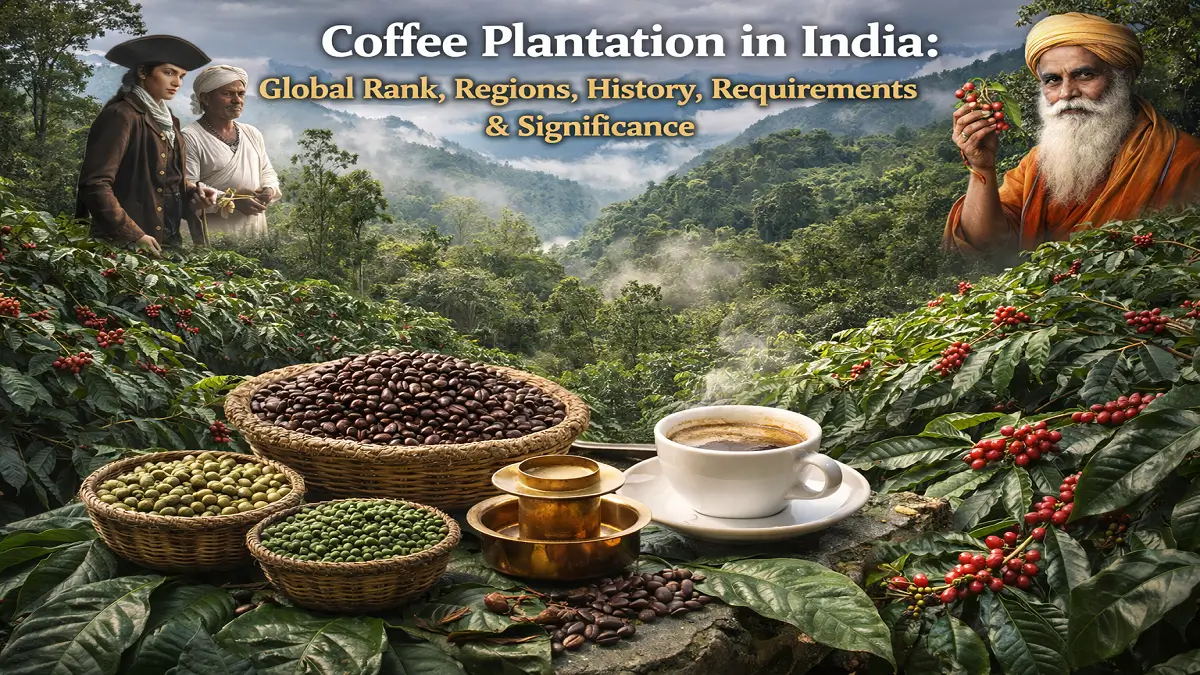
Coffee Plantation in India is a globally significant agricultural activity that connects biodiversity conservation, tribal livelihoods, export earnings, and international trade. Coffee is the second most traded commodity in the world after crude oil, with nearly 2.25 billion cups consumed daily worldwide. India holds an important position as the 7th largest coffee producer globally, known for its high-quality, shade-grown, and sustainable coffee.
India’s Global Rank in Coffee Production
India ranks 7th in the world in terms of coffee production and area under cultivation. Coffee plantation in India covers approximately 4.45 lakh hectares, contributing significantly to:
- Agricultural exports
- Rural employment
- Foreign exchange earnings
Nearly 70% of India’s coffee production is exported, making coffee a key export-oriented plantation crop.
Coffee Plantation in India: Key Features
Indian coffee enjoys a premium image in international markets due to:
- Shade-grown cultivation in ecologically sensitive regions
- Mild acidity and rich aroma
- Sustainable tribal and smallholder farming practices
- Minimal use of chemicals, supporting biodiversity preservation
India grows both:
- Arabica coffee – known for superior quality and aroma
- Robusta coffee – valued for higher yield and strong flavor
Both varieties are cultivated in almost equal proportions.
Historical Development of Coffee Plantation in India
Origin and Introduction
- Ethiopian Origin: Coffee originated in the Kaffa province of Ethiopia
- Arab Domestication: Arabs first domesticated coffee in Yemen, shaping early trade routes
Baba Budan’s Contribution (1600 AD)
Indian coffee cultivation began when Baba Budan, a Sufi saint, smuggled seven Mocha coffee seeds from Yemen and planted them at Baba Budan Giri hills in Karnataka.
Colonial Expansion
- During the 18th century, British planters established commercial coffee plantations in South India
- Development of roads, curing works, ports, and export systems
- Indian coffee gained global recognition as shade-grown, high-quality coffee
Coffee Plantation in India: Climatic and Soil Requirements
Coffee plantation depends on specific pedo-climatic conditions to ensure quality yield.
Soil Requirements
- Deep, fertile, organic-rich, well-drained soils
- Slightly acidic soil is ideal
Climate Requirements
-
Rainfall: 1000–2500 mm annually
-
Temperature:
- Arabica: 15–25°C
- Robusta: 20–30°C
-
Humidity: 70–90% relative humidity
Altitude and Shade
- Arabica: 1000–1500 meters
- Robusta: 500–1000 meters
- Natural shade trees are essential to protect plants and improve bean quality
Major Coffee Plantation Regions in India
Coffee plantation regions in India are divided into traditional, non-traditional, and North-Eastern zones.
Traditional Regions (Western Ghats)
These regions produce about 96% of India’s coffee.
Karnataka
- Contributes over 70% of India’s coffee production
- Major districts: Kodagu (Coorg), Chikkamagaluru, Hassan
Kerala
- Major Robusta producer
- Important districts: Wayanad and Idukki
Tamil Nadu
- Known for high-quality Arabica
- Regions: Nilgiris, Dindigul, Theni
Non-Traditional Regions (Eastern Ghats)
Known for organic and tribal-based coffee farming.
- Andhra Pradesh: Araku Valley, Alluri Sitharama Raju district
- Odisha: Koraput and Rayagada districts
These regions focus on sustainable livelihoods for tribal communities.
North-Eastern Coffee Regions
Small but emerging plantations under hill climates:
- Assam
- Arunachal Pradesh
- Manipur
- Meghalaya
- Mizoram
- Nagaland
- Tripura
Role of the Coffee Board of India
The Coffee Board of India plays a central role in promoting and regulating coffee plantation.
- Established: Under the Coffee Act, 1942
- Ministry: Ministry of Commerce and Industry
- Headquarters: Bengaluru, Karnataka
Major Functions
- Integrated Coffee Development Project: Replantation, yield improvement, sustainability
- Expansion into Non-Traditional Areas: Using remote sensing and soil analysis
- Tribal Empowerment: Training, financial assistance, and market access
- Export Promotion: Branding, quality certification, and global market expansion
Economic and Ecological Significance
- India produces around 3.6 lakh tonnes of coffee annually
- Exports to over 128 countries
- Domestic consumption increased from 84,000 tonnes (2012) to 91,000 tonnes (2023)
- Coffee supports biodiversity conservation through shade-grown agroforestry systems
Speciality Coffees of India
- Monsooned Malabar AA
- Mysore Nuggets Extra Bold
- Kaapi Royale
These specialty coffees fetch premium prices globally.
Recent Developments in Coffee Plantation in India
Global and Diplomatic Initiatives
- 5th World Coffee Conference (2023) hosted in Bengaluru
- Focus on sustainability, circular economy, and regenerative agriculture
GI Certification
India has secured GI tags for 7 coffee varieties, including:
- Coorg Arabica
- Wayanad Robusta
- Araku Valley Arabica
- Monsooned Malabar
Export Growth
- Coffee exports rose from USD 719 million (2020–21)
- To USD 1.29 billion (FY 2023–24)
- And USD 1.8 billion (FY 2024–25)
India is now the 5th largest coffee exporter globally.
Policy Support
- GST reduced to 5% on instant and processed coffee
- Trade agreements like India–UK CETA and India–EFTA TEPA (2024) provide zero-duty access
Tribal-Led Models
- Koraput Coffee (TDCCOL) ensures fair pricing and sustainable livelihoods
- Supported by the Coffee Board of India


 UV Index Explained: The Hidden Health Ri...
 QS World University Rankings 2026: India...
 Best Airlines in the World 2026: Best Fu...











