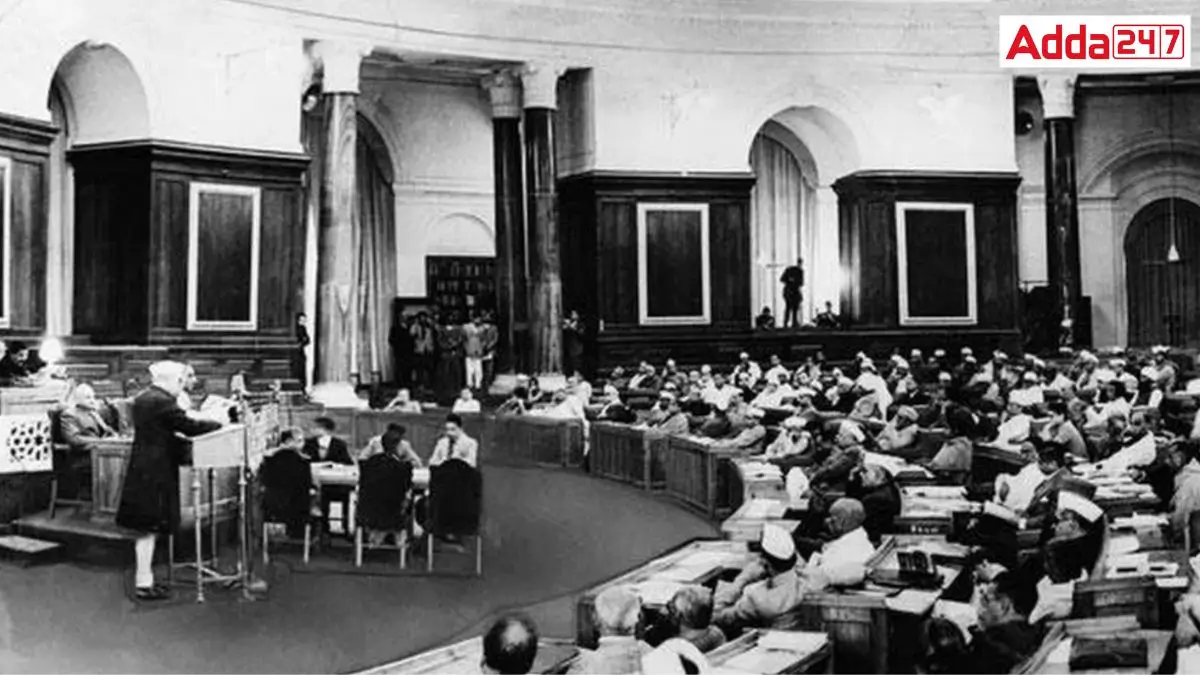
The Constituent Assembly of India, formed in 1946, was entrusted with the historic responsibility of drafting the Indian Constitution. Over nearly four years, it debated India’s political future and shaped a democratic republic rooted in justice, liberty, equality and fraternity, reflecting the country’s vast social and cultural diversity. The Constituent Assembly (1946–1950) remains central to constitutional and polity discussions, especially for exams, as it framed the world’s lengthiest written Constitution, adopted on 26 November 1949 and enforced on 26 January 1950, marking India’s transition into a sovereign republic.
What Is the Constituent Assembly?
The Constituent Assembly is a representative body created specifically to frame or amend a Constitution.
- India’s Constituent Assembly was formed in November 1946 under the Cabinet Mission Plan (1946).
- It was a partly elected and partly nominated body.
- The Assembly met for the first time on 9 December 1946.
- After completing its work, it functioned as India’s Provisional Parliament from January 26, 1950, until the first general elections in 1951–52.
Its objective was to ensure self-determination through a Constitution made by Indians.
Historical Background and Demand
The demand for a Constituent Assembly arose due to dissatisfaction with British-imposed laws like the Government of India Acts of 1919 and 1935, which limited Indian self rule.
- In 1934, M. N. Roy first proposed the idea.
- The Indian National Congress formally demanded it in 1935.
- Jawaharlal Nehru insisted the Constitution must be framed without external interference.
- The demand was accepted in principle in the August Offer (1940) and materialized through the Cabinet Mission (1946).
This marked a decisive step toward independence.
Composition of the Constituent Assembly
The Assembly initially had a total strength of 389 members.
- British India: 296 members
- Princely States: 93 members
Members were elected indirectly by provincial legislatures using proportional representation with single transferable vote. Representatives of princely states were nominated by rulers. After Partition, the strength reduced as Muslim League members from Pakistan withdrew.
Key Leaders and Their Roles
Several national leaders played defining roles in the Assembly.
- Dr. B. R. Ambedkar chaired the Drafting Committee.
- Rajendra Prasad served as President of the Assembly.
- Sardar Vallabhbhai Patel led committees on federalism and states.
- Jawaharlal Nehru introduced the historic Objective Resolution.
Their debates shaped India’s constitutional philosophy.
Making of the Indian Constitution: Key Milestones
- The Constitution was framed through systematic stages.
- 9 December 1946: First session of the Constituent Assembly
- 13 December 1946: Objective Resolution moved by Nehru
- 22 January 1947: Objective Resolution adopted
- 1947-48: Drafting Committee prepared first draft
- 4 November 1948 – 17 October 1949: Detailed clause-by-clause debate
- 26 November 1949: Constitution adopted
- 26 January 1950: Constitution came into force
This day is celebrated as Republic Day.
Constituent Assembly Committees
A. Organizational Committees
| Committee | Chairperson |
| Rules of Procedure | Rajendra Prasad |
| Steering Committee | Rajendra Prasad |
| Staff & Finance | Rajendra Prasad |
| Credentials Committee | A. K. Ayyar |
| Order of Business | K. M. Munshi |
| States Negotiation | J. L. Nehru |
| Flag Committee | Rajendra Prasad |
| Functions of Assembly | G. V. Mavlankar |
B. Principal Committees
| Committee | Chairperson |
| Advisory Committee (FRs & Minorities) | Sardar Patel |
| Union Powers Committee | J. L. Nehru |
| Union Constitution Committee | J. L. Nehru |
| Provincial Constitution Committee | Sardar Patel |
| Drafting Committee | Dr. B. R. Ambedkar |
C. Sectoral Committees
| Committee | Chairperson |
| Ad-hoc Citizenship Committee | S. Varadachariar |
| Chief Commissioners’ Provinces | N. Gopalaswami Ayyangar |
| Financial Provisions Experts | N. R. Sarkar |
| Minority Safeguards (WB & EP) | Sardar Patel |
When Did the Constitution Come into Force?
Although adopted on 26 November 1949, most provisions came into effect on 26 January 1950, commemorating the Poorna Swaraj Declaration (1929). Certain provisions relating to citizenship and elections took effect earlier, on 26 November 1949.
Criticism of the Constituent Assembly
Despite its achievements, the Assembly faced criticism.
- Members were not directly elected by universal adult franchise.
- It was initially formed under British authority.
- The process took nearly four years, longer than some other constitutions.
- Critics like Granville Austin called it Congress-dominated.
However, its inclusive debates made the Constitution resilient and adaptable.
Question
Q. Who chaired the Drafting Committee of the Constituent Assembly?
A) Jawaharlal Nehru
B) Rajendra Prasad
C) Sardar Patel
D) Dr. B. R. Ambedkar


 India's First Digital Census 2027 Begins...
 PM Modi Launches Kaynes Semiconductor Pl...
 India Census 2027 Digital: Phase 1 Start...