
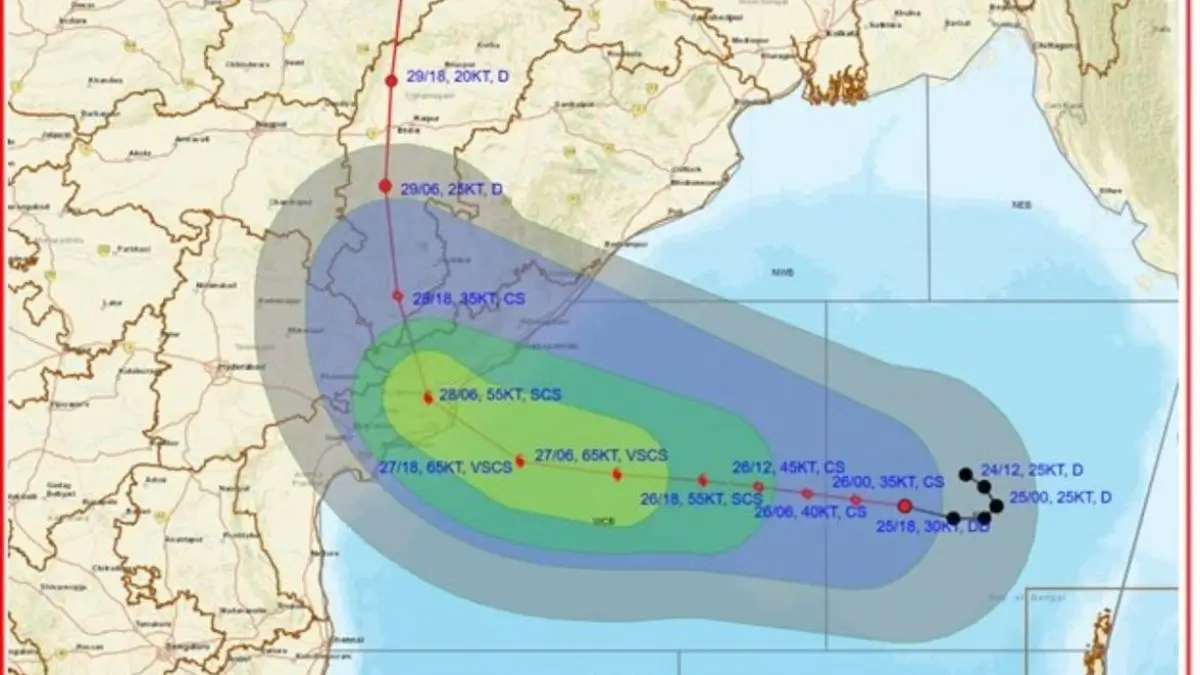
Cyclone Arnab has grown strong in the east-central and adjoining west-central Bay of Bengal and expected to make landfall along the coasts of Andhra Pradesh and Yanam on October 28, 2026. As per the Indian Meteorological Department (IMD), the storm would develop into a very severe cyclonic storm having sustained winds of 115–125 kmph and gusts of up to 140 kmph. The forecast indicates that the coastal area extending from Bapatla to Visakhapatnam could be the probable landfall area. Both Andhra Pradesh and Odisha are now ready for minimizing their risks from winds, rains, and flooding.
Cyclone Arnab’s Current Position and Forecast Path
As per the IMD’s latest bulletin, which was released on October 26th 2026, Cyclone Arnab was located at the coordinates between 15.4°N and 88.9°E in the east-central and adjoining west-central Bay of Bengal. It had moved to the west at around 15 kmph over the last six hours.
At 5:30 am IST, the cyclonic storm was about 650 km east-southeast of Visakhapatnam, 730 km southeast of Kakinada and 910 km east of Bapatla.
Landfall and Maximum Wind Speed
IMD’s forecast is as follows,
- October 26: Becoming a severe cyclonic storm over the west-central Bay of Bengal.
- October 27: Strengthening further into very severe cyclonic storm.
- October 28: Expected to make landfall along Andhra Pradesh and Yanam coast, between Bapatla and Visakhapatnam, in forenoon.
The forecast wind speed at the time of landfall is 115-125 kmph, with gusts up to 140 kmph. This is forecast wind speed at landfall.
Risks from Rainfall, Storm Surge, and Inundations
There are dangers of rainfall, strong winds, high waves and coastal inundation because of the cyclone.
The Indian Meteorological Department (IMD) has said there is danger of storm surge of 1.0 – 1.5 meters above astronomical tide which may inundate coastal low-lying areas of Andhra Pradesh.
The maximum storm surge is expected near Kakinada in East Godavari district and Yanam in Union Territory of Puducherry.
Fishermen are advised not to venture into sea areas affected. Warning signals have also been hoisted by port authorities in certain areas of Andhra Pradesh and Odisha coast.
Preparations for Cyclones in Andhra Pradesh and Odisha
In view of the impending very severe cyclonic storm, the chief minister of Andhra Pradesh, N. Chandrababu Naidu has issued instructions to all government departments and district administrations to remain alert and make necessary arrangements. There are instructions to set up control rooms and disseminate necessary information to people.
Similarly, the chief minister of Odisha, Mohan Charan Majhi has reviewed the possible impact of the cyclone and allocated tasks to concerned departments. The efforts in this regard are being made for the safety of the people.
Very Severe Cyclonic Storm: What is It?
The IMD follows certain categories of tropical cyclonic systems prevailing over the North Indian Ocean on the basis of the maximum sustained wind speeds.
| Cyclone category | Maximum sustained wind speed |
| Cyclonic Storm | 62–88 kmph |
| Severe Cyclonic Storm | 89–117 kmph |
| Very Severe Cyclonic Storm | 118–166 kmph |
| Extremely Severe Cyclonic Storm | 167–221 kmph |
| Super Cyclonic Storm | 222 kmph or more |
The predicted wind speed of Arnab falls just at the lower edge of Very Severe Cyclonic Storm category.








 National Strategic Trade Command Centre ...
 India Plans Mandatory Automatic Emergenc...
 India Notifies New Telecom Rules for Tes...