
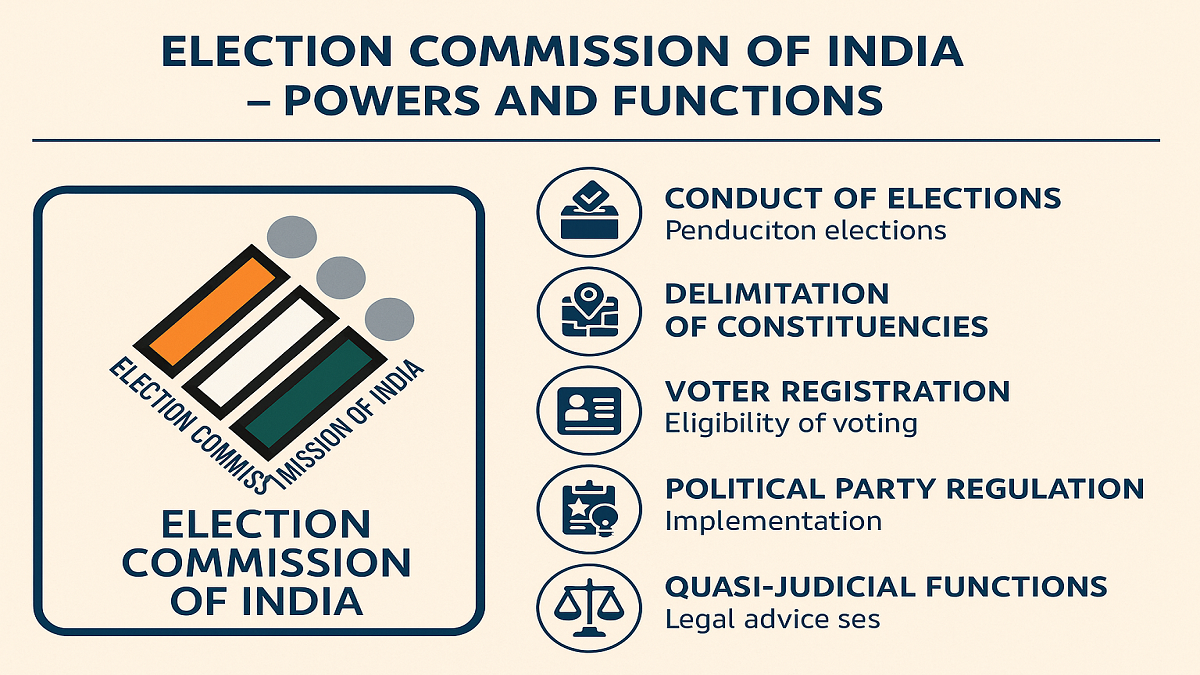
The Election Commission of India (ECI) is a constitutional body established under Article 324 of the Indian Constitution. It is responsible for conducting free, fair, and impartial elections in the country. The ECI was set up in 1950, and since then, it has played a crucial role in strengthening democracy in India, the world’s largest democracy.
Originally, the Election Commission was a single-member body (with only the Chief Election Commissioner). However, since 1993, it has been functioning as a multi-member body consisting of one Chief Election Commissioner (CEC) and two Election Commissioners (ECs).
Composition of the Election Commission
- Chief Election Commissioner (CEC) and two Election Commissioners (ECs).
- Appointed by the President of India.
- They enjoy tenure of 6 years or up to 65 years of age, whichever is earlier.
- They have equal powers, and decisions are made by majority vote.
- The CEC cannot be removed except in the same manner as a Supreme Court judge, ensuring independence.
Powers of the Election Commission of India
The ECI has been vested with wide powers to ensure the integrity of elections:
- Superintendence and Control of Elections – Under Article 324, the ECI has the ultimate authority over the conduct of elections to Parliament, State Legislatures, and the offices of President and Vice-President.
- Model Code of Conduct – The Commission enforces the Model Code of Conduct (MCC) to regulate political parties and candidates during elections.
- Advisory Powers – It advises the President or Governors regarding disqualification of MPs and MLAs under the Constitution and Representation of the People Act.
- Quasi-Judicial Powers – The Commission settles disputes related to the recognition of political parties and the allocation of election symbols.
- Disciplinary Powers – It can reprimand, warn, or even derecognize political parties and candidates violating election rules.
- Emergency Powers – If elections cannot be held due to violence, natural disasters, or irregularities, the Commission can postpone or cancel them.
Functions of the Election Commission of India
The functions of the ECI are broad, covering all aspects of the election process:
- Conduct of Elections – Organizes and supervises elections to Lok Sabha, Rajya Sabha, State Legislative Assemblies, and President and Vice-President of India.
- Preparation of Electoral Rolls – Supervises the preparation, revision, and updating of voter lists to ensure accuracy.
- Registration of Political Parties – Grants recognition to political parties and allots election symbols.
- Monitoring Election Expenditure – Keeps a check on candidates’ spending to prevent the influence of money power in elections.
- Ensuring Free and Fair Voting – Deploys observers, EVMs, and now VVPAT machines to maintain transparency.
- Voter Education and Awareness – Runs campaigns like Systematic Voters’ Education and Electoral Participation (SVEEP) to increase voter turnout.
- Use of Technology – Ensures smooth conduct of polls through EVMs, online voter registration, and digital initiatives.


 ECINet KYC Feature Explained: How Voters...
 BIRAC-BioNEST Incubation Centre Inaugura...
 E20 Petrol India 2026: Nationwide Rollou...











