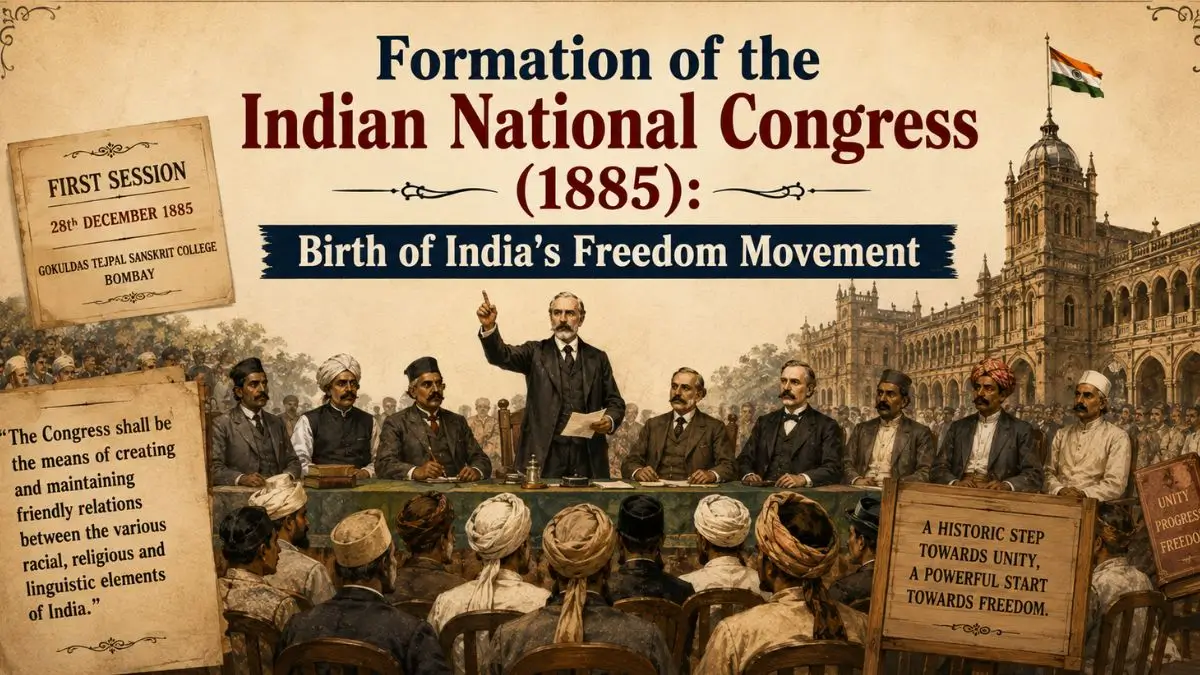
Indian National Congress (INC) was established in 1885 and emerged as one of the most significant political organizations in the history of freedom struggle in India. Starting from being a platform for educated Indians to leading mass movements against British colonialism, Indian National Congress underwent many important phases.
Several political associations and socio-religious movements were there in India prior to 1885 that made possible the organized nationalism. Founding of Congress provided an opportunity for political leaders from different regions of India to come together, discuss common issues and frame a common political agenda.
Annual and special sessions of INC got importance because important issues regarding India’s nationalist movement were discussed and decided in these sessions.
Foundation of the Indian National Congress
An all-India political organization was being thought by Indian political leaders prior to 1885. It was the retired British civil servant Allan Octavian Hume (A.O. Hume) who played a very important role in making this idea into reality.
With the cooperation of some of the most influential Indian political leaders, A.O. Hume organized the first session of Congress. Although the meeting was originally planned at Poona, but due to the outbreak of cholera at Poona, the meeting venue was shifted to Bombay.
First session of Indian National Congress was held on 28 December 1885 at Gokuldas Tejpal Sanskrit College, Bombay.
Womesh Chandra Bonnerjee (W.C. Bonnerjee) was the president of the first session of INC.
The first session of Indian National Congress was attended by 72 delegates coming from different parts of India. At this time, INC remained an organization of educated Indians in which lawyers and professionals constituted a large part.
Objectives of the Early Congress
The early Congress leadership paid priority attention to establishing a political platform rather than calling for independence right away.
The following were the objectives set forth by W.C. Bonnerjee: to create friendship between Indians, eliminate prejudices related to race, religion and province, increase national unity, discuss political questions and outline further actions in the interests of the people.
Therefore, the early Congress aimed at raising political consciousness and national unity among Indians.
Theories Behind the Foundation of INC
There are various interpretations of the reasons behind the foundation of Indian National Congress in 1885 put forward by historians.
Safety Valve Theory
- This theory states that A.O. Hume helped to found the Congress as a form of organised constitutional pressure valve to discharge the dissatisfaction of educated Indians.
- The theory claims that the British rulers were afraid of potential revolt and intended to channel the political dissatisfaction through an organized movement instead of allowing a rebellion to arise.
- This theory was adopted by some nationalist leaders such as Lala Lajpat Rai, but still there is a lot of controversy surrounding its validity among historians.
Conspiracy Theory
- R.P. Dutt, a historian, gave a more critical version of the theory described above.
- Conspiracy Theory states that the Congress was founded as part of an attempt to prevent an uprising and that certain members of Indian middle classes were also involved in this process.
Lightning Conductor Theory
- The third theory, the Lightning Conductor Theory, was developed by Gopal Krishna Gokhale.
- The Lightning Conductor Theory states that the Congress was founded as a reflection of increasing political consciousness of Indians and desire of Indians for organization which can represent their political and economic interests.
- Nowadays, many theories of INC foundation emphasize the role of Indian nationalism and political consciousness along with Hume’s organizational efforts.
Important Sessions of the Indian National Congress
- President: Rash Behari Ghosh
- In this session, there was a split between Moderate and Extremists.
- Some of the leaders of the extremist wing like Bal Gangadhar Tilak, Lala Lajpat Rai and Bipin Chandra Pal stood for active programme which involved boycott, swadeshi and national education.
- Disagreement with the Moderates led to the disturbance and finally suspension of the session.
Year 1916 – Lucknow Session
- President – Ambica Charan Mazumdar
- Lucknow Session of 1916 is important since this session saw the reunification of Moderates and Extremists within Congress.
- Lucknow Pact was signed between the Congress and the All India Muslim League in this session, which marked an important phase of cooperation between the two organizations.
Year 1917 – Calcutta Session
- President – Annie Besant
- Annie Besant becomes the first woman president of the Indian National Congress.
Year 1920 – Special Calcutta Session
- President – Lala Lajpat Rai
- Special session of Congress took place during which the political situation arising out of the Jallianwala Bagh massacre and Khilafat was discussed.
- Non-Cooperation programme was adopted and later developed further at the Nagpur Session.
Year 1920 – Nagpur Session
- President – C. Vijayaraghavachariar
- Reorganization of Congress took place during the Nagpur Session and the strengthening of its commitment to the Non-Cooperation Movement.
- The organization broadened its mass base and participation of masses beyond the educated middle-class leaders.
Year 1923 – Special Delhi Session
- President – Maulana Mohammad Ali
- Congress revisited its stand on council entry and decided that Congress members can take part in elections to legislative councils.
- This development led to the coming up of the Swarajist trend within the national movement.
Year 1924 – Belgaum Session
- President – Mahatma Gandhi
- Belgaum Session has historical importance since it is the only session of Congress presided over by Mahatma Gandhi.
Year 1925 – Kanpur Session
- President – Sarojini Naidu
- Sarojini Naidu becomes the first Indian woman to preside over the Congress and the second woman after Annie Besant.
Year 1929 – Lahore Session
- President – Jawaharlal Nehru
- Lahore Session of 1929 is a landmark in India’s freedom struggle.
- Historic resolution of Purna Swaraj, or complete independence, is adopted by the Congress as its aim.
- The Congress also decides to observe 26 January 1930 as Independence Day, laying the political foundation for the Civil Disobedience Movement.
1931 – Karachi Session
- President – Vallabhbhai Patel
- The Karachi Session is particularly important for its resolution on Fundamental Rights and the National Economic Programme.
- It laid down the several important principles that are related to civil rights and socio-economic justice, which subsequently found the mention in India’s
- Constitution and politics as an independent country.
- At this session, the Congress has also approved the Gandhi-Irwin Pact.
- It showed appreciation for the courage and sacrifice of Bhagat Singh, Rajguru, and Sukhdev but opposed political violence.
1936 – Lucknow Session
- President – Jawaharlal Nehru
- This session attached great importance to the economic and social upliftment of Indians.
- In the meantime, the Congress was demanding complete independence, but it increasingly started dealing with problems of poverty, economic inequalities, and social welfare.
1937 – Faizpur Session
- President -Jawaharlal Nehru
- This session was historically significant in that it was the first Congress session to be held in a rural environment.
- The Congress focused on the problem of peasants and agrarian issues at this session.
- The Congress also demanded a Constituent Assembly based on adult suffrage.
1938 – Haripura Session
- President – Subhas Chandra Bose
- This session was presided over by Subhas Chandra Bose.
- One of its important decisions was the formation of National Planning Committee with Jawaharlal Nehru as chairman.
- The Congress increasingly started seeing the connection between political freedom and economic planning and industrial development.
1939 – Tripuri Session
- President – Subhas Chandra Bose
- Subhas Chandra Bose was again re-elected the Congress President after beating Pattabhi Sitaramayya who was supported by Gandhi.
- The subsequent differences between Subhas Chandra Bose and the Congress leadership resulted in his resignation from the presidency and eventual ouster from the Congress leadership.
1946 – Meerut Session
- President – J.B. Kripalani
- As British rule came to its end, the Congress dealt with the rapidly changing political situation.
- The party approved its participation in the Constituent Assembly and tackled the political consequences of the Cabinet Mission.
From a Moderate Party to a Mass Movement
In the beginning stages, Congress comprised mostly of well-educated and constitutional nationalists. It started out with its demands being those of administrative reforms, participation of Indians in the government and civil issues.
Gradually, the Congress underwent drastic changes.
The Swadeshi movement, extremist nationalism, the Home Rule movement and subsequently, the mass movements of the Mahatma Gandhi widened the base of the Congress Party.
Finally, the Congress emerged as the main organization fighting for the masses against British colonialism through the Non-Cooperation movement, Civil Disobedience movement and Quit India movement.








 Who Is Navi Pillay? Nobel Peace Prize 20...
 Vande Bharat vs Amrit Bharat Express: Ke...
 Asian Games to LA28: Which Sports Earned...