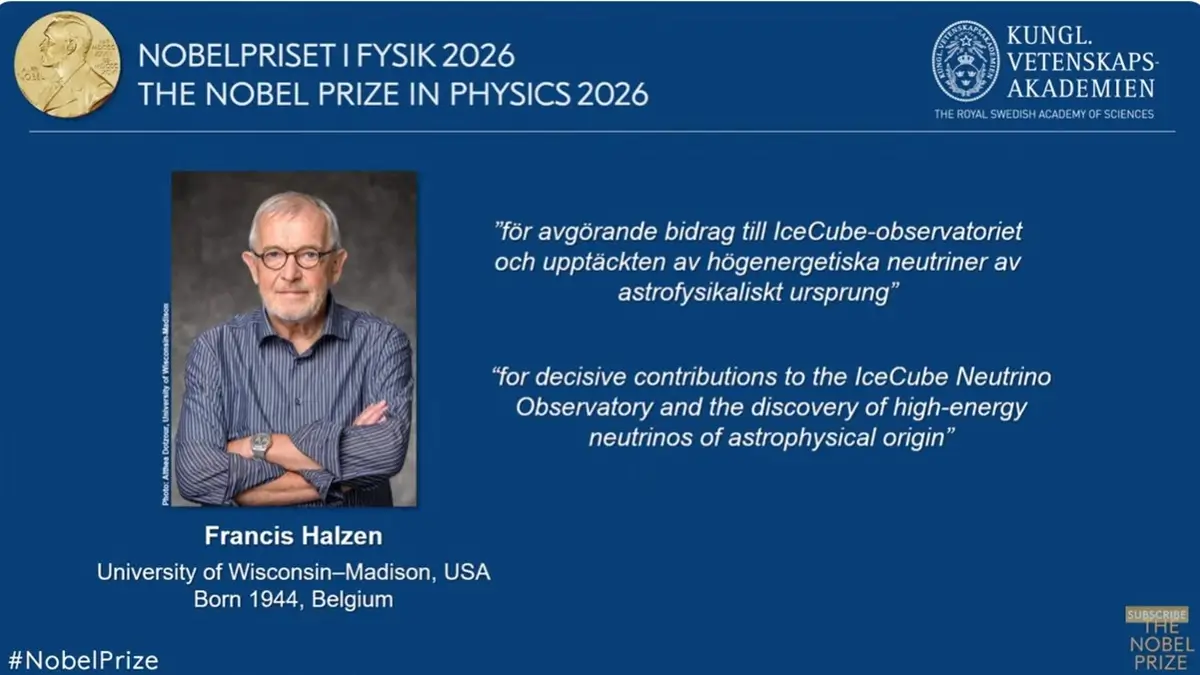
The Royal Swedish Academy of Sciences has awarded the Nobel Prize in Physics 2026 to physicist Francis Halzen for his pioneering work on the IceCube Neutrino Observatory and the discovery of high-energy neutrinos of astrophysical origin.
The prize citation states that Halzen was honoured “for decisive contributions to the IceCube Neutrino Observatory and the discovery of high-energy neutrinos of astrophysical origin.”
His work helped establish an entirely new way of observing the universe by using elusive particles known as neutrinos as cosmic messengers.
Who is Francis Halzen?
Francis Halzen is a physicist best known for his key role in developing the scientific concept behind the IceCube Neutrino Observatory.
His research focused on the idea that extremely high-energy neutrinos coming from distant astrophysical sources could be detected using a massive volume of transparent ice.
The result was the creation of IceCube, a giant neutrino detector installed deep beneath the ice at the South Pole.
What are Neutrinos?
Neutrinos are extremely light, electrically neutral subatomic particles.
They are often called “ghost particles” because they interact only very weakly with matter. Trillions of neutrinos can pass through the human body every second without producing any noticeable effect.
Because they can travel vast cosmic distances without being significantly deflected or absorbed, neutrinos can carry information directly from some of the most energetic and distant regions of the universe.
This makes them valuable tools for studying phenomena that may be difficult to observe using ordinary light or other electromagnetic radiation.
What is the IceCube Neutrino Observatory?
The IceCube Neutrino Observatory is a massive scientific detector located at the South Pole in Antarctica.
Instead of using a conventional telescope, IceCube uses a huge volume of Antarctic glacial ice to detect neutrinos.
Thousands of sensitive light detectors are embedded deep within the ice. When a neutrino interacts with matter in or near the detector, it can produce charged particles that generate tiny flashes of light.
These flashes are recorded by IceCube’s sensors and used by scientists to estimate the:
- Direction of the incoming neutrino
- Energy of the neutrino
- Possible astrophysical source from which it originated
How Does IceCube Detect Neutrinos?
Neutrinos normally pass through matter almost unaffected. However, on rare occasions, a neutrino collides with another particle.
Such an interaction can produce a fast-moving charged particle.
As this charged particle travels through the transparent Antarctic ice, it can produce a characteristic blue light known as Cherenkov radiation.
IceCube’s detectors record this light, allowing scientists to reconstruct the path and energy of the original neutrino.
Discovery of High-Energy Astrophysical Neutrinos
One of the most important achievements of the IceCube project was the detection of high-energy neutrinos originating beyond Earth’s atmosphere.
These particles provided evidence that extremely energetic processes in the distant universe are capable of producing neutrinos.
The discovery opened a new window into the study of cosmic phenomena and helped establish neutrino astronomy as an important branch of modern astrophysics.
A New Type of Astronomy
Traditional astronomy largely depends on detecting electromagnetic radiation such as:
- Visible light
- Radio waves
- Infrared radiation
- X-rays
- Gamma rays
Francis Halzen’s work helped demonstrate that the universe can also be studied through neutrinos.
Because neutrinos can escape from dense cosmic environments and travel almost unchanged over enormous distances, they can reveal information about regions that may be hidden from conventional telescopes.
This has contributed to the development of multi-messenger astronomy, in which scientists study the universe using several different cosmic signals.
Why the Discovery is Important
High-energy neutrinos can help scientists investigate some of the most powerful objects and events in the universe, including:
- Active galactic nuclei
- Supermassive black holes
- Exploding stars
- Gamma-ray bursts
- Other high-energy cosmic accelerators
Their detection can also help researchers understand the origin of cosmic rays, which are among the highest-energy particles observed in nature.
Importance of the South Pole
The Antarctic ice is especially suitable for neutrino detection because it provides:
- An enormous natural detection medium
- Deep, clear and stable ice
- Very low levels of environmental interference
- A large volume in which rare neutrino interactions can be observed
Francis Halzen’s concept of using glacial ice on this scale made the IceCube observatory possible.
Nobel Prize in Physics
The Nobel Prize in Physics is awarded by the Royal Swedish Academy of Sciences.
It is one of the original Nobel Prize categories established according to the will of Alfred Nobel.
The prize recognises discoveries and achievements that have made major contributions to physics and to humanity’s understanding of the natural world.
Important Exam Facts
| Particular | Details |
|---|---|
| Nobel Prize | Nobel Prize in Physics 2026 |
| Winner | Francis Halzen |
| Awarding Institution | Royal Swedish Academy of Sciences |
| Prize Citation | Decisive contributions to IceCube and discovery of high-energy astrophysical neutrinos |
| Major Project | IceCube Neutrino Observatory |
| Location of IceCube | South Pole, Antarctica |
| Particles Studied | Neutrinos |
| Type of Neutrinos Detected | High-energy neutrinos of astrophysical origin |
| Scientific Field Advanced | Neutrino astronomy |
| Detection Medium | Antarctic glacial ice |
| Important Light Phenomenon | Cherenkov radiation |
| Broader Field | Multi-messenger astronomy |








 Shabari Naturals Wins G-Mark Global Desi...
 Lionel Messi Recognized With 2026 Prince...
 Usha Mangeshkar to Receive Inaugural Hon...