
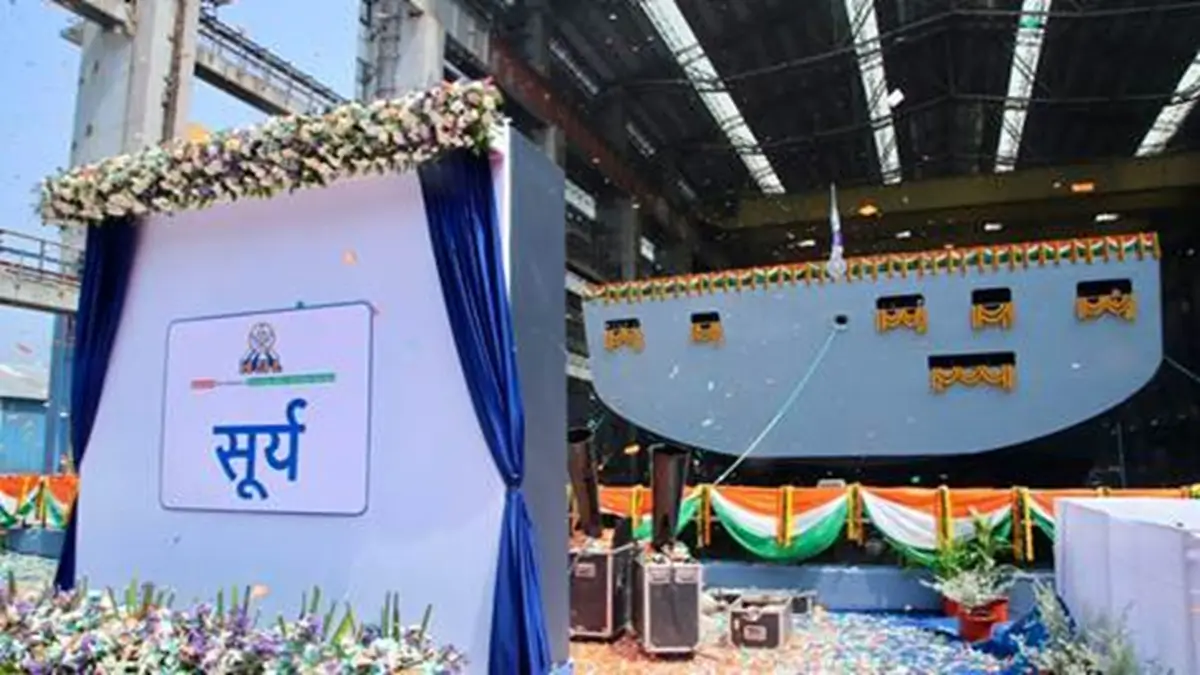
Raksha Mantri Rajnath Singh launched the first indigenous Fleet Support Ship (FSS-1), named ‘Surya’, at Hindustan Shipyard Limited (HSL), Visakhapatnam, on 6 October 2026.
On the same occasion, he also laid the keel of the fifth Fleet Support Ship (FSS-5) and inaugurated the upgraded Slipway-4 and a 300-tonne Goliath Crane at HSL.
These developments are expected to strengthen India’s indigenous shipbuilding capability and support the construction of larger and more complex naval vessels.
About Fleet Support Ship ‘Surya’
The FSS-1, Surya, has been designed and built indigenously by Hindustan Shipyard Limited.
The vessel was launched after traditional honours performed by Laila Swaminathan, President of the Navy Wives Wellness Association (NWWA).
Fleet Support Ships are designed to provide logistics and replenishment support to naval warships during long-duration operations at sea.
Key Features of Fleet Support Ships
The ships will include:
- Enhanced cargo carrying capacity
- Increased fluid carrying capacity
- At-sea replenishment capability
- First-line maintenance workshops
- Helicopter deck for Multi-Role Helicopter operations
- Self-defence systems
These capabilities will enhance the reach, endurance and operational effectiveness of the Indian Navy, especially in the Indian Ocean Region.
Importance of Fleet Support Ships
Fleet Support Ships enable naval vessels to remain deployed at sea for longer periods without returning frequently to port.
They provide:
- Fuel
- Supplies
- Maintenance support
- Logistics assistance
- Operational sustainment
This makes them crucial for long-range and extended naval deployments.
Upgraded Slipway-4
The upgraded Slipway-4 at Hindustan Shipyard Limited has been extended and strengthened.
It can now support the construction and launching of vessels of up to 45,000 DWT.
This will allow HSL to undertake larger and more sophisticated shipbuilding projects.
300-Tonne Goliath Crane
A new 300-tonne Goliath Crane was also inaugurated.
The crane spans Slipways 3 and 4 and was designed and manufactured by L&T Geostructure in collaboration with Konecranes under the Make in India initiative.
Its major technological features include:
- PLC controls
- Variable Frequency Drives
- Tandem lifting
- Remote diagnostics
- Condition monitoring
The crane will support faster and more precise handling of large shipbuilding blocks.
Hindustan Shipyard Limited
Rajnath Singh highlighted the long maritime history of HSL and recalled that the first ship built in independent India, ‘Jala Usha’, was launched at Visakhapatnam in 1948.
HSL achieved Miniratna Category-I status in 2025 after coming under the Ministry of Defence.
The shipyard has played an important role in meeting India’s maritime and defence requirements for more than eight decades.
Visakhapatnam as a Maritime Hub
The Raksha Mantri stressed the strategic importance of Visakhapatnam, which has:
- Eastern Naval Command
- Naval Dockyard
- Hindustan Shipyard Limited
- Visakhapatnam Port
He called for the city to be developed as a major Maritime Industrial Hub by integrating shipbuilding, port infrastructure, naval expertise, MSMEs, startups, universities and research institutions.
Push for Self-Reliance and Global Competitiveness
Rajnath Singh emphasised that India’s shipbuilding goals should move beyond self-reliance towards global competitiveness.
He highlighted the need to improve:
- Indigenous design capability
- Timely delivery
- Productivity
- Supply-chain resilience
- Skilled manpower
- Cost competitiveness
- Ship repair and lifecycle support
He also called for stronger collaboration among the Indian Navy, HSL, DRDO, MSMEs, startups, academia and industry.








 SIMBEX-2026: 33rd India-Singapore Mariti...
 IBSAMAR 2026: 9th India-Brazil-South Afr...
 India-Australia Joint Military Exercise ...










