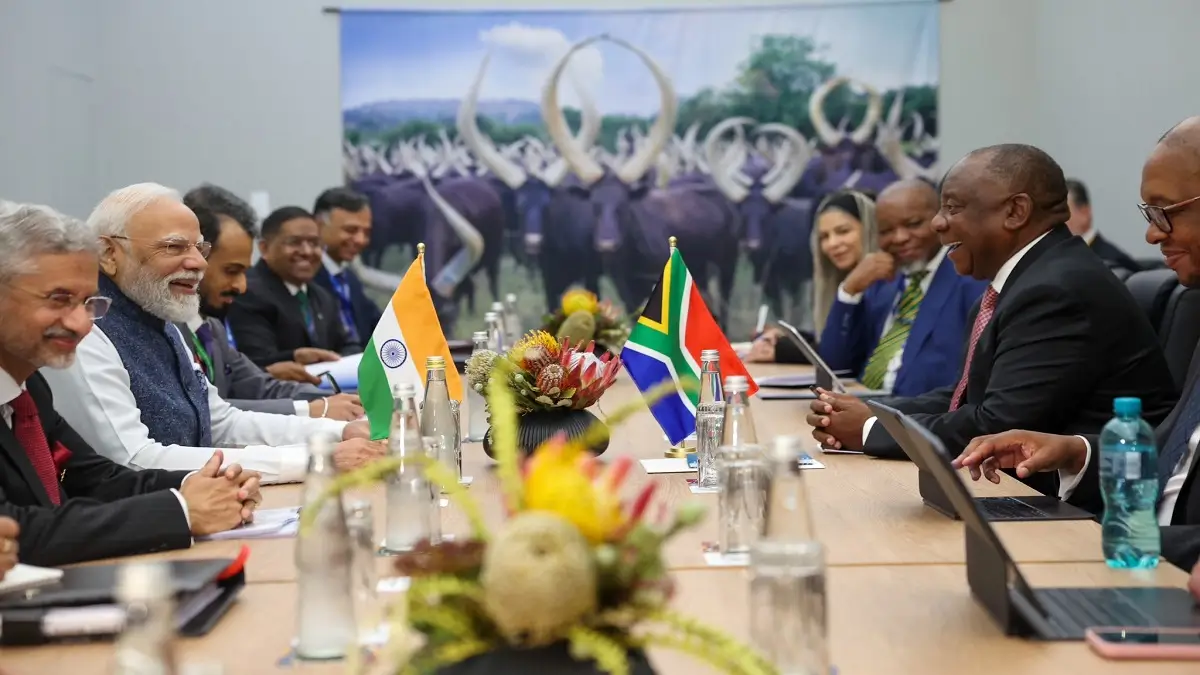
The 20th G20 Leaders’ Summit was a historic event, marking the first time the group convened on the African continent. However, it was equally notable for the absence of US President Donald Trump, who boycotted the event due to political disagreements with the South African presidency. Despite this, the remaining leaders adopted a comprehensive declaration focusing on climate finance, African representation, and global inequality.
Exam Cheat Sheet: The 10 Key Takeaways
| Area of Focus | Key Commitment / Target |
| 1. Philosophy | Adopted Ubuntu principles: interconnectedness & multilateralism. |
| 2. IMF Reform | Created a 25th Chair at the IMF for Sub-Saharan Africa. |
| 3. Debt | Strengthened the G20 Common Framework for debt treatment. |
| 4. Climate Finance | Goal to scale finance from “Billions to Trillions”; $5.8T needed for NDCs. |
| 5. Energy | Mission 300: Connect 300 million Africans to electricity by 2030. |
| 6. Critical Minerals | Launched the G20 Critical Minerals Framework for stable supply chains. |
| 7. Food Security | Reaffirmed Right to Food; condemned starvation as a weapon of war. |
| 8. AI & Tech | Launched the AI for Africa Initiative for equitable technology sharing. |
| 9. Social Goals | Nelson Mandela Bay Target: Reduce youth unemployment (NEET) by 5%. |
| 10. UN Reform | Call to expand the UN Security Council to include underrepresented regions. |
Deep Dive: Understanding the Declaration
A. The “African Summit” & Financial Inclusion
The summit prioritized integrating the developing world into the global financial architecture.
1. Historic Context & Ubuntu The declaration anchored itself in Ubuntu, emphasizing that individual success depends on communal well-being. This philosophy was used to counter rising geopolitical instability, arguing that “no one is left behind” only through multilateral cooperation.
2. Boosting African Voice in Finance A major win for the Global South was the structural change at the International Monetary Fund (IMF).
- New Chair: A 25th seat on the IMF Executive Board dedicated to Sub-Saharan Africa.
- SDR Channelling: The G20 exceeded the goal of $100 billion in Special Drawing Rights (SDRs) for countries in need.
3. Tackling the Debt Crisis Recognizing that debt prevents low-income countries from investing in healthcare and education, the leaders committed to:
- The G20 Common Framework (CF): To speed up debt treatment.
- Debt Swaps: Encouraging “debt-for-development” or “debt-for-climate” swaps.
B. Climate Change & Energy Transition
4. “Billions to Trillions” Despite US objections, the declaration strongly supported the Paris Agreement. It highlighted that developing nations need $5.8–5.9 trillion before 2030 to meet their climate goals (NDCs). The focus is on Disaster Risk Reduction (DRR) and protecting Small Island Developing States.
5. Just Energy Transitions (Mission 300) Addressing the fact that 600 million Africans lack electricity, the G20 supported:
- Mission 300: A World Bank/African Development Bank plan to electrify 300 million people in Africa by 2030.
- Global Targets: Tripling renewable energy capacity and doubling energy efficiency by 2030.
6. Critical Minerals Framework As the world digitizes, demand for minerals (like lithium and cobalt) is skyrocketing. The new voluntary framework aims to:
- Prevent developing nations from being mere raw material exporters.
- Promote local beneficiation (processing minerals in the country of origin)
C. Social Justice & Governance
7. Food Security & War With 720 million people facing hunger, the leaders stated that “intentional starvation of civilians should not be used as a method of warfare.” They also supported the African Continental Free Trade Area (AfCFTA) to boost local food production.
8. AI for Development The summit recognized the risks and benefits of AI, launching the AI for Africa Initiative. This platform ensures that data governance, privacy, and ethics are shared priorities between the G20 and the African Union.
9. Youth & Gender Targets Two specific numerical targets were adopted:
- Nelson Mandela Bay Target: Reduce the rate of youth Not in Employment, Education, or Training (NEET) by 5% by 2030.
- Brisbane-eThekwini Goal: Reduce the gender gap in labor participation by 25% by 2030.
10. UN Security Council Reform Echoing calls from the IBSA grouping (India, Brazil, South Africa), the declaration termed UN reform “a necessity.” It calls for an enlarged Security Council that better represents 21st-century geopolitical realities.


 International Rail Coach Expo 2026 Inaug...
 International Malaria Conference 2026 En...
 India to Host Bharat Steel Summit in New...