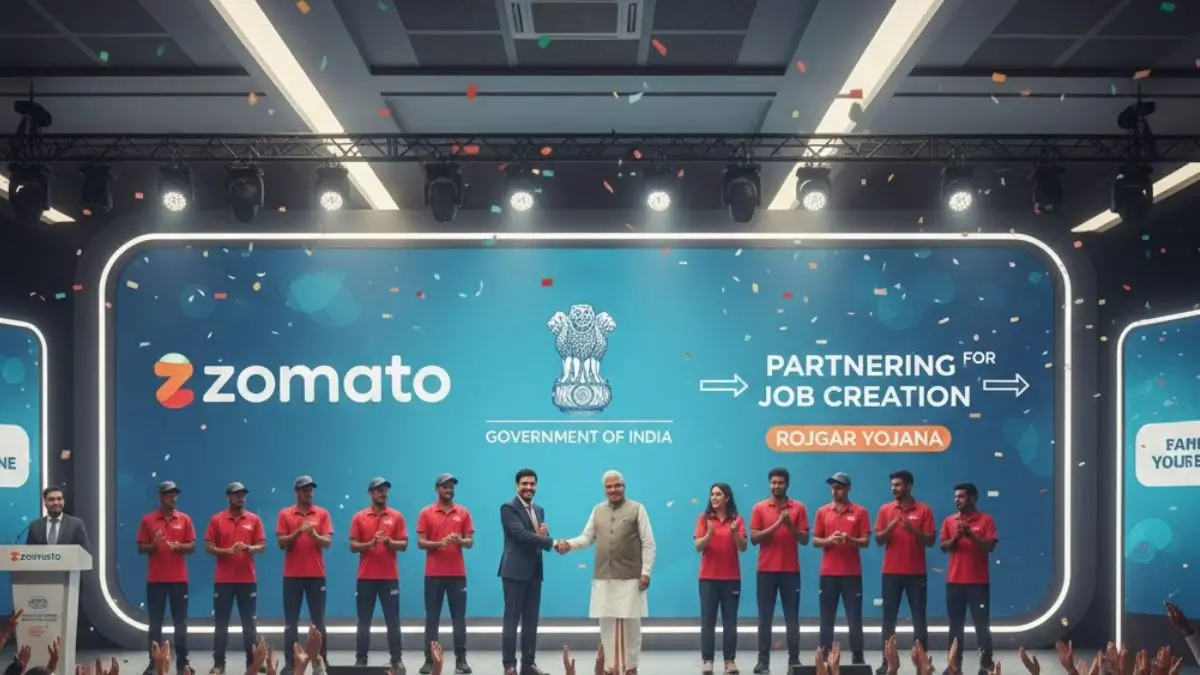
In a move aimed at expanding access to technology-enabled and flexible employment, the Government of India has signed a Memorandum of Understanding (MoU) with Zomato to generate up to 2.5 lakh job opportunities annually through the National Career Service (NCS) portal. This collaboration marks a strategic step toward integrating platform-based gig roles into India’s formal employment ecosystem, especially benefiting youth and women jobseekers.
Background: What is the NCS Portal?
- Launched in 2015, the National Career Service (NCS) portal is a flagship platform under the Ministry of Labour and Employment, designed to connect job seekers with employers across sectors.
- As of 2025, the portal has mobilized over 7.7 crore vacancies, making it a significant tool for facilitating employment and livelihood across the country and even internationally.
- The portal plays a crucial role in the government’s broader mission under Digital India to promote inclusive and transparent recruitment systems.
What the Zomato MoU Entails
Under the new ‘Aggregator’ category created within the NCS platform, Zomato will list around 2.5 lakh flexible livelihood opportunities every year. These are primarily aimed at delivery partners and gig workers, offering structured access to income-generating roles.
The opportunities will be,
- Real-time and technology-enabled,
- Flexible in terms of working hours,
- Integrated with social protection schemes,
- Accessible across urban and semi-urban areas.
The collaboration aligns with the goals of the Pradhan Mantri Viksit Bharat Rozgar Yojana (PM-VBRY) and supports the government’s long-term vision of Viksit Bharat 2047, which focuses on inclusive growth and formalization of all forms of work.
Significance for the Gig Economy
India’s gig economy—comprising delivery workers, freelancers, and platform-based professionals—is rapidly expanding but often lacks access to formal employment benefits like insurance, pensions, or structured contracts. This MoU seeks to bridge that gap by,
- Formalizing gig work,
- Promoting job dignity and stability,
- Digitally registering workers, making them eligible for social schemes,
- Encouraging other platforms to adopt similar models.
The move also reflects a shift toward recognizing platform economy roles as legitimate forms of employment, meriting policy inclusion and protection.


 India Launches AI-Driven Initiative to M...
 What the NPC-MoEFCC Agreement Means for ...
 IIT Bombay & Honeywell Launch Sustai...