
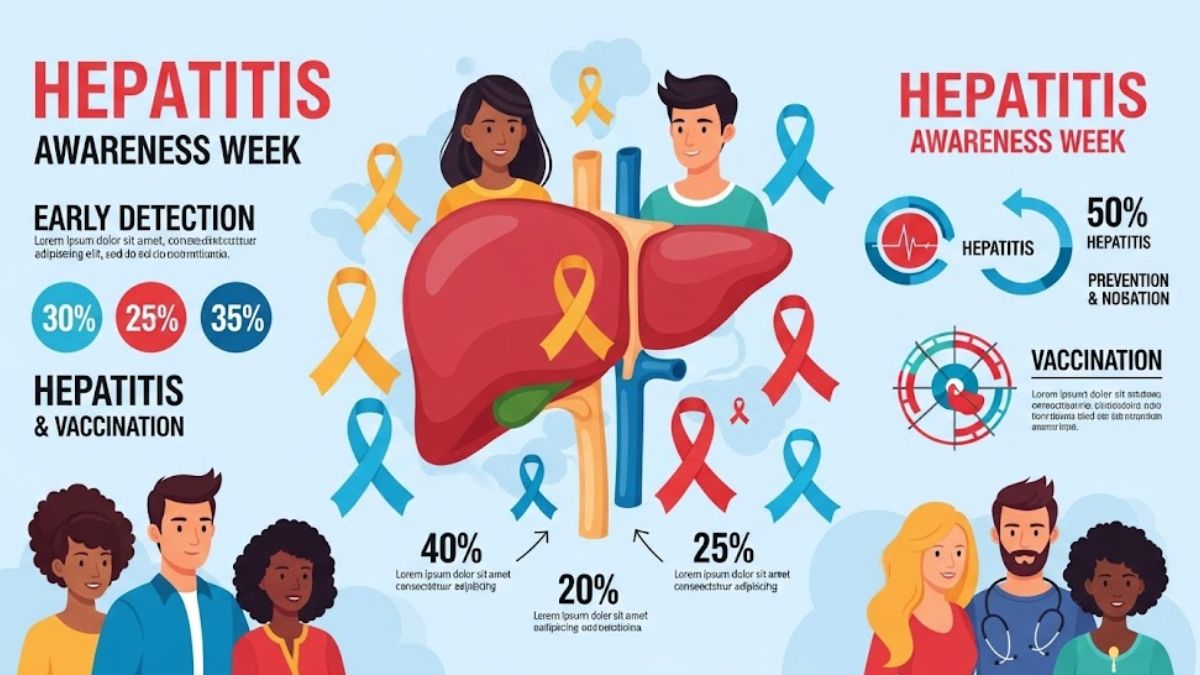
Hepatitis Awareness Week, observed every year from July 26 to August 1, is dedicated to raising awareness about viral hepatitis, its causes, prevention, and treatment. This week plays a crucial role in educating the public, honoring those affected, and encouraging preventive healthcare. The observance also highlights July 28 as National Hepatitis Day, which marks the birthday of Dr. Baruch Blumberg, the Nobel laureate who discovered the Hepatitis B virus and developed its vaccine.
Historical Background of Hepatitis
Ancient Descriptions
The first mention of Hepatitis A, commonly associated with outbreaks of jaundice, dates back to 400 B.C., when Hippocrates described its clinical features in his treaty De Morbis Internis. Later, in the 17th and 18th centuries, outbreaks were also reported during military campaigns.
Differentiation of Hepatitis Types
In the 1940s, researchers first distinguished Hepatitis A from Hepatitis B, noting that Hepatitis B had a longer incubation period. This was a major step forward in understanding the disease.
By 1947, scientist Mac Callum suggested a clear categorization, separating epidemic Hepatitis (short incubation) from serum Hepatitis (long incubation).
Discovery of New Hepatitis Viruses
Between 1963 and 1989, scientists identified the five major hepatitis viruses that are known today,
- Hepatitis A virus (HAV)
- Hepatitis B virus (HBV)
- Hepatitis C virus (HCV)
- Hepatitis delta virus (HDV) (discovered in 1977 by Mario Rizetto in Torino)
- Hepatitis E virus (HEV)
Advances in Prevention and Treatment
Development of Hepatitis B Vaccine
A milestone in prevention came in 1981, when the FDA approved the first plasma-derived Hepatitis B vaccine for human use. By 1986, second-generation DNA recombinant Hepatitis B vaccines were produced. These were synthetically prepared and are now widely recognized as safe and effective in the United States and globally.
The Burden of Hepatitis B and C
Hepatitis B and Hepatitis C together are responsible for over 80% of liver cancer cases worldwide.
Hepatitis C is primarily transmitted through infected blood exposure, including intravenous drug use, high-risk sexual activity, and childbirth from an infected mother.
Nearly every patient with Hepatitis C develops antibodies to HCV, though these may remain undetectable in immunodeficient patients.
Significance of Hepatitis Awareness Week
Raising Awareness
The week focuses on spreading awareness about symptoms, prevention, and treatment of viral hepatitis. Social media campaigns, seminars, and public discussions are organized to educate communities.
Community Support
The observance brings together patients, healthcare professionals, and communities to show solidarity with those affected. It also encourages early detection and treatment, emphasizing that untreated hepatitis can lead to severe liver damage.
Highlighting Urgency of Treatment
Hepatitis often develops into life-threatening liver diseases, making early treatment critical. Hepatitis Awareness Week underlines the importance of vaccination, safe practices, and regular health checkups.
Key Dates and Timeline
- 400 B.C. – Hippocrates documents the first clinical features of Hepatitis.
- 1947 – Mac Callum categorizes Hepatitis based on incubation periods.
- 1977 – Hepatitis Delta Virus identified by Mario Rizetto.
- 1981 – FDA approves the first Hepatitis B vaccine.
- 1986 – Second-generation DNA recombinant Hepatitis B vaccine becomes available.
Hepatitis Awareness Week Dates (Upcoming Years)
- 2025: July 26 – August 1 (Saturday–Friday)
- 2026: July 26 – August 1 (Sunday–Saturday)
- 2027: July 26 – August 1 (Monday–Sunday)
- 2028: July 26 – August 1 (Wednesday–Tuesday)
- 2029: July 26 – August 1 (Thursday–Wednesday)


 National Safe Motherhood Day 2026: Why M...
 Jyotirao Phule Jayanti 2026: India Begin...
 World Homoeopathy Day 2026: Advancing Ho...











