
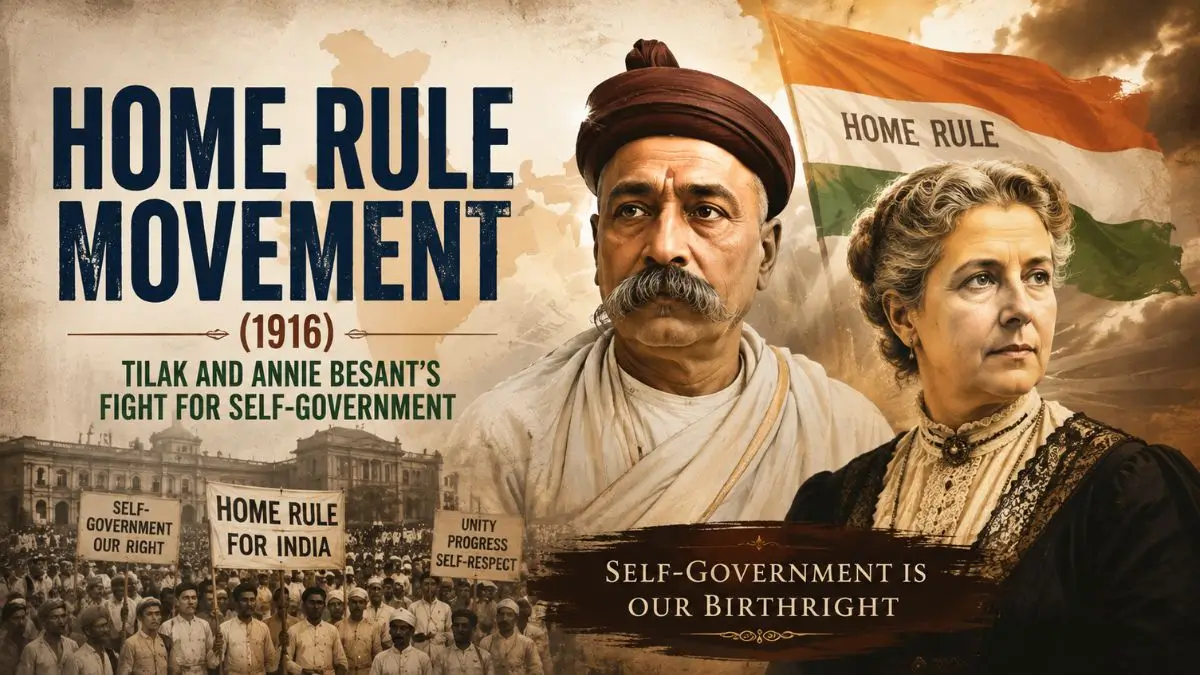
The Home Rule Movement in India (1916-1918) is another notable stage in the process of India’s struggle for independence and the resurgence of the nationalist movement after several years of political stagnation in the country. The movement was mainly led by Bal Gangadhar Tilak and Annie Besant, who advocated for self-government or home rule of India within the British Empire.
It is partly inspired by the Home Rule Movement in Ireland, the campaign aimed at the political education of the people and creating public opinion and pressure on the British government. Though, the movement itself did not lead to the achievement of self-government, it helped to resurrect the nationalist movement and laid the groundwork for the mass movement later headed by Mahatma Gandhi.
What Was the Home Rule Movement?
The Home Rule Movement was a political campaign initiated in 1916 to strive for home rule in India. The main concept of the movement was that India should be granted more control over its own administration but remaining within the Commonwealth of Britain.
The movement took place in the times of the First World War (1914-1918). Indian nationalists suggested that, having fought for freedom and democracy abroad, Britain should grant the same rights to India.
Unlike the activities of the Congress which used to concentrate mainly at annual sessions, the Home Rule Leagues were working all the year round through meetings, political education, newspaper propaganda and the formation of branches.
Reasons Behind the Home Rule Movement
Some of the reasons which brought about favorable ground for the movement include;
Firstly, the Indian Councils Act 1909, popularly called the Morley-Minto Reforms, did not satisfy the aspirations of the nationalists. The reforms gave limited political representation, but no responsible government was granted to the Indians.
There had been a split of the Congress Party into the moderates and the extremists in 1907 through the Surat Split. The absence of Bal Gangadhar Tilak from Indian politics through his imprisonment from 1908 to 1914 further weakened nationalist mobilization.
The return of Bal Gangadhar Tilak from Mandalay in 1914 and the appearance of Annie Besant as an active nationalist brought a new hope. Both leaders felt that pressure and education of the masses were needed to force the British Government to accept India’s demand for self-government.
In addition, there was the issue of the First World War. The rising prices, increased taxation, among other difficulties faced by the people as a result of war contributed to the dissatisfaction of the public. “England’s need is India’s opportunity” became Annie Besant’s slogan.
Furthermore, there was the attempt to bring unity among the moderate and extremist wings of Congress. This occurred at the Lucknow Session in 1916.
Home Rule Leagues
Probably one of the most remarkable aspects of the movement was the formation of the two distinct Home Rule Leagues.
Tilak’s Home Rule League
- This organisation was founded by Bal Gangadhar Tilak in April 1916 in India. The head office of the league was in Poona (Pune).
- The operations of Tilak’s league were mostly limited to Maharashtra excluding Bombay City, Karnataka, the Central Provinces and Berar. The structure of his league was relatively well-defined.
- The league demanded Swarajya, imparted political education and favoured the use of vernacular languages. His league was successful in taking the call for self-governance outside the conventional political arenas.
Besant’s Home Rule League
- The All-India Home Rule League was founded by Annie Besant in September 1916 at Madras.
- Unlike Tilak’s league, Besant’s league covered a wider area geographically and worked almost throughout the whole of India, except Bombay City. They worked through an extensive network of branches and depended much upon political propaganda and education.
- George Arundale was the organisational secretary of the league and B.P. Wadia and C.P. Ramaswamy Aiyar were some of its prominent associates.
- The two leagues were independent entities, yet they generally had a common goal – that of obtaining Home Rule for India.
Leaders of the Home Rule Movement
A few important nationalist leaders joined hands in organising the movement. Bal Gangadhar Tilak and Annie Besant were its foremost leaders.
A few other important persons associated with the movement were G.S. Khaparde, Joseph Baptista, Sir S. Subramania Iyer and Muhammad Ali Jinnah.
Besides, a few important emerging leaders of nationalism were also associated with the agitation. These leaders were Jawaharlal Nehru, Motilal Nehru, Chittaranjan Das, Bhulabhai Desai and K.M. Munshi.
The movement thus provided an important platform where different sections of nationalist politics came together.
Programme and Methods of the Home Rule Movement
Home Rule Leagues did not confine themselves to political education and mobilisation alone but also adopted political methods.
Methods adopted by Home Rule Leagues included political education through public meetings, lectures, conferences, press and pamphlets. In addition, political education was carried out by establishing libraries and political associations.
The Home Rule Movement encouraged people to participate in local government bodies and thus politicised the areas that earlier remained politically inactive.
Another important feature of the Home Rule Movement was the effective utilisation of the press. Newspapers like New India and Commonweal published by Annie Besant served this purpose very well.
British Government’s Reaction
As the Home Rule movement gathered momentum, the British government reacted with repressive measures.
Restrictions on political meetings took place in many places, and Tilak faced government restrictions. He was not allowed to go to certain places too.
The most stringent measure of the government was taken against Annie Besant. In June 1917, she, along with B.P. Wadia and George Arundale, was arrested and placed under internment.
The arrest of Besant resulted in widespread protests throughout the country. Even moderate nationalists started criticising the government’s policy.
Besant was released in September 1917, but in the meantime, the incident gave much publicity to the Home Rule movement.
Montagu Declaration of 1917
Pressure exerted by the Home Rule Movement led to an important political event.
In 1917, Edwin Montagu, who was Secretary of State for India, declared that the policy of the British government regarding India was the development of self-governing institutions gradually in India leading to responsible government.
The significance of the declaration was that the demand for self-government was gaining more legitimacy in British politics.
From the point of view of Indian nationalists, the Montagu Declaration was an important change in the official British policy.
Significance of the Home Rule Movement
One of the important aspects of the Home Rule Movement was that it revived the spirit of Indian nationalism which had been hampered by political differences in the past decade.
An important accomplishment of this movement was that it made the politics of the nationalists a year round affair and not an annual one linked with the Congress sessions.
It was also responsible for spreading the political consciousness among the masses by organizing speeches, newspapers, public meetings, and local branches of the movement.
The movement succeeded in bringing together different sections of the political leadership for a common cause.








 Who Is Navi Pillay? Nobel Peace Prize 20...
 Vande Bharat vs Amrit Bharat Express: Ke...
 Asian Games to LA28: Which Sports Earned...










