
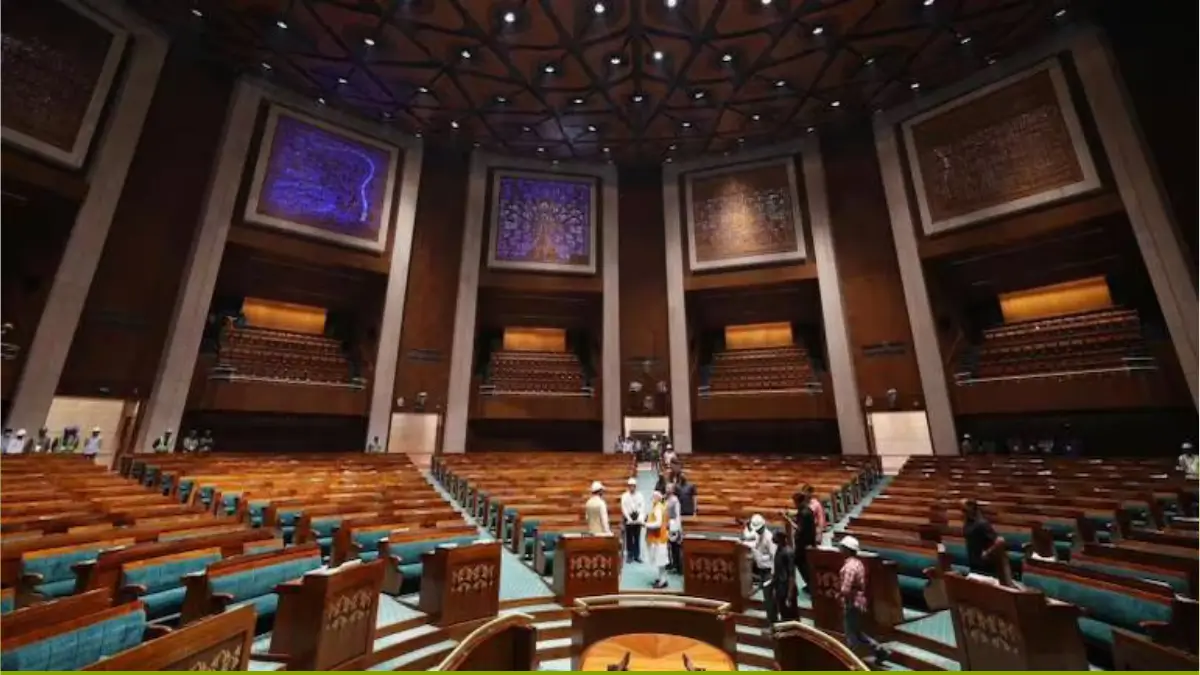
Did you know that the Rajya Sabha plays a very important role in making laws in India? It is also called the Council of States and represents the states and union territories of the country. This makes it a key part of India’s democratic system.
Unlike the Lok Sabha, members of the Rajya Sabha are not directly elected by the people. Instead, they are chosen by elected representatives, which gives it a unique structure and purpose in the Parliament.
The strength or total number of members in the Rajya Sabha is fixed by the Constitution of India. However, this number is not always fully occupied, as it may change slightly due to vacancies or other reasons.
Understanding the number of seats in the Rajya Sabha helps us learn how representation is balanced among different states. It also gives us a clearer idea of how India’s parliamentary system works in practice.
About Rajya Sabha
The Rajya Sabha is the upper house of the Parliament of India. It plays a very important role in making laws and represents the states and union territories at the national level. Unlike the Lok Sabha, its members are not directly elected by the people. Instead, they are chosen by elected representatives of states and certain union territories.
Total Strength of the Rajya Sabha
The Constitution of India allows a maximum strength of 250 members in the Rajya Sabha. However, the current strength is 245 members.
These 245 members are divided into two main categories. Out of them, 233 members are elected, while 12 members are nominated by the President of India.
Elected Members of the Rajya Sabha
The majority of seats in the Rajya Sabha are filled through elections. These 233 members represent the states and some union territories.
They are not elected directly by the public. Instead, they are chosen by the members of the state legislative assemblies. This system ensures that states have a voice in national decision-making.
Nominated Members
Apart from elected members, 12 members are nominated by the President of India. These members are selected because of their excellence in fields such as:
- Literature
- Science
- Art
- Social service
Their experience and knowledge help in improving the quality of debates and discussions in Parliament.
Basis of Seat Allocation
Seats in the Rajya Sabha are distributed based on the population of each state or union territory. This means that states with larger populations usually get more seats.
However, the distribution is not always perfectly updated with current population figures. Some states may still have more seats based on older population data. For example, Tamil Nadu has more representatives compared to some states with larger populations today, like Bihar and West Bengal.
Representation of Union Territories
Not all union territories send members to the Rajya Sabha. Only those with legislative assemblies can have representation.
Union territories like:
- Andaman and Nicobar Islands
- Chandigarh
- Dadra and Nagar Haveli and Daman and Diu
- Ladakh
- Lakshadweep
do not have representation because they do not have their own legislatures.
Historical Background of Seats
When the Constitution came into force on 26 January 1950, the Rajya Sabha had a total of 216 members. Out of these, 204 were elected and 12 were nominated.
Over time, the number of seats increased to reflect changes in the country’s structure and population.
Legal Provision for Seat Strength
The current strength of 245 members is based on the Representation of the People Act, 1951. According to this law, the number of seats can be increased up to 250 if needed.
This flexibility allows the system to adapt to future changes in population and administrative divisions.


 Who were the Seven Sisters of Petroleum?...
 What is the State Flower of Florida? Che...
 Which is the Largest Desert in Asia? Che...











