
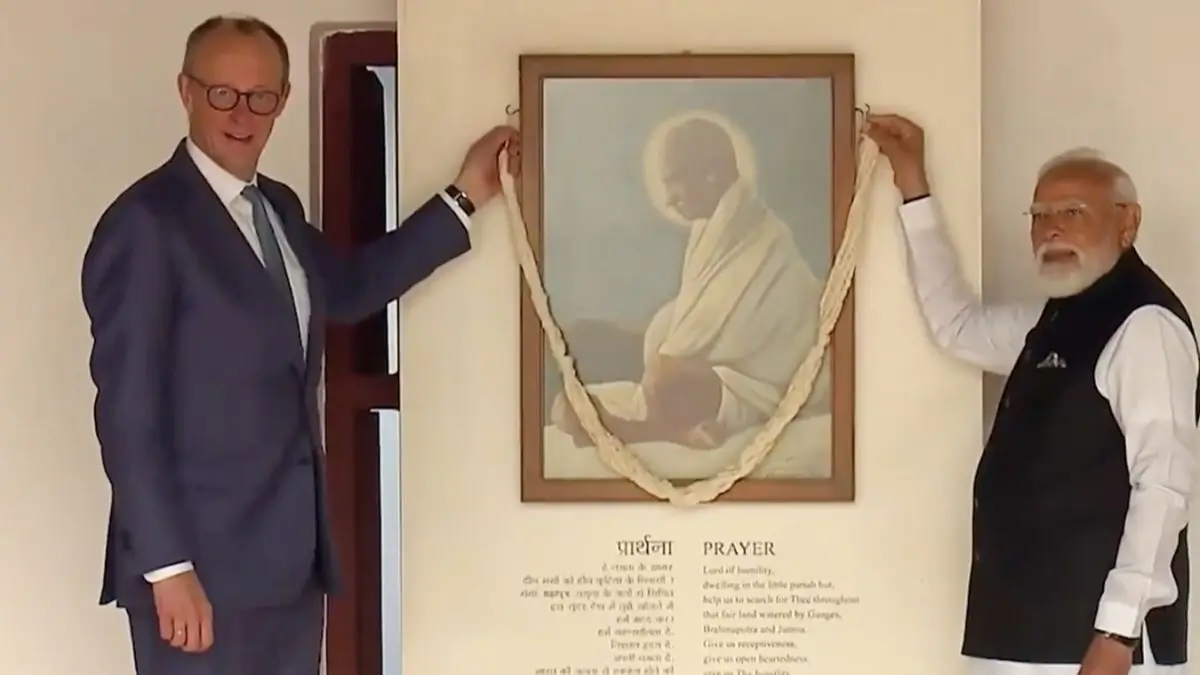
India and Germany further strengthened their long-standing strategic partnership during the official visit of German Chancellor Friedrich Merz to India from 12-13 January 2026. Hosted by Prime Minister Narendra Modi, the visit focused on defence, economic growth, green development, technology cooperation and global issues. The Joint Statement reflects growing trust and shared democratic values between the two countries.
Why in News?
India and Germany issued a Joint Statement in January 2026 following high level talks in Ahmedabad. This was Chancellor Merz’s first official visit to India and Asia, marking 75 years of diplomatic relations and building on the India-Germany Strategic Partnership.
Areas of Cooperation Partnership Signed
Defense and Security Cooperation
- Defense cooperation formed a major pillar of the discussions. Both countries agreed to deepen military-to-military engagement through joint exercises, training programmes and regular staff-level talks.
- Germany confirmed participation in Naval Exercise MILAN 2026, IONS Conclave of Chiefs, and Air Combat Exercise TARANG SHAKTI 2026.
- Cooperation in defense manufacturing will expand through a Defense Industrial Cooperation Roadmap, promoting co-development and co-production.
- Collaboration in submarines, counter-drone systems and advanced defense technologies combines India’s skilled manpower with Germany’s high-end technological expertise, enhancing long-term strategic security cooperation.
Counter-Terrorism and Global Security
- India and Germany strongly condemned terrorism in all forms, including recent terror attacks in Jammu & Kashmir and Delhi.
- Both sides committed to closer coordination against terrorist networks, financing and safe havens, in line with UN Charter and international law.
- Cooperation under the Joint Working Group on Counter-Terrorism and implementation of the Mutual Legal Assistance Treaty were welcomed.
- The leaders reiterated support for action against entities listed under the UN 1267 Sanctions Committee, highlighting shared concerns on global security and violent extremism.
- This reflects strong alignment on peace, stability and international security norms.
Trade, Economy and Investment
- Economic cooperation remains a strong driver of bilateral ties.
- India-Germany trade crossed USD 50 billion in 2024, accounting for over 25% of India’s trade with the EU. Both leaders encouraged greater investment in manufacturing, startups, MSMEs, AI and digital technologies.
- India invited German companies to expand operations under its business-friendly ecosystem, while Germany promoted itself as a destination for Indian investment.
- Support for the India-EU Free Trade Agreement was reiterated, expected to unlock new trade opportunities and strengthen resilient global supply chains.
Technology, Innovation and Science
- The Joint Statement highlighted rapid progress in critical and emerging technologies. A new Semiconductor Ecosystem Partnership will strengthen collaboration across the value chain.
- Both countries agreed to cooperate on AI, digital governance, telecom and Industry 4.0 under the Indo-German Digital Dialogue.
- The extension of the Indo-German Science and Technology Centre (IGSTC) and establishment of Centres of Excellence in battery technology, green transport and healthcare were welcomed.
- Space cooperation between ISRO and DLR will also expand, encouraging industry-level engagement and research collaboration.
Green and Sustainable Development Partnership
- Climate action is a flagship area of cooperation. Under the Green and Sustainable Development Partnership (GSDP), Germany has committed €10 billion till 2030, with around €5 billion already utilised.
- Funds support renewable energy, green hydrogen, sustainable urban transport, biodiversity and climate-resilient infrastructure.
- Both sides strengthened cooperation on green hydrogen, battery storage and renewable energy manufacturing.
- A major green ammonia offtake agreement under India’s National Green Hydrogen Mission reflects growing commercial collaboration and shared commitment to sustainable development goals and the Paris Agreement.
Indo-Pacific and Global Issues
- India and Germany reaffirmed support for a free, open and rules-based Indo-Pacific, announcing a new bilateral consultation mechanism.
- Germany’s growing engagement in the region was welcomed, including cooperation under the Indo-Pacific Oceans Initiative.
- Both countries supported the India–Middle East–Europe Economic Corridor (IMEC) for global connectivity.
- On global issues, they backed UN Security Council reforms, expressed concern over the Ukraine conflict, welcomed progress towards peace in Gaza, and reiterated commitment to a Two-State Solution.
Education, Skilling and People-to-People Ties
- People-to-people relations remain central to the partnership.
- Germany announced visa-free transit for Indian passport holders, easing travel and mobility. Cooperation under the Migration and Mobility Partnership Agreement will promote ethical skilled migration, especially in healthcare and renewable energy sectors.
- The two sides launched initiatives for skill development, higher education cooperation and German language training in India.
- Growing student exchanges, joint degree programmes and institutional linkages between IITs and German universities highlight deepening educational and cultural ties.
Background of India-Germany Relations
India and Germany established diplomatic relations in 1951. The Strategic Partnership was launched in 2000, with Inter-Governmental Consultations (IGC) introduced in 2011. Germany is India’s largest trading partner in the EU and a key collaborator in clean energy, technology and vocational training.
Key Summary at a Glance
| Aspect | Details |
| Why in News? | India-Germany Joint Statement issued during German Chancellor’s visit in Jan 2026 |
| Defense | Joint exercises, defense industrial roadmap, naval cooperation |
| Economy | Trade crossed USD 50 billion, support for India–EU FTA |
| Technology | Semiconductors, AI, space and research cooperation |
| Climate | €10 billion GSDP, green hydrogen and renewables |
| Global Issues | Indo-Pacific, UNSC reforms, Ukraine, Gaza |
| People Ties | Visa-free transit, skilling, education cooperation |
Features About Germany
| Chancellor | Friedrich Merz |
| Capital | Berlin |
| Continent | Located in Central Europe |
| Bordered by | Denmark (north), Poland and Czech Republic (east), Austria and Switzerland (south), and France, Luxembourg, Belgium, Netherlands (west) |
| Major Mountain Ranges | Alps (southern Germany)
Bavarian Forest (southeast) Black Forest (southwest) Harz Mountains (central) |
| Rivers | Major rivers: Rhine, Danube, Elbe, Weser, Oder
Rhine is the longest river within Germany (865 km) |
Question
Q. India-Germany trade crossed which milestone in 2024?
A. USD 30 billion
B. USD 40 billion
C. USD 50 billion
D. USD 60 billion


 Newcastle Disease Spread in Europe 2026:...
 Mongolia Gets New Prime Minister Amid Po...
 Myanmar Military Chief Min Aung Hlaing B...











