
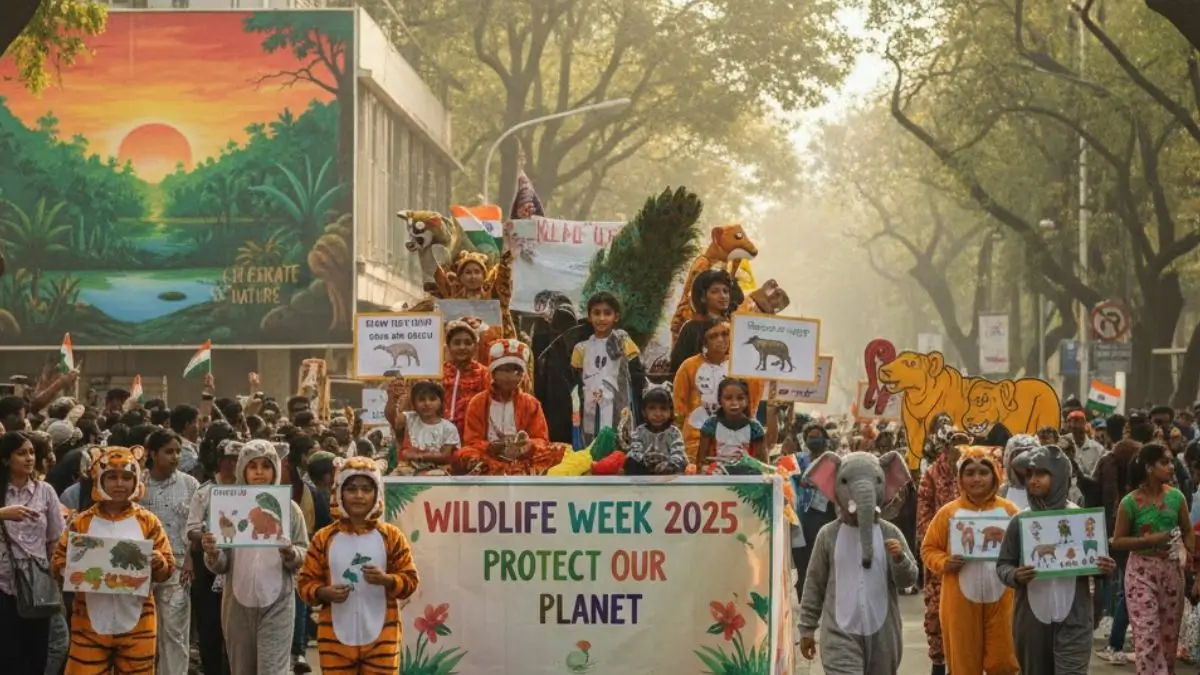
Wildlife Week 2025 was marked by a major conservation push, with the Union Environment Minister Bhupender Yadav launching five new national projects focused on endangered species and human–wildlife conflict management. Themed “Human–Wildlife Coexistence,” the celebrations took place at IGNFA, Dehradun, and highlighted India’s commitment to sustainable wildlife conservation through innovation, collaboration, and community participation.
Event Highlights and Collaborations
Organized by the Ministry of Environment, Forest and Climate Change (MoEFCC) in collaboration with institutions like the Wildlife Institute of India (WII), ICFRE, IGNFA, and FRI, the event brought together,
- Forest officers, scientists, and conservationists
- Students and research scholars
- Technology innovators and youth from 20+ States/UTs
Minister Yadav emphasized that “wildlife protection is a shared responsibility,” and urged a shift from “conflict to coexistence” through technology, community engagement, and policy reforms.
Launch of Five National Conservation Projects
A landmark moment in India’s conservation journey, the Minister announced the rollout of five species-focused and ecosystem-oriented projects:
1. Project Dolphin (Phase II)
Expands monitoring and protection of river and marine dolphins. Focuses on improving habitats and reducing underwater noise, fishing threats, and pollution.
2. Project Sloth Bear
Introduces a national implementation framework to address habitat loss, conflict zones, and illegal poaching affecting the sloth bear population.
3. Project Gharial
A structured plan for the conservation of the critically endangered gharial, focusing on river ecosystems, nesting site restoration, and breeding programs.
4. Centre of Excellence for Human–Wildlife Conflict (CoE-HWC)
To be set up at SACON, the centre will lead on policy support, mitigation strategies, and AI-based monitoring tools for conflict-prone regions.
5. Tigers Outside Tiger Reserves Initiative
Aims to protect tiger populations living outside protected reserves, using community-driven conservation, camera traps, and landscape-level planning.
New Estimation and Monitoring Programmes
The Minister also launched four national-level population estimation initiatives,
- Second Cycle of River Dolphin & Cetacean Estimation (plus new field guide)
- All India Tiger Estimation (Cycle 6) with field manuals in 8 regional languages
- Action Plan for Second Snow Leopard Estimation Cycle
- Progress Report on Great Indian Bustard and Lesser Florican Estimation
These will strengthen India’s species database, help track trends, and guide policy action at the national level.
Hackathon and Youth Engagement
A standout feature of the celebrations was the National Hackathon on Human–Wildlife Conflict Coexistence, which brought together,
- 420 participants from 75 institutions across 20 states/UTs
- Use of AI, spatial analytics, and community tools to design real-time conflict solutions
- Six finalist teams presented before an expert jury; top three received cash prizes, and others were awarded certificates
Such events underscore the role of innovation and youth in biodiversity conservation.
Key Points
- Wildlife Week 2025 Theme: Human–Wildlife Coexistence
- Location: IGNFA, FRI Campus, Dehradun
- Launched Projects: Dolphin Phase II, Sloth Bear, Gharial, CoE–HWC, Tigers Outside Reserves
- Estimation Cycles: River Dolphin, Tiger (Cycle 6), Snow Leopard, Great Indian Bustard
- Hackathon: 420 participants, AI-based conflict tools
- Centre for HWC: To be established at SACON


 What Is Vantara University? India’s Firs...
 Mundra Port Sets Record as India’s Large...
 Former Delhi HC Judge Yashwant Varma Ten...











