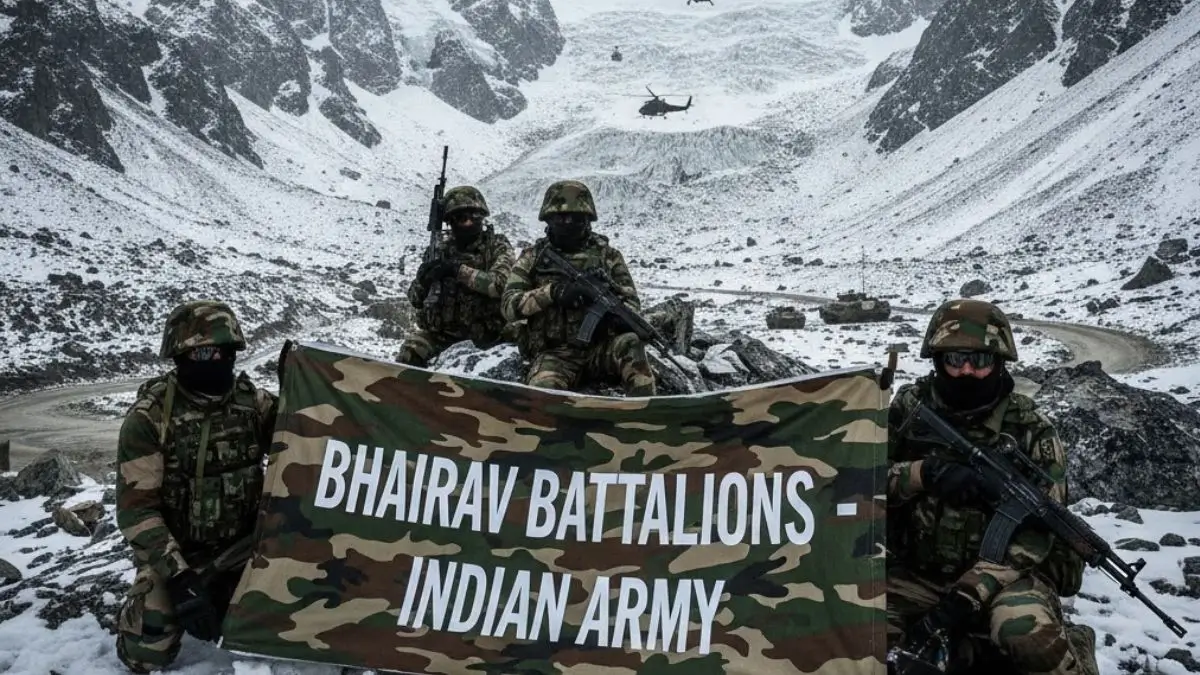
The Indian Army is undergoing a bold transformation with the introduction of 25 Bhairav Battalions, a new class of elite units designed to operate between the regular infantry and the Special Forces. These “lean and mean” battalions will focus on surprise strikes, counter-insurgency operations, reconnaissance, and high-mobility missions, especially along India’s volatile borders with China and Pakistan. The creation of these battalions is part of a broader military modernisation push aimed at boosting rapid response capability and strategic depth.
What Are Bhairav Battalions?
First announced by Army Chief General Upendra Dwivedi in July 2025, the Bhairav Battalions represent a hybrid combat model. Unlike the small Ghatak Platoons that operate within each infantry battalion (about 20 soldiers each), the Bhairav Battalions will be larger — about 250 soldiers per unit — and specially trained for terrain-specific missions.
According to Lt Gen Ajay Kumar, Director General of Infantry, the Bhairav units are designed to,
- Disrupt enemy operations through cross-border strikes
- Conduct surprise attacks and deep reconnaissance
- Serve as force multipliers by relieving Special Forces of less critical missions
- Integrate soldiers from various regiments, including Infantry, Artillery, Signals, and Air Defence
This diverse composition makes each battalion highly versatile, capable of independent, rapid deployments under complex conditions.
Deployment and Strategic Relevance
So far, five battalions are operational, and four more are being raised. The full complement of 25 is expected to be ready within the next six months. Deployment focus includes,
- Northern borders with Pakistan and China
- Northeastern insurgency zones
- Western sectors, supporting rapid mobilisation
- This build-up comes amid ongoing border tensions and rising asymmetric threats, including terror infiltration and drone warfare.
Operational Rationale: Lessons from Operation Sindoor
Lt Gen Kumar linked the need for Bhairav Battalions to insights from Operation Sindoor, a high-profile Indian military action targeting terror camps across the border in May 2025. The operation revealed a gap between tactical mobility and strategic objectives, necessitating new formations capable of,
- High-speed operations with independent command
- Integrated Intelligence, Surveillance, and Reconnaissance (ISR) capabilities
- Close coordination between multiple arms of the Army
- The Bhairav units are expected to bridge the gap between infantry and Special Forces, ensuring faster, more agile responses in future hybrid warfare scenarios.
Other Key Transformations in the Army
The induction of Bhairav Battalions is just one part of the Indian Army’s modernization strategy, which includes,
1. Ashni Platoons
Specialised units within infantry battalions trained for drone operations, covering,
- Surveillance roles
- Loitering munitions (drones that explode on impact)
- Kamikaze-style drone attacks
2. Rudra Brigades
Combined arms formations integrating,
- Infantry, tanks, mechanised units, artillery, UAVs, logistics, and Special Forces
- Designed for autonomous battlefield dominance with tech-driven flexibility
3. Shaktibaan Regiments
Unmanned warfare-focused regiments with,
- Swarm drones and RPAS
- Precision strike capability using long and medium-range loitering munitions
4. Divyastra Batteries
Next-gen artillery units combining,
- Traditional guns with drones for real-time target tracking
- Deep-strike and precision engagement against moving targets
- Together, these units reflect a major shift toward network-centric and AI-assisted warfare, with flexible, tech-enabled battlefield units replacing static formations.


 INS Sanshodhak: India’s Indigenous Surve...
 Indian Navy Inducts Indigenous Stealth F...
 Indian Air Force to Equip MiG-29 Jets wi...