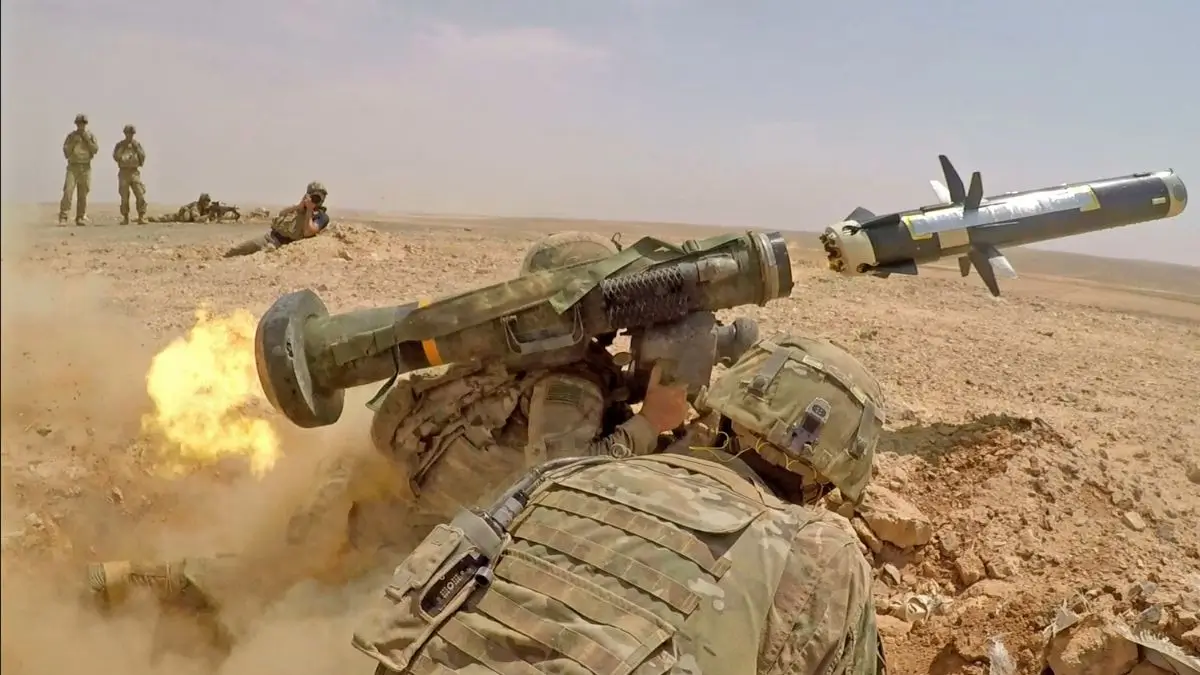
The Indian Army set to acquire the US-made FGM-148 Javelin anti-tank guided missiles, thus putting an end to the quest for the state-of-the-art “tank killer” that had been going on for almost 17 years now. The first contract has already been signed using the Foreign Military Sales (FMS) procedure and the procurement process is carried out utilizing the emergency powers of the Army. Although the initial batch is rather limited and will hardly solve the problem of lack of the missiles in the Army, this acquisition may have some further implications in terms of the co-production/manufacturing of Javelins in India.
Why Is India Buying Javelin Missiles?
First of all, Javelin gives a tremendous operational advantage over some of the anti-tank guided missiles employed by the Army at present. This is because the Javelin missile has an imaging infrared seeker which locks on the target before the actual launching of the weapon.
Thus, unlike in case with some existing systems, such as Milan-2T or Konkurs-M which are wire-guided and thus require the guidance till the moment of impact, the operator can launch the missile and immediately take cover.
Moreover, Javelin can be launched at tanks from above, at their comparatively more vulnerable top armor and can penetrate explosive reactive armor.
What Is in the Javelin Deal?
The US Army has signed a Letter of Offer and Acceptance through the US Foreign Military Sales process.
The procurement is being done under emergency procurement provisions which authorize urgent procurements up to a delegated financial limit of ₹300 crore. The actual quantity of the contract is expected to be less than an earlier notice issued by the US government.
The US Department of Defense had notified Congress in November 2025 of a potential sale of 100 rounds of Javelin missiles, one fly-to-buy missile, 25 launchers, and associated equipment, training gear, simulation rounds and spares at an estimated cost of $45.7 million.
India’s 17-year search for an anti-tank missile
The Indian Army’s quest for the Javelin goes back to 2009 when Indian soldiers fired the Javelin during Exercise Yudh Abhyas in Babina.
The Indian government signaled that India would request the United States for the third-generation anti-tank missile and also the transfer of technology in 2010. However, the plan did not fructify.
India later chose the Spike missile developed by Israel in 2014, but the deal was repeatedly put on hold until it was finally cancelled. India got a limited number of Spike missiles through emergency procurement in 2019 and also ordered ₹287 crore worth of the Spike in 2023 from Kalyani Rafael Advanced Systems.
Can Javelins Be Made in India?
While the newest addition is a possible way forward for collaborative manufacturing in India, which is something that has long been talked about between Washington and New Delhi.
At the same time, the development of the indigenous anti-tank missile system in India has seen progress. The MPATGM of DRDO has already undergone flight tests in the top-attack mode at the moving target and has been reported by the ministry of defense as being ready for induction.
The MPATGM is produced in conjunction with Bharat Dynamics and Bharat Electronics.
Why Javelin Is Important For The Army
Because of its capability to attack armoured objects from a secure place, along with fire-and-forget guidance and top-attack, this weapon becomes highly important in the context of Indian geography.
Also, the use of Javelin on the battlefields of Ukraine added to the interest in this particular weapon. Still, the acquisition of Javelins by India can be considered as an emergency one.








 ICGS Ajit Commissioned: Indian Coast Gua...
 Indian Navy to Commission Mangrol Anti-S...
 India Unveils First Fleet Support Ship â...