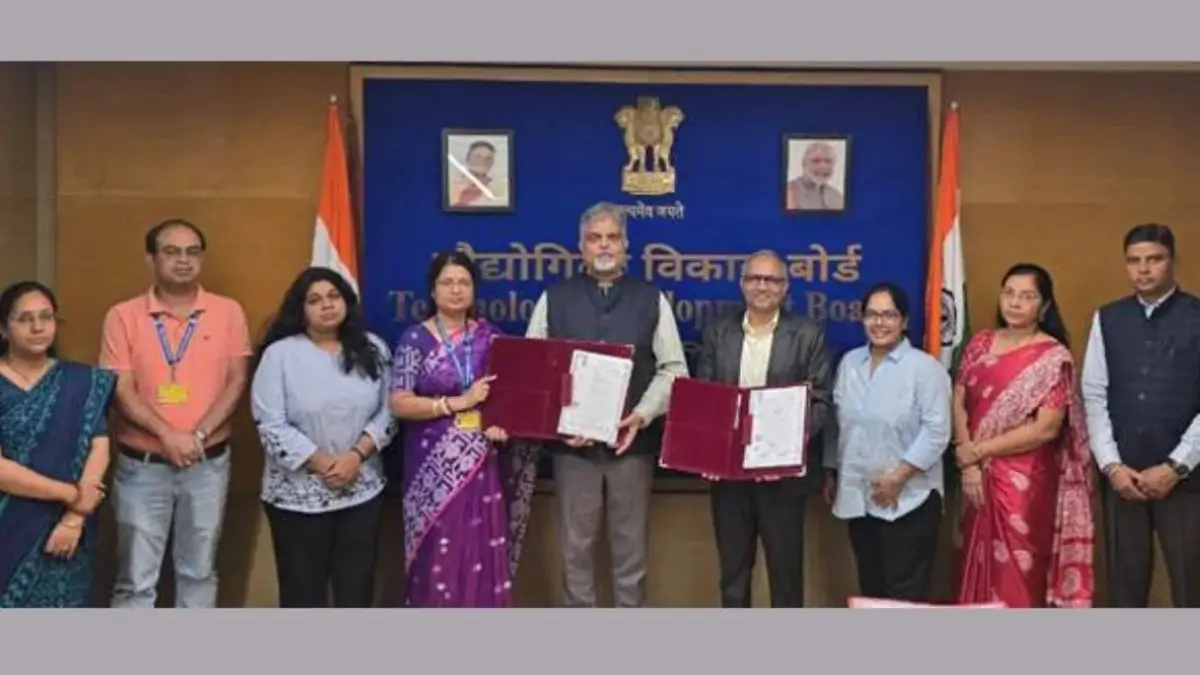
India is taking steps to boost its domestic space intelligence capabilities with an Artificial Intelligence-based Electronic Intelligence (AI-ELINT) satellite constellation project. Under the project, the Technology Development Board (TDB) under the Department of Science and Technology (DST) has signed an agreement with Bengaluru-based Astrome Technologies Pvt. Ltd to offer it funding worth INR 64.05 crore under its RDI Fund. The project is estimated to cost INR 128.11 crore and aims to build an indigenous satellite network.
AI-ELINT Satellite Network Overview
The project involves deploying micro satellites, of ~50kg, which operate in the Low Earth Orbit (LEO). This will form a network of multiple satellites.
This project will involve,
- Electronic Intelligence (ELINT) payload – This detects and analyses electronic signals across a wide frequency spectrum.
- Artificial Intelligence based ground processing tools – To analyse the data collected by the satellites.
- Communication capability between the satellites.
As the number of satellites increases, the network will allow greater coverage and revisit capability. This project will enable continuous surveillance of targeted areas.
Funding & Technology
- Funding by TDB: INR 64.05 crore
- Total Project Cost: INR 128.11 crore
- Technology Readiness Level: TRL-4 to TRL-9
- Funding will be provided in the form of Optionally Convertible Debt (OCD) under the RDI Fund. The TDB will cover around 50% of the project cost.
What is Technology Readiness Level?
It is a 9 point scale used to judge how developed a piece of technology is.
| Overview | TRL Level |
| Basic research & proof of concept: | TRL 1-3 |
| Technology validation & prototyping | TRL 4-6 |
| System demonstration, qualification & deployment | TRL 7-9 |
The project aims to take its key technologies from TRL-4 to TRL-9.
What is Optionally Convertible Debt?
Optionally Convertible Debt is a type of debt which offers an option to convert the debt into equity.
This means that an organisation is able to provide financial support to a company without having to gain any equity.
Research, Development and Innovation (RDI) Fund Overview
The RDI Scheme was approved on 1st July 2025 by the Union Cabinet with total spending of INR 1 Lakh Crore over 6 years. It was officially launched by Prime Minister Narendra Modi on 3rd November 2025.
The aim of the scheme is to incentivise private sector involvement in research, development and innovation, specifically within strategic and emerging technology.
Key Objectives,
- Long term and low cost finance for research and innovation.
- Allows the private sector investment in impactful technologies.
- Encourage domestic technology development.
- Improve technological independence in India.
- Support deep tech startups and strategic technologies.
The Technology Development Board (TDB) and Biotechnology Industry Research Assistance Council (BIRAC) have been approved as Second Level Fund Managers.
Technology Development Board Overview
The Technology Development Board is a statutory body within the Department of Science and Technology (DST) in the Ministry of Science and Technology.
- Formed: 1st September 1996
- Legislation: Technology Development Board Act 1995
- Department: Department of Science and Technology
- Ministry: Ministry of Science and Technology
- Main Objective: Encourage development and commercialisation of domestic technologies.
The Technology Development Board offers financial assistance to industries and organisations who are developing technology.





 New COVID-19 Variant PJ.2.1: Symptoms, S...
 Antarctic Ozone Hole Ranks Seventh Large...
 Asteroid 2026 QQ8 Becomes Earth's Tempor...