
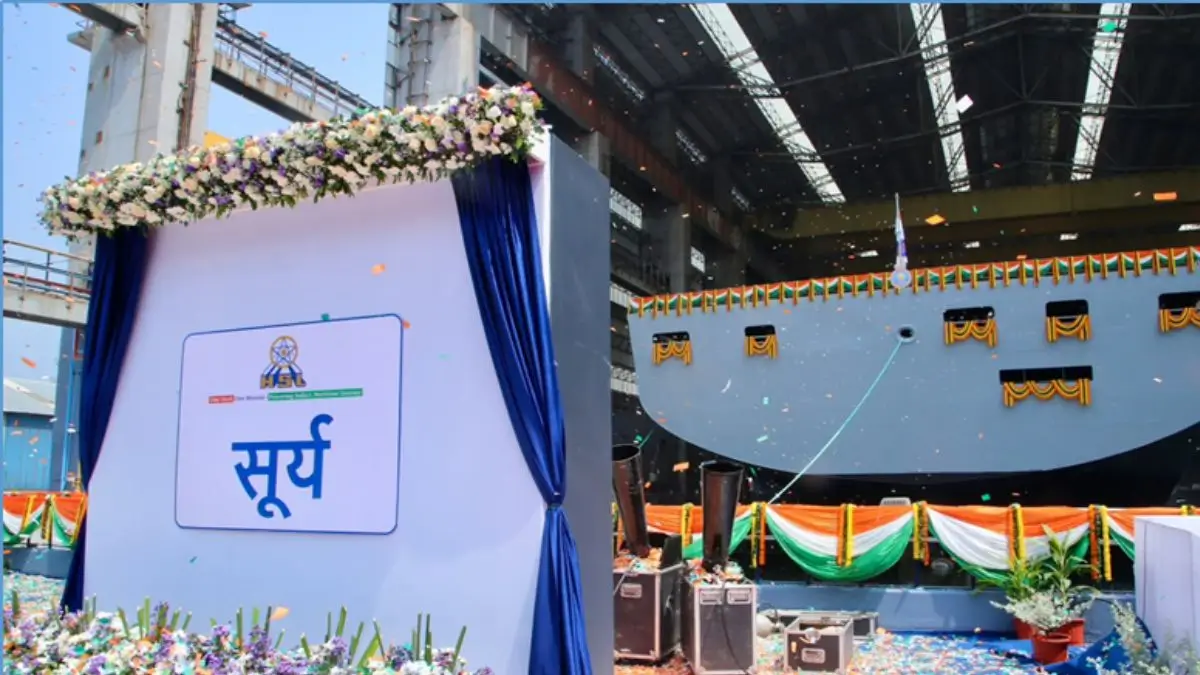
India’s Defence Minister, Mr. Rajnath Singh, has commissioned the first of its kind indigenous Fleet Support Ship (FSS-1) of Indian Navy called ‘Surya’ from Hindustan Shipyard Limited, Visakhapatnam. This is the first ship of the Surya class of Fleet Support Ships and is meant to provide logistical support to the Indian Navy’s task force which is far away from the naval base.
The commissioning of this warship is a significant development in India’s capability to build warships and maritime logistics capacity. A Fleet Support Ship allows warships to replenish themselves in high seas and reduces their reliance on reaching port for replenishment.
What is a Fleet Support Ship?
A Fleet Support Ship (FSS) is a large naval auxiliary warship which serves mainly for underway replenishment (UNREP).
The warship will have the ability to provide essential requirements like,
- Fuel and aviation turbine fuel (ATF)
- Fresh water
- Ammunition
- Provisions
- Dry stores
- Spares
The underway replenishment allows the combat ships to stay at sea for longer durations without affecting their preparedness.
The Capabilities of Underway Replenishment
The foremost operationally useful feature of ‘Surya’ is its underway replenishment capability.
The ship is capable of replenishing liquid and dry goods in other naval ships when at sea. The replenishment capabilities of the ship include the alongside, stern and vertical replenishment (VERTREP).
This will ensure that more than one warship receives necessary supplies without having to interrupt their deployment.
Replenishing the warships with fuel, water, ammunition and provisions can help extend the reach of naval task forces significantly.
Understanding VERTREP
Vertical Replenishment (VERTREP) is the supply transfer between ships using helicopters.
In contrast to alongside replenishment where ships operate in close quarters, VERTREP involves the supply transfer through helicopters in the air, adding flexibility to maritime operations.
Aviation and Medical Facilities
The ship has a spacious flight deck and hangar to accommodate multi-role helicopters.
These aviation facilities will be used for carrying out the replenishment tasks, along with other naval tasks.
The ship also has hospital and casualty care facilities, giving the ship an additional role in humanitarian assistance and disaster relief operations.
These capabilities will come handy during,
- Natural Disasters
- Evacuation Operations
- Maritime Emergencies
- Humanitarian Operations
- Massive Relief Operations
Maintenance At Sea Capability
The next significant aspect is that there are engineering and electronics workshops available on board.
They will be capable of providing first-line maintenance, defect correction and combat repairs for ships of the navy operating on the deployment.
It will help to avoid the necessity of constant return to a naval base of ships carrying out logistical functions due to technical problems and improve fleet readiness during the deployment period.
Self-Protection and Survivability
Despite the fact that the Fleet Support Ship is not a combat ship but rather a logistic platform, its operations may occur in a dangerous maritime environment.
That is why the ‘Surya’ is equipped with the self-protection and survivability system which includes close-in weapon systems, decoy and anti-torpedoe systems.
Importance for India’s Blue-Water Navy
‘Surya’ holds importance for India’s blue-water navy capabilities.
Naval fleets that operate in distant marine regions need logistical support during their deployment. The role of a fleet support ship is similar to that of a mobile logistic base that allows combat ships to stay operational for a longer period of time.
This holds true especially for India’s interests in the Indian Ocean Region (IOR) and the broader Indo-Pacific region.
‘Surya’ will be useful for,
- Longer deployments of naval formations
- Endurance of carrier battlegroups
- Operational activities away from India
- Humanitarian assistance and disaster relief
- India’s overall maritime footprint under the SAGAR approach








 Sanjay Seth to Inaugurate SAREX-2026 off...
 Air Marshal Ashutosh Dixit Appointed Nex...
 Raksha Mantri Launches First Indigenous ...










