
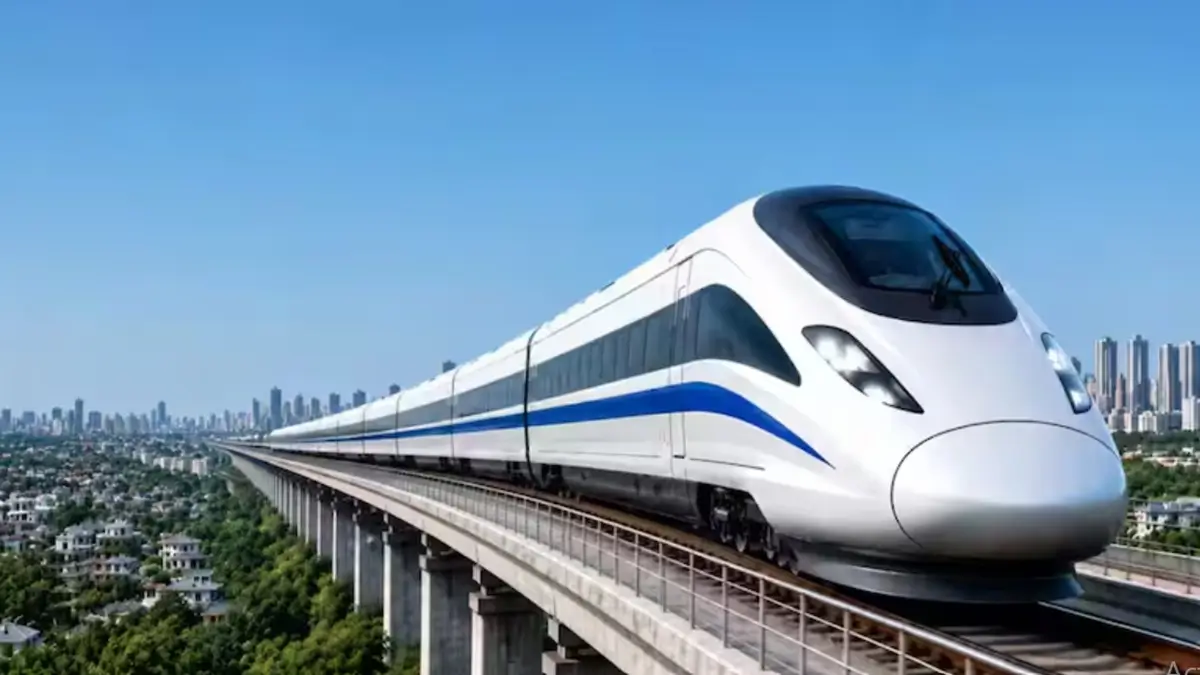
India is preparing to significantly expand its high-speed rail network with seven proposed bullet train corridors that will connect major metropolitan cities across the country. The National High Speed Rail Corporation Limited (NHSRCL) has initiated the process to develop India’s next-generation B35 Bullet Train, which will be designed and manufactured domestically to operate on these future high-speed rail routes.
The new trainsets are expected to have a maximum design speed of 350 km/h and an operational speed of 320 km/h, making them among the fastest trains planned for India.
India’s 7 Proposed Bullet Train Corridors
The proposed high-speed rail network includes the following seven corridors:
| S. No. | Bullet Train Corridor | Expected Travel Time |
|---|---|---|
| 1 | Mumbai – Pune | 48 Minutes |
| 2 | Pune – Hyderabad | 2 Hours 8 Minutes |
| 3 | Hyderabad – Bengaluru | 2 Hours 10 Minutes |
| 4 | Hyderabad – Chennai | Proposed |
| 5 | Bengaluru – Chennai | 73 Minutes |
| 6 | Delhi – Varanasi | 3 Hours 15 Minutes |
| 7 | Varanasi – Siliguri | Proposed |
Fastest Travel Times on Proposed Bullet Train Network
The proposed corridors are expected to drastically reduce travel time between major cities.
| Route | Expected Travel Time |
| Mumbai – Ahmedabad | 1 Hour 57 Minutes |
| Mumbai – Pune | 48 Minutes |
| Bengaluru – Chennai | 73 Minutes |
| Bengaluru – Hyderabad | 2 Hours 10 Minutes |
| Pune – Hyderabad | 2 Hours 8 Minutes |
| Delhi – Lucknow | 2 Hours |
| Delhi – Varanasi | 3 Hours 15 Minutes |
The high-speed network is expected to provide a faster alternative to both road and air travel for many intercity routes.
B35: India’s Next-Generation Bullet Train
The B35 Bullet Train is being developed by the National High Speed Rail Corporation Limited (NHSRCL) as India’s indigenous high-speed train for future corridors.
Key Features
- Maximum Design Speed: 350 km/h
- Operational Speed: 320 km/h
- Developed in India
- Designed for future high-speed rail corridors
- Improved passenger comfort and safety
- Advanced signalling and modern train control systems
The B35 trainsets are expected to become the backbone of India’s expanding bullet train network.
Mumbai–Ahmedabad Bullet Train Project
India’s first bullet train project—the Mumbai–Ahmedabad High-Speed Rail Corridor—is currently under construction.
Project Highlights
| Particulars | Details |
| Corridor Length | 508 km |
| First Operational Section | Surat – Vapi |
| Length of First Section | 97 km |
| Expected Operational Date | August 2027 |
| Implementing Agency | NHSRCL |
The Surat–Vapi stretch in Gujarat is expected to become India’s first operational bullet train section.
Benefits of the Proposed Bullet Train Network
The expansion of India’s high-speed rail network is expected to provide several benefits:
- Significant reduction in travel time.
- Improved regional connectivity.
- Faster business and economic movement.
- Promotion of domestic high-speed rail technology.
- Employment generation through infrastructure development.
- Reduced dependence on short-haul flights.
- Better integration of major economic corridors.
About NHSRCL
The National High Speed Rail Corporation Limited (NHSRCL) is the implementing agency responsible for planning, constructing, and operating high-speed rail projects in India.
It is spearheading the country’s bullet train programme, including the Mumbai–Ahmedabad High-Speed Rail Corridor and future proposed routes.
Key Highlights
- India plans to develop 7 new bullet train corridors.
- The B35 Bullet Train will be developed and manufactured in India.
- The train will have a maximum speed of 350 km/h and an operational speed of 320 km/h.
- Mumbai–Pune is expected to be covered in just 48 minutes.
- Bengaluru–Chennai travel time is expected to reduce to 73 minutes.
- The Mumbai–Ahmedabad Bullet Train Project is progressing, with the Surat–Vapi section expected to become operational by August 2027.








 National Strategic Trade Command Centre ...
 India Plans Mandatory Automatic Emergenc...
 India Notifies New Telecom Rules for Tes...










