
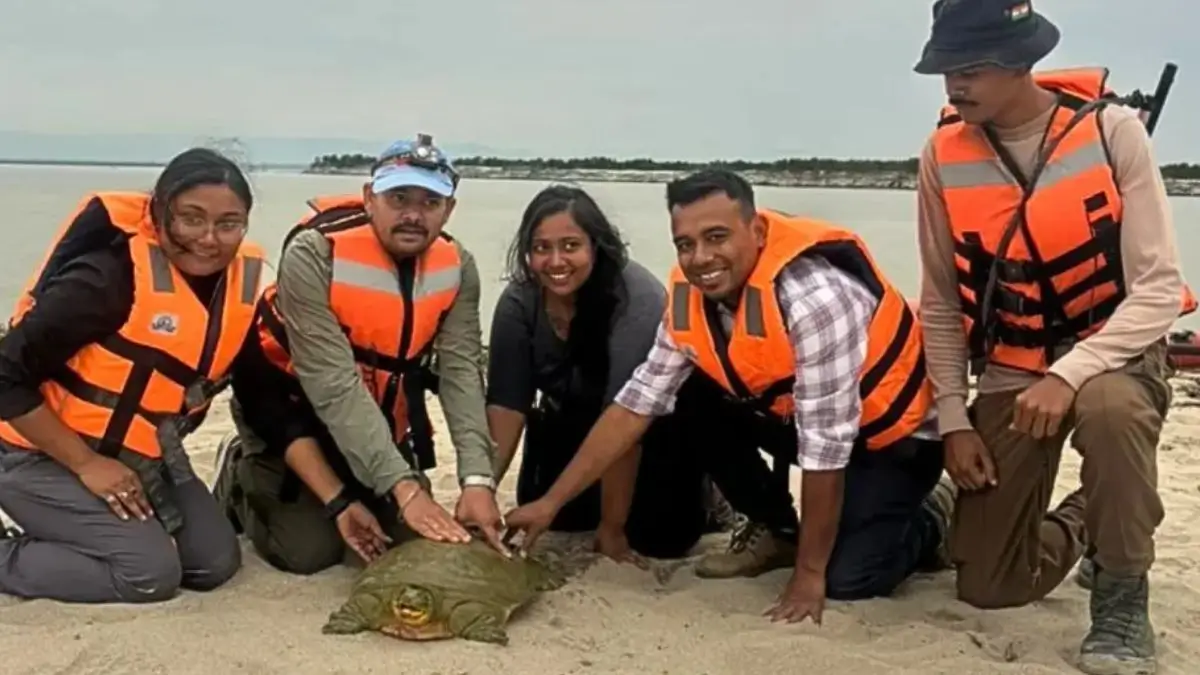
India’s first satellite tagged Ganges softshell turtle released in the Kaziranga National Park and Tiger Reserve. This initiative was launched on Endangered Species Day and it aims to track the movement and habitat of this rare species.
What Is the Ganges Softshell Turtle?
The Ganges softshell turtle (Nilssonia gangetica) is a unique freshwater species found across the India.
Key Features
- Distinct arrowhead-shaped markings on the head
- They are found in rivers, lakes and reservoirs.
- Mainly large and long-lived species.
Despite its wide distribution across India they are classified as endangered on the IUCN Red List.
Why Satellite Tagging Is Important
This initiative marks the first time in India that this species has been satellite tagged.
Objectives of Tagging
- Track seasonal movement patterns
- Identify the breeding and nesting sites
- Understand home range and habitat use
According to experts from the Wildlife Institute of India (WII), this data will help in better conservation planning in the Brahmaputra river basin.
How the Project Was Carried Out
The tagging operation involved the capturing a healthy adult turtle, also fitting a satellite transmitter under veterinary supervision and also releasing it safely back into its natural habitat.
The project was conducted by the,
- Ministry of Environment, Forest and Climate Change
- Assam Forest Department
- Kaziranga authorities
- Supported by the National Geographic Society
Kaziranga: A Key Habitat for Freshwater Turtles
Kaziranga is one of the most important regions for the turtle conservation.
Key Facts
- It is home to 5 out of 8 softshell turtle species found in India.
- It is located along the Brahmaputra river ecosystem.
- Also recognized globally for the its biodiversity.
This makes Kaziranga a priority conservation zone for the freshwater species.
Ecological Importance of Ganges Softshell Turtle
These turtles play a crucial role to maintaining ecosystem balance.
They,
- Act as natural scavengers
- Also feed on dead and decaying matter
- Help to clean river ecosystems
They are also considered as important indicators of freshwater health.
Additional Conservation Success Related to Hoolock Gibbon
In another encouraging signs, a Hoolock Gibbon was recently seen using the canopy bridge at the Hollongapar Gibbon Sanctuary.
Union Minister Bhupender Yadav also praised this as an example of how small and science-based interventions can support wildlife conservation.








 Lakshadweep Becomes India’s First 100%...
 Ayodhya Ram Temple Receives FSSAI’s â€...
 Ambaji Mohanthal Gets GI Tag: Gujarat’...










