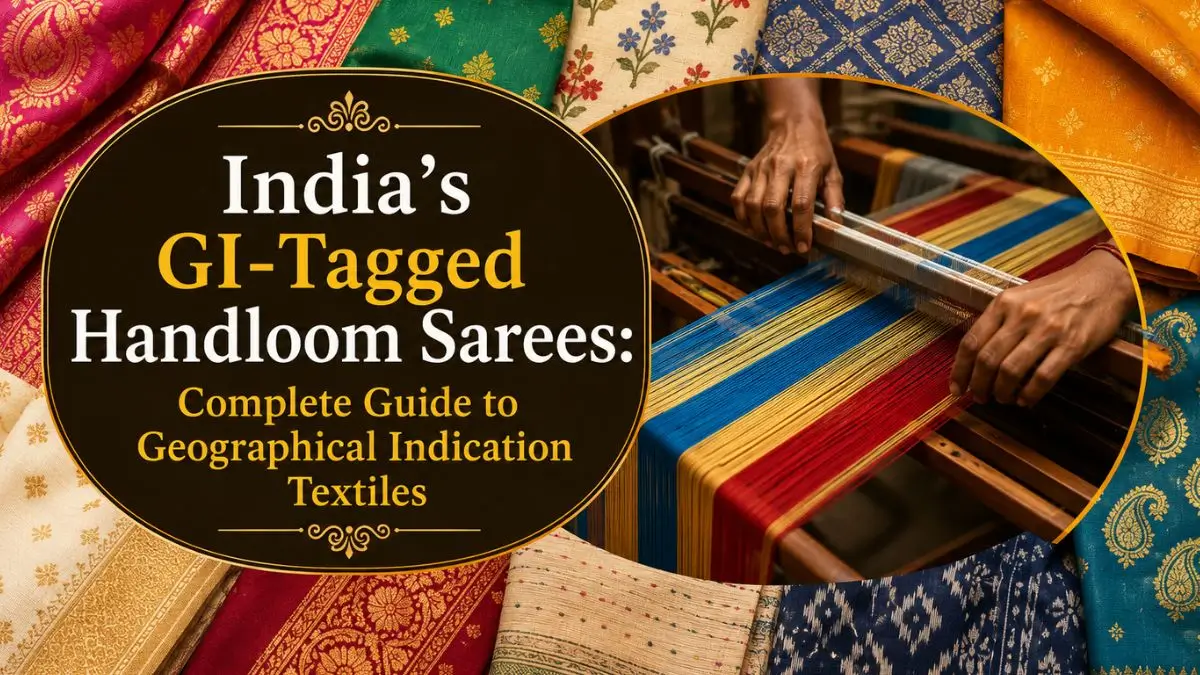
The handloom industry in India is one of the best illustrations of India’s rich cultural legacy and textile industry. This includes the Banarasi sarees of Uttar Pradesh, Kanjeevaram silk of Tamil Nadu and the various Pochampally Ikat as well as the famous double-ikat Patola of Gujarat.
A Geographical Indication (GI) tag is a form of intellectual property that associates the name, reputation and qualities of the product with its geographical location. In case of handlooms sarees, GI tagging could be helpful for the preservation of the technique and support of the communities involved in it as well as consumers against frauds.
What is a GI Tag?
Geographical Indication (GI) tag is the intellectual property tag assigned to a product that has originated in a particular geographical area. The product is supposed to have some distinct quality or reputation because of its origination in that particular place.
In India, the protection of Geographical Indications is provided under the Geographical Indications of Goods (Registration and Protection) Act, 1999.
For the traditional textile products, the GI protection may be obtained on the basis of,
- Traditional techniques of weaving
- Design and motifs specific to the region
- Materials and fibers used in production
- Dyeing and production process
- Reputation of the region related to the product
Thus, GI helps to separate the authentic products from those that only look like them.
Why is GI Tag Necessary for Handloom Sarees?
Handloom traditions in India have evolved over hundreds of years and are intimately linked to their community of origin.
GI tagging could serve various purposes,
- Protection of identity: It ensures that the name of the product is protected and maintains its reputation.
- Benefits artisans: It builds up the market identity of products produced by the traditional weaving community.
- Benefits buyers: Buyers can use the GI tag as one of the measures while identifying products from the region.
- Protection from infringement: Any infringement in the use of the geographical name of the product can be challenged legally.
- Cultural preservation: It ensures the perpetuation of traditional weaving skills.
Some Best Known GI Tagged Handloom Sarees of India
There are several GI tagged textile traditions in India. Some of the well-known sarees and textiles include the following.
1. Banarasi Saree – Uttar Pradesh
Banarasi saree originates from Varanasi and neighboring weaving districts of Uttar Pradesh. This saree is famous for its designs, silk fabric and zari work.
Traditionally, Banarasi sarees include designs inspired by the art traditions of India including floral patterns and Mughal designs.
Due to intricate weaving and ornamentation, Banarsi silk has become one of the most recognizable traditional fabrics in India.
2. Kanjeevaram Silk Saree – Tamil Nadu
The Kanjeevaram or Kanjivaram silk sarees are originated from Kanchipuram in Tamil Nadu.
These sarees are well known for their rich silk fabric, border, zari work and traditional motifs. The designs may also include temple designs, floral designs and other regional motifs.
The weaving traditions are an integral part of cultural heritage of Kanchipuram.
3. Chanderi Saree – Madhya Pradesh
The Chanderi sarees come from Chanderi district of Madhya Pradesh.
This saree is famous for its light weight and translucent quality. Traditionally, the Chanderi textiles can be produced using silk, cotton or combination of both.
4. Pochampally Ikat – Telangana
The Pochampally Ikat is one of the most famous resist dyeing and weaving traditions in India.
The tradition is associated with Pochampally and neighboring districts of Telangana region. The fabric is recognized for its characteristic geometric pattern, which was produced using the Ikat method.
Ikat is the method in which yarns are treated with resist dyes before weaving. The design appears after the weaving process.
5. Sambalpuri Saree – Odisha
The Sambalpuri saree represents traditional Ikat weaving tradition of Odisha.
The Sambalpuri textiles are well known for their characteristic Bandha tie and dye and traditional motifs. The designs can represent various symbols and patterns inspired by nature and culture of the region.
Common motifs are fish, elephant, conch shell, etc are included in it.
6. Paithani Saree – Maharashtra
The Paithani saree is woven in Paithan in Maharashtra and distinguished by its silk fabric and zari embroidery.
Peacock and lotus are among the traditional designs of the Paithani saree. Borders and richly embroidered pallu distinguish the saree.
Today Paithani is one of the important representatives of the traditional textiles of Maharashtra.
7. Patola Saree – Gujarat
Patola saree from Patan in Gujarat is one of the most skillful handloom traditions in India.
Double-Ikat Patola is characterized by its complex preplanning process because both warp and weft yarns are resist dyed and then the threads must be accurately aligned in order to create patterns.
Patan Patola is especially prized for its complex production process and specific skills involved.
8. Mysore Silk – Karnataka
Mysore silk is associated with the Karnataka tradition of weaving silk sarees and distinguishes itself by its smooth texture, pure silk fabric and zari embroidery.
This textile is one of the important parts of the silk heritage of Karnataka.
9. Ilkal Saree – Karnataka
Ilkal saree originates in Ilkal in Karnataka.
One of the characteristics of the traditional Ilkal saree is the combination of cotton body and silk pallu. Borders and traditional weaving technique are among the distinguishing features of the textile.
10. Kota Doria – Rajasthan
Kota Doria is one of the fabrics originating in Kota in Rajasthan.
This textile is distinguished by its lightweight quality and square check pattern created by its traditional weaving technique.
Its airy quality makes this fabric especially popular in warm climate regions.
11. Bengal Handloom Sarees – West Bengal
The handloom tradition in West Bengal is rather diverse; among the representatives of this tradition are Bengal cotton and Tant sarees.
Tant sarees are traditionally distinguished by their lightness, breathability and borders.
GI Tag vs Handloom: Are They Identical?
No, both concepts are not identical.
A GI marks and safeguards the geographical location as well as features related to the product. The other concept of certification and labeling in relation to handloom focuses on certain production and marketing aspects of textiles.
It is thus clear that consumers cannot presume that all products bearing a geographical name are handloomed or that all handloomed sarees have a GI tag.








 Vande Bharat vs Amrit Bharat Express: Ke...
 Asian Games to LA28: Which Sports Earned...
 Guava Capital of India: Which Place Is K...