
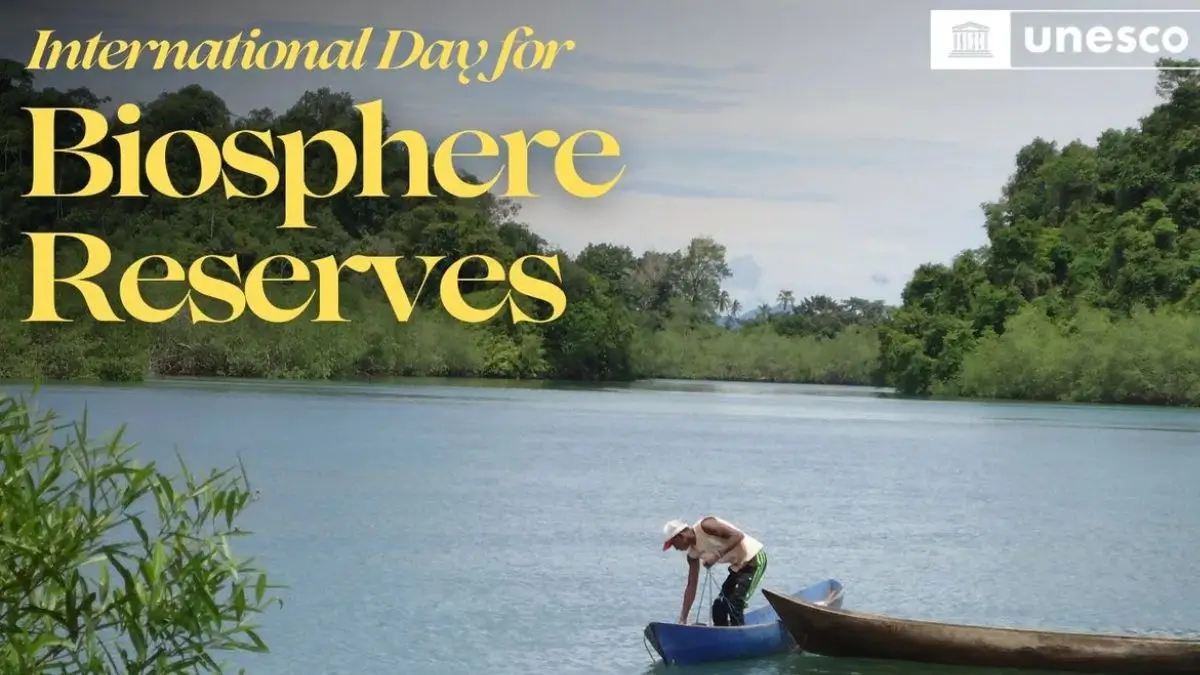
The International Day for Biosphere Reserves is celebrated every year on 3rd November. This was declared by UNESCO at its 41st General Conference in 2021 (Resolution 37). The first International Day for Biosphere Reserves was celebrated on 3rd November 2022 to mark the end of the 50th anniversary celebrations of the UNESCO Man and the Biosphere Programme. This day aims to celebrate sustainable development in harmony with humans and nature.
Why is International Day for Biosphere Reserves Celebrated?
Biosphere reserves show how natural resources can be managed in a sustainable way to help preserve biodiversity whilst allowing human activity.
This helps countries, institutions and communities understand how to develop in a sustainable way. Biosphere reserves also demonstrate the importance of scientific research, awareness raising and community engagement.
There are currently 797 biosphere reserves within the UNESCO’s World Network of Biosphere Reserves across 145 countries (June 2026). This covers around 7.5 million square kilometres which means that over 5% of the Earth’s landmass.
What are Biosphere Reserves?
Biosphere reserves are land, sea or coastal areas designated under UNESCO’s Man and Biosphere (MAB) programme. They aim to conserve biodiversity and cultural diversity whilst also developing in a sustainable way.
They are often referred to as “living laboratories” for sustainable development.
Biosphere reserves are nominated by their country’s government. They are part of the country and therefore UNESCO do not own them.
Three key roles of Biosphere Reserves
Biosphere Reserves have three functions under the UNESCO MAB programme.
Role and It’s Key Points
- Conservation: Biodiversity, genetic resources, species, ecosystems and landscapes are protected.
- Development: Sustainable development is encouraged to improve economic development and benefit communities.
- Logistic Support: Scientific research, environmental monitoring, education and training is supported.
This links together conservation and communities and scientific knowledge.
Three zones of Biosphere Reserves
Biosphere Reserves have three zones,
Zone and It’s Key Points
- Core Zone: An area that is legally protected to help conserve ecosystems, species and genetic diversity over time.
- Buffer Zone: Surrounds or borders the core zone. Research, education, environmental monitoring and sustainable activities are supported.
- Transition Zone: This is the outer zone where communities live, and sustainable economic and human activities take place.
This means areas of ecological importance can be preserved whilst activities that do not cause conflict can take place in surrounding areas.
UNESCO Man and the Biosphere Programme (MAB)
The Man and the Biosphere (MAB) programme is an intergovernmental scientific programme launched by UNESCO in 1971. It aims to improve the relationship between people and their environment using science.
It uses natural and social sciences to encourage sustainable resource management and conserve biodiversity.
Key objectives of MAB:
- Conserve biodiversity and ensure ecosystems are healthy.
- Encourage sustainable development.
- Encourage scientific research.
- Environmental education and training.
- Improve collaboration between governments, scientists and communities.
- Biosphere reserves are recognised under this programme by UNESCO. They are linked through UNESCO’s World Network of Biosphere Reserves (WNBR).
Biosphere Reserves in India recognised by UNESCO
India has 18 notified biosphere reserves. 13 of these are part of UNESCO’s World Network of Biosphere Reserves. The most recent addition was the Cold Desert Biosphere Reserve in Himachal Pradesh (September 2025).
List of India’s 13 recognised biosphere reserves by UNESCO:
- Nilgiri Tamil Nadu, Kerala and Karnataka
- Gulf of Mannar Tamil Nadu
- Sundarbans West Bengal
- Nanda Devi Uttarakhand
- Nokrek Meghalaya
- Pachmarhi Madhya Pradesh
- Similipal Odisha
- Achanakmar-Amarkantak Madhya Pradesh & Chhattisgarh
- Great Nicobar Andaman and Nicobar Islands
- Agasthyamalai Kerala & Tamil Nadu
- Khangchendzonga Sikkim
- Panna Madhya Pradesh
- Cold Desert Himachal Pradesh
Note: There are 18 biosphere reserves notified in India. One of these is the Great Rann of Kutch in Gujarat however this is not part of UNESCO’s World Network.
World Network of Biosphere Reserves (WNBR)
The World Network of Biosphere Reserves (WNBR) consists of sites recognised under UNESCO’s Man and Biosphere Programme.
It encourages international collaboration, sharing knowledge and learning from best practice.
Global statistics of UNESCO Biosphere Reserves (2026)
- Biosphere Reserves: 797
- Countries: 145
- Area Covered: 7.5 million
- Directly benefit from site: 300 million






 World Jellyfish Day 2026: Date, History,...
 International Day to End Impunity for Cr...
 Important Days in November 2026: Nationa...