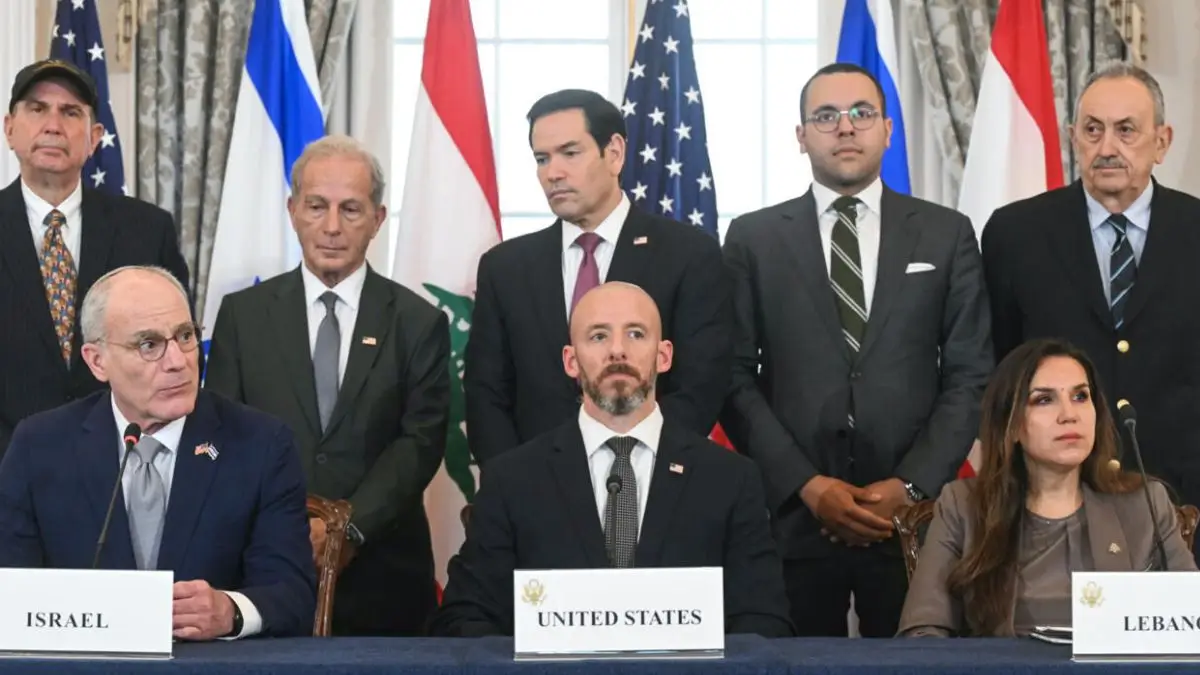
After several months of escalating violence between Israel and Lebanon, the United States has brokered a Trilateral Framework Agreement with Israel and Lebanon and described it as the first step towards long-term peace and stability. It was signed in Washington 26th June, 2026 and the agreement outlines a phased roadmap for to restoring the Lebanese state authority, reducing the military tensions along the border areas and creating conditions for lasting security.
What Is the Israel-Lebanon Trilateral Framework?
The Trilateral Framework is a US-mediated political and security agreement that was signed by representatives of the United States, Israel, and Lebanon.
Rather than being as a final peace treaty, it establishes the structured roadmap which aimed at to reducing hostilities, restoring Lebanese sovereignty and addressing long-standing security concerns along the Israel-Lebanon border.
US Secretary of State Marco Rubio has described the agreement as “the beginning of the beginning,” and emphasizing that it is an initial but significant step towards regional stability.
Why This Agreement Was Needed?
Since March 2026, intense fighting between Israel and Hezbollah has caused multiple severe humanitarian and security challenges.
According to reports,
- More than 4,000 people have been killed in the Lebanon.
- Thousands have been displaced from original places.
- Infrastructure has also suffered the extensive damage.
- Cross-border exchanges of fire have raised fears of a broader regional war.
The agreement seeks to halt this cycle of violence along with it creating mechanisms to prevent the future escalation.
Key Provisions of the Trilateral Framework
The framework introduces a phased and conditional process rather than an immediate military withdrawal.
1. Gradual Israeli Military Redeployment
Israel has agreed to progressively redeploy the its forces from Lebanese territory.
However, withdrawals will occur only after the specific security conditions are set to met.
2. Lebanese Armed Forces to Assume Control
The agreement envisages the Lebanese Armed Forces (LAF) gradually taking control of those areas which are currently affected by conflict.
This aims to strengthen the state authority across Lebanese territory.
3. Disarmament of Non-State Armed Groups
One of the most important provisions is the requirement for the verified disarmament of non-state armed groups.
Although the agreement does not involve Hezbollah directly and it explicitly identifies the organization as the non-state armed group whose military infrastructure must eventually be dismantled.
This provision remains as the most controversial aspect of the framework.
4. Pilot Security Zones
This agreement introduces two initial pilot zones where,
- The Israeli forces will withdraw.
- Lebanese security forces will take over.
- Progress will be monitored before expanding the arrangement.
Additional zones may be implemented with the mutual agreement.
5. US-Supported Military Coordination Group
A joint military coordination mechanism with US participation will also supervise the implementation, monitor compliance and addresses the security concerns during the transition.
6. Humanitarian Assistance
The United States has also pledged $100 million in humanitarian assistance to support the Lebanon’s recovery and help communities affected by months of conflict.
How Have the Key Players Reacted?
United States
Washington views this framework as a practical roadmap to reduce the violence while strengthening Lebanon’s institutions.
US officials believe the agreement offers the greater regional stability, improved border security and a pathway towards reconstruction.
Israel
Israeli Prime Minister Benjamin Netanyahu has also welcomed the agreement but he stressed that Israel would not completely withdraw from Lebanon until Hezbollah is fully disarmed and no longer poses a threat.
Israel also argues that its military operations were carried out in response to attacks launched by Hezbollah.
Lebanon
Lebanese President Joseph Aoun has described this framework as the first step towards to restoring Lebanon’s sovereignty across its territory.
He expressed hope that displaced citizens would eventually be able to return safely to their homes once stability is restored in the region.
Hezbollah
Hezbollah has strongly rejected the agreement.
The group described it as the “non-existent,” and they vowed to continue resisting Israeli military presence.
Strategic Importance of the Agreement
This framework extends beyond the bilateral security concerns.
- Strengthening Lebanese State Authority
- Reducing Regional Tensions
- Enhancing US Diplomatic Role
- Supporting Reconstruction








 Who Is Katie Zacharia? Trump Names New W...
 Panama Earthquake 2026: 7.7-Magnitude Qu...
 Akie Abe Unveils Shinzo Abe Memorial Cor...