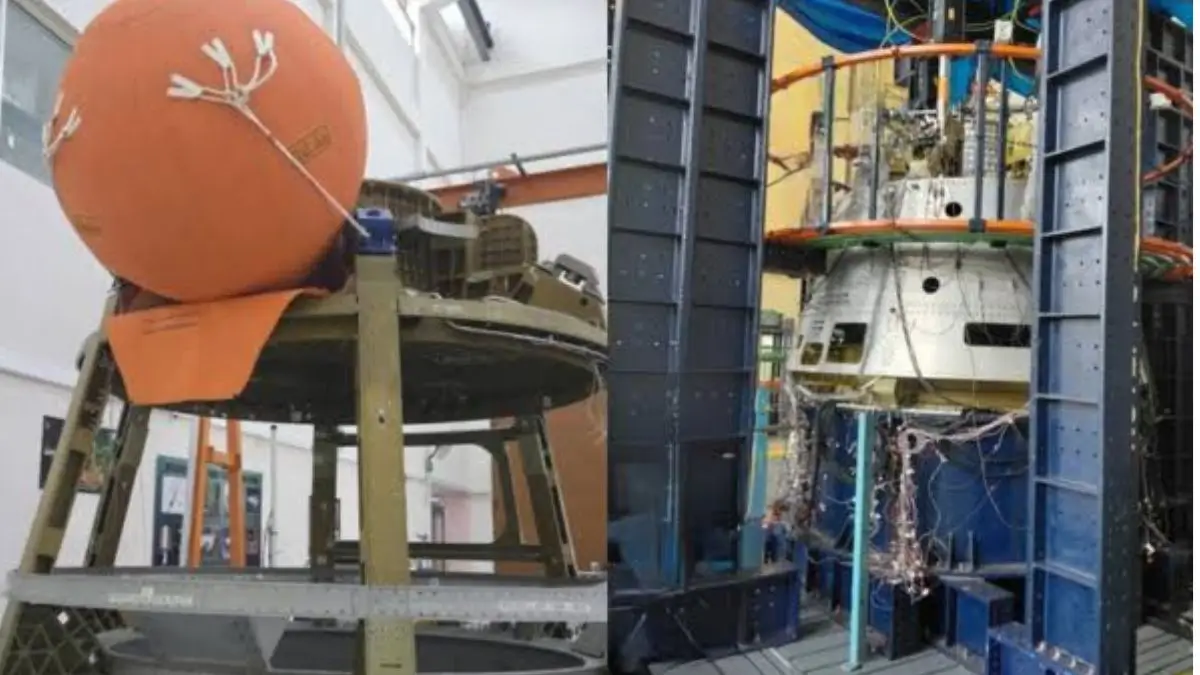
The Indian Space Research Organization (ISRO) has successfully completed three major qualification tests for the Gaganyaan Crew Module, with this it marks the country’s preparations for its first human spaceflight mission. It was conducted on 12th of July, 2026, the tests validated the key safety systems, including the Crew Module Uprighting System (CMUS), the umbilical separation mechanism and the apex cover separation system. These technologies are essential for the ensuring astronaut safety during splashdown, atmospheric re-entry, and parachute deployment, and it bringing the Gaganyaan mission one step closer to the launch.
What Did ISRO Test?
ISRO had carried out three critical system-level tests, which are designed to verify the reliability and safety of the Gaganyaan Crew Module during different mission phases.
The successful tests covered the,
- Crew Module Uprighting System (CMUS)
- Crew-Service Umbilical Unit (CSU-2) Separation Mechanism
- Apex Cover Structural Integrity
Each system performs the crucial function during the spacecraft’s return to the Earth and safe recovery after landing in the sea.
Crew Module Uprighting System (CMUS): Ensuring Safe Splashdown
The first and most important test involved the Crew Module Uprighting System (CMUS).
Why Is It Important?
After the Crew Module lands in to the sea, it must remain in an upright position to ensure the safety of astronauts during recovery operations.
If the capsule were to float upside down or tilt excessively, it could delay the rescue efforts and compromise crew safety.
How the System Works
ISRO had developed a stored cold-gas-based uprighting system that automatically inflates the flotation devices using compressed gas.
During the qualification test,
- High-pressure gas stored in the cylinders was released.
- Control valves activated the inflation sequence.
- Floatation devices also inflated successfully.
- The system demonstrated its ability to keep the Crew Module upright after splashdown.
This is one of the most critical safety features for India’s first human spaceflight mission.
Successful Test of Crew-Service Umbilical Separation Mechanism
The second major milestone involved validating the Crew-Service Umbilical Unit (CSU-2) separation system.
What Is the Umbilical Mechanism?
The umbilical mechanism acts as the physical interface between,
- Crew Module (CM) – where astronauts will stay
- Service Module (SM) – which provides propulsion, electrical power and mission support
Why Is Separation Necessary?
Before atmospheric re-entry,
The Service Module separates from the Crew Module.
- CSU-1 disconnects first.
- CSU-2 separates shortly before re-entry.
ISRO has confirmed that,
- CSU-2 separated cleanly.
- The Crew Module structure remained stable.
- Mechanical interfaces functioned as it designed.
This successful validation is essential for to ensuring a safe transition from orbital flight to Earth re-entry.
Apex Cover Separation Test Successfully Completed
The third qualification test had also validated the Apex Cover Separation System.
What Is the Apex Cover?
The apex cover is the protective structure that is located on top of the Crew Module.
Its primary function is to safeguard the,
- Parachutes
- Deployment mechanisms
- Other recovery subsystems
during launch and orbital flight.
Why Is Separation Critical?
Before the parachutes deploy during descent,
- The apex cover must separate perfectly.
- Any failure could prevent the parachute deployment.
- Safe deceleration of the Crew Module depends on this sequence.
The latest test confirmed that,
- The structure has maintained its integrity.
- Separation occurred as it was intended.
- The system met mission safety requirements.
Why These Tests Matter for Gaganyaan
Human spaceflight missions require extremely high levels of reliability because astronaut safety depends on the every system functioning flawlessly.
These three successful qualification tests significantly strengthen the mission readiness by validating systems responsible for the,
- Safe ocean recovery
- Controlled atmospheric re-entry
- Successful parachute deployment
- Structural stability
- Crew survival during post-landing operations
These milestones reduce mission risk and improve the confidence ahead of the crewed launch.
About the Gaganyaan Mission
Gaganyaan is India’s first indigenous human spaceflight programme being developed by ISRO.
Mission Objectives
The mission aims to:
- Demonstrate India’s human spaceflight capability.
- Send Indian astronauts (Gaganyatris) into low Earth orbit.
- Safely return the crew to Earth after completing the mission.
The programme represents one of India’s most ambitious space initiatives and places the country among a select group of nations with independent human spaceflight capability.






 Elon Musk to Rename SpaceXAI as SpaceXSI
 Kerala Develops AI-Based Dengue Early Wa...
 SpaceX Starship Reaches Orbit for First ...