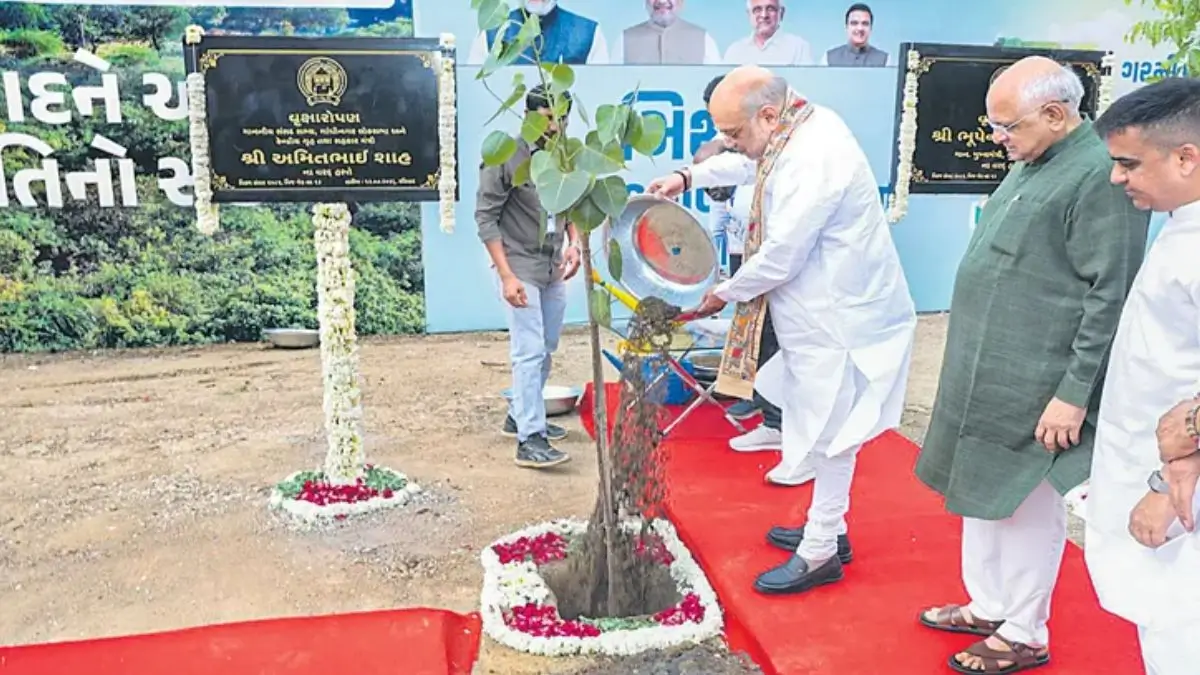
Ahmedabad has made the its entry into the Guinness World Records by planting 361,000 saplings in a single hour, and establishing a new world record for the largest Miyawaki action for plantation in an hour. This initiative was organized by the Ahmedabad Municipal Corporation (AMC) on July 12, 2026, and was held at Bhadaj near the Gota-Godhavi Canal under the guidance of Honorable Union Home Minister Amit Shah. The operation was carried out with the involvement of more than 25,000 volunteers and established a new record for large scale Miyawaki plantation drive.
Ahmedabad Sets a New Guinness World Record
The record-breaking plantation drive organized as the part of Ahmedabad’s ongoing efforts to increase the green cover in city and combat the effects of the climate change.
Key Highlights
- Saplings planted: 361,000
- Time taken for sampling plantation: Exactly one hour
- Date: July 12, 2026
- Location: Bhadaj, Ahmedabad, Gujarat
- Organizer: Ahmedabad Municipal Corporation (AMC)
- Method used: Miyawaki afforestation technique
- Volunteers: More than 25,000
This achievement has officially surpassed the previous Guinness World Record for the highest number of the saplings planted in one hour.
Massive Public Participation
Huge participation in the plantation activity made the record achievement feasible.
The number of volunteers was more than 25,000, thus making it as among the biggest ever environmental campaigns led by the local community in India.
Among the participants were, students from different schools; NCC cadets, law enforcement officers, government officials, representatives of organizations and local residents.
Such intense participation from the public allowed the thousands of saplings to be planted successfully in the allotted time of one hour.
Plantation Site and Area Covered
The Ahmedabad Municipal Corporation (AMC) has selected the Gota-Godhavi Canal area in the Thaltej Ward for the plantation campaign.
Area details
- Total Site Area: 91,006 sq. metres
- Core Plantation Area: 76,000 sq. metres
- Saplings Planted: 361,000
- Tree Species: 35 indigenous species
The carefully planned site was also designed to maximize tree density while promoting the long-term ecological restoration.
What is Miyawaki Method?
Miyawaki Method is a method of the afforestation which was introduced by Japanese botanist, Dr. Akira Miyawaki, in the 1970s.
The method works by planting a variety of native plants in a single area to create the forests which are almost like natural forests.
Main Characteristics of Miyawaki Method
- Use of local species
- Plant dense forests in smaller areas
- Trees that grow 10 times faster
- Local forests turn out to be 30 times denser than normal forests
- Little maintenance needed afterwards
- Promotes biodiversity and improves soil quality
These features contributes to the fact that the Miyawaki method is widely used in the afforestation projects worldwide.
Indigenous Species for the Climate of Gujarat
The plantation also involved the participation of 35 local species of trees adapted to the climate of Gujarat.
The use of local tree species provides the following advantages,
- Adaptation to the weather
- Higher survival rate
- Higher biodiversity level
- Better habitat for birds and animals
- Higher resistance to pests








 Government Unveils 2026-2030 Strategy to...
 Health Ministry to Launch JOSH Teams for...
 PM Modi Completes 25 Years as Head of Go...