
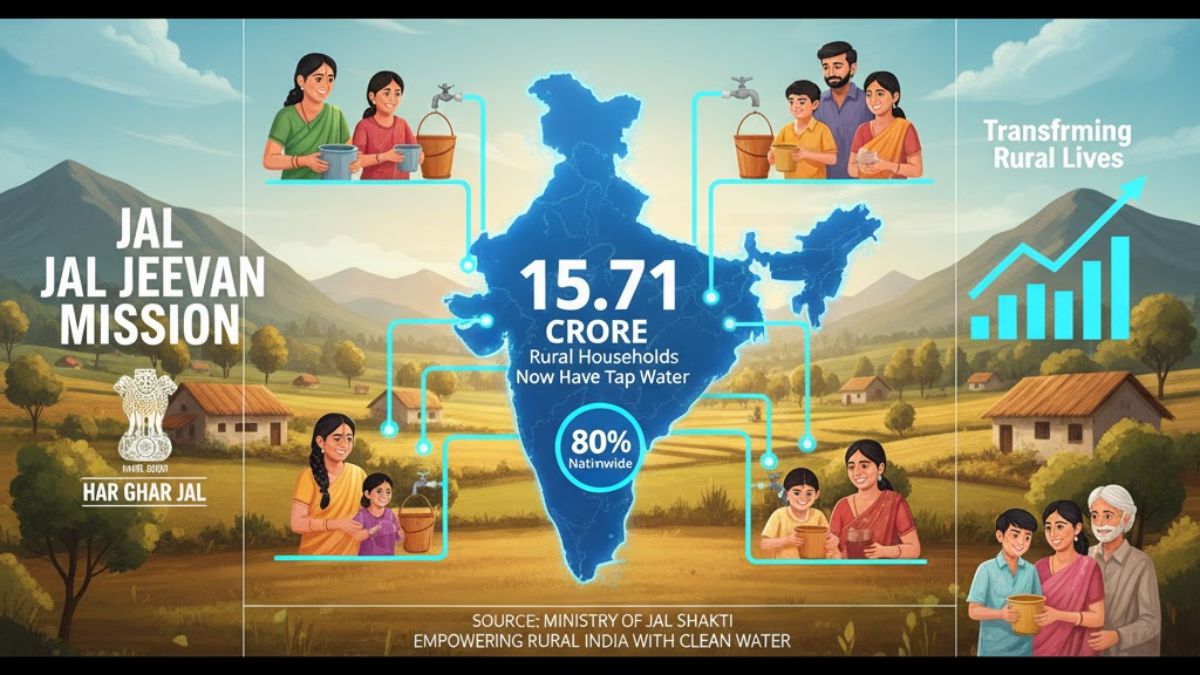
The Jal Jeevan Mission (JJM) has achieved a major milestone: over 15.71 crore rural households now have tap water connections, translating to more than 80% national coverage. This reflects a rapid transformation in rural water access since the mission’s launch in August 2019. As the infrastructure nears completion, the focus is now shifting towards sustainability, service reliability, and local governance.
The Next Phase: From Taps to Trust
While connecting homes to piped water was the first challenge, ensuring that water flows consistently and safely is the next. The mission’s new priorities include,
- Sustainability: Ensuring water sources remain viable and protected over time.
- Functionality: Guaranteeing that systems deliver water daily, not just exist on paper.
- Service delivery: Providing water that meets quality standards and is accessible at all times.
This shift requires stronger institutions, trained personnel, and community engagement at the village and district levels.
Districts in Focus: The Peyjal Samvad
Recognizing the critical role of district administrations, the Ministry of Jal Shakti held the first-ever District Collectors’ Peyjal Samvad in New Delhi. This platform aims to,
- Strengthen district-led implementation and accountability.
- Encourage cross-learning among districts through case studies and innovation showcases.
- Build peer networks to improve problem-solving and governance.
District Collectors are now seen as the connective link between national policy and local delivery, ensuring not just tap water access but consistent, reliable service.
Tools for Better Governance
To support this governance shift, several reforms are underway,
- Dashboards track supply, coverage, and complaints in real-time.
- Village-level monitoring is integrated with digital platforms like eGram Swaraj.
- Grievance redressal systems and citizen feedback apps ensure accountability.
- Convergence with other schemes (PM Gati Shakti, watershed programmes) boosts impact.
- Training and knowledge exchange help districts replicate successful models nationwide.
These tools are designed to ensure that once a tap is installed, it continues to work long-term — reliably and sustainably.
Key Takeaways
- Jal Jeevan Mission was launched in August 2019.
- As of October 2025, over 15.71 crore rural households have tap water.
- This covers more than 80% of all rural households in India.
- The goal is to provide 55 litres per person per day of safe drinking water.


 Ministry of Textiles Extends RoSCTL Sche...
 Delhi Government Launches the Lakhpati B...
 What Is Amrit Bharat Station Scheme? Gov...











