
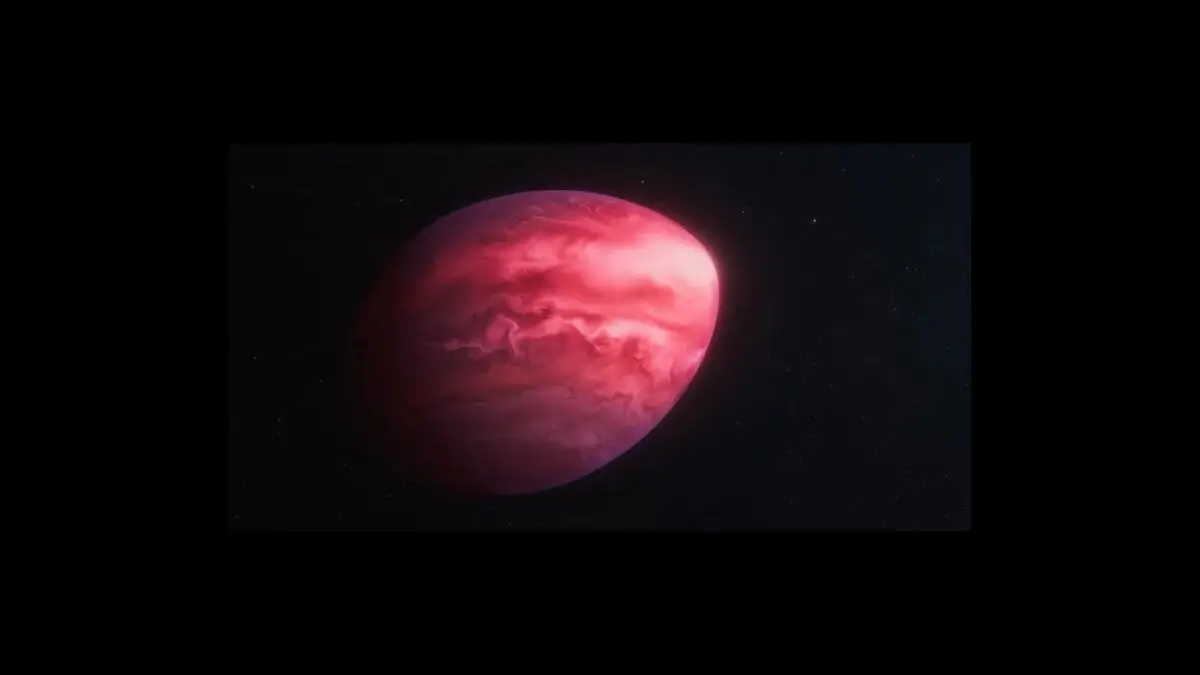
A groundbreaking discovery astronomers using the James Webb Space Telescope have identified one of the most unusual planets ever observed. An exoplanet stretched into a lemon like shape due to intense gravitational forces. The discovery highlights the telescope’s unparalleled ability to study extreme cosmic environments and expands our understanding of how diverse planetary systems can be.
About the Newly Discovered Planet
- The newly discovered planet is named PSR J2322-2650b.
- It is roughly Jupiter sized but orbits its host pulsar at an extraordinarily close distance of about one million miles, which is just 1% of the Earth Sun distance.
- Due to this proximity the planet completes one orbit in just 7.8 Earth hours, making its ‘year’ shorter than a typical workday on Earth.
Why the Planet Is Lemon Shaped
- The planet’s bizarre shape is caused by extreme tidal forces exerted by the pulsar.
- These forces stretch the planet along its orbit, deforming it into an elongated, oblong structure, similar to a lemon or a rugby ball.
- Scientists describe it as the ‘stretchiest planet’ ever confirmed, suggesting it may represent an entirely new class of planetary objects.
Unique Observation Advantage
- Unlike normal stars, pulsars emit most of their energy in gamma rays, which are invisible to infrared telescopes.
- This unusual feature allowed astronomers to observe the planet clearly without interference from its host star.
- According to Michael Zhang of the University of Chicago, this made it possible to obtain an exceptionally clean atmospheric spectrum of the planet a rare opportunity in exoplanet research.
Extreme Temperature and Composition
- The planet’s surface temperature reaches an estimated 3,700°F (around 2,040°C), making it four times hotter than Venus, the hottest planet in our solar system.
- Even more astonishing is its atmospheric composition which is dominated by helium and carbon, with little to no oxygen or nitrogen.
- Such a composition has never been observed before on any known planet.
- Scientists speculate that the planet may have carbon soot clouds, which could condense into solid diamond-like structures deep inside the planet due to intense pressure.
Scientific Significance
- The discovery is published in The Astrophysical Journal Letters, challenges existing models of planet formation, structure, and atmospheric chemistry.
- It raises new questions about how planets can survive near neutron stars and whether such extreme worlds are more common than previously thought.
- The findings also demonstrate the James Webb Telescope’s transformative role in exploring unconventional and extreme planetary systems.
Key Takeaways
- The discovery was made using the James Webb Space Telescope.
- The planet is named PSR J2322-2650b.
- It orbits a pulsar (neutron star) at an extremely close distance.
- Strong tidal forces have stretched it into a lemon-like shape.
- One orbit lasts only 7.8 Earth hours.
- The atmosphere is dominated by helium and carbon.
Question
Pulsars are best described as:
A. Slowly rotating giant stars
B. Exploding stars
C. Rapidly rotating neutron stars formed after supernovae
D. Cold stellar remnants emitting infrared radiation


 Meet MAI-Transcribe-1: Microsoft’s Fast,...
 What is Outer Space Treaty 1967? Princip...
 What Is Mission Mitra? ISRO’s New Experi...











