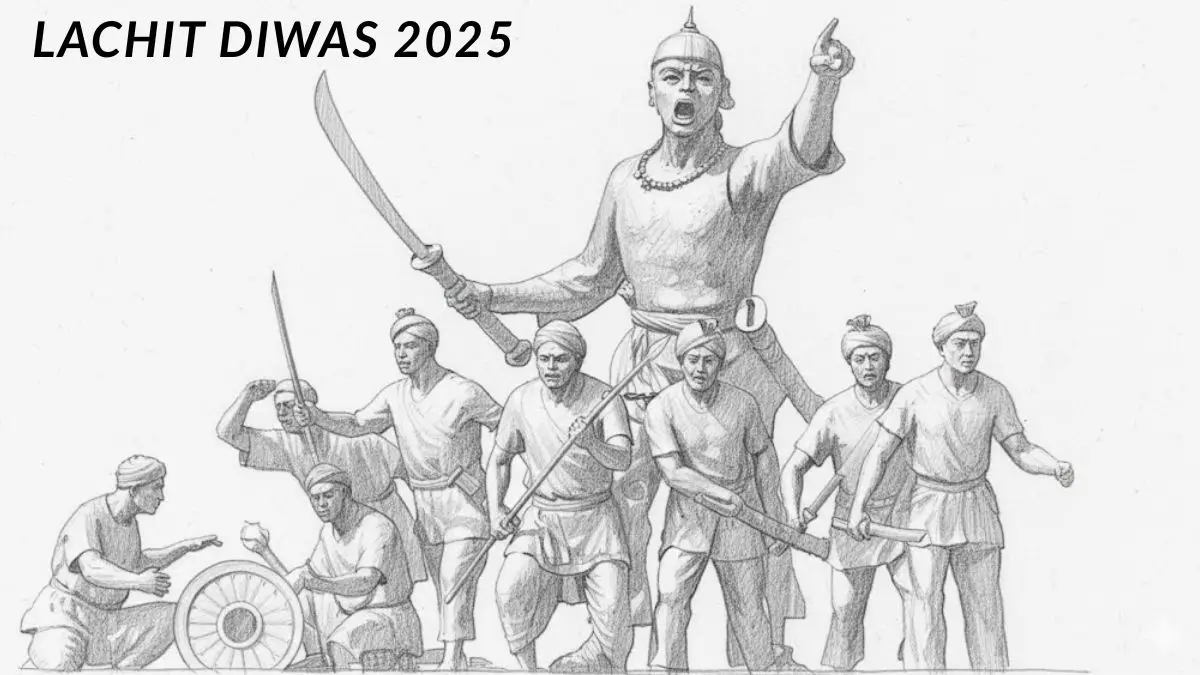
Lachit Divas, observed annually on November 24, commemorates the unmatched bravery and leadership of Lachit Borphukan, the legendary commander of the Ahom Kingdom who thwarted Mughal expansion into Assam in the Battle of Saraighat (1671). In 2025, this day continues to be celebrated with great pride in Assam and across India, marking not only a military victory but also symbolising the spirit of resistance, patriotism, and regional identity. Lachit Borphukan stands tall in Indian history as a symbol of courage and strategic brilliance.
Background of the Ahom Kingdom and Mughal Conflict
Spread and Legacy of the Ahom Dynasty
The Ahom dynasty, originating from present-day Assam, ruled the Brahmaputra valley from the 13th to the early 19th century. They were known for their resilient governance, advanced military organization, and cultural integration with local populations.
Mughal-Ahom Clashes
- From 1615 to 1682, the Ahoms fought a series of wars with the Mughal Empire, beginning during Emperor Jahangir’s reign and continuing until Aurangzeb’s rule.
- In 1662, the Mughals under Mir Jumla captured Garhgaon, the Ahom capital.
- A counter-offensive was launched under Swargadeo Chakradhwaja Singha, marking a resurgence in Ahom strength.
- The conflict peaked with the Battle of Saraighat in 1671, when the Mughal army under Raja Ram Singh I of Jaipur was decisively defeated by Ahom forces led by Lachit Borphukan.
Lachit Borphukan: The General Who Shaped Assam’s Destiny
Early Life and Appointment
Lachit Borphukan was a high-ranking military commander in the Ahom kingdom. Appointed as one of the five councillors under King Chakradhwaja Singha, he was entrusted with military, judicial, and administrative powers — a rare combination that highlighted his calibre.
Military Strategy and Tactics
Lachit was known for his preference for guerrilla warfare, utilising the terrain of Assam and swift river manoeuvres to his advantage. Despite being outnumbered, his forces leveraged mobility, local knowledge, and morale to overcome the better-equipped Mughal army.
Victory at the Battle of Saraighat
- The Battle of Saraighat, fought on the Brahmaputra River, is one of the most significant naval battles in Indian history.
- Lachit led from the front, despite being seriously ill.
- His courage, planning, and ability to inspire his troops ensured a crushing defeat for the Mughal forces, halting their expansion into the North-East.
- He passed away in 1672, a year after the victory, but his name became immortalised in Assamese and Indian folklore.
Lachit Divas: Significance and Celebrations
Symbol of Patriotism and Defence
Lachit Divas honours a man who refused to surrender his homeland to external invaders. His legacy underscores the idea that a small, determined force, guided by strategy and conviction, can withstand a far greater adversary.
Celebrations in Assam and Beyond
- State ceremonies at the Lachit Barphukan Gold Medal event, awarded to the best graduating cadet at the National Defence Academy (NDA).
- School and college competitions in essay writing, elocution, and cultural programmes on Lachit’s life.
- Public readings, historical reenactments, and documentaries are shared widely to raise awareness of his contributions.
National Recognition
In recent years, the government of India has highlighted Lachit Borphukan’s legacy at a national level, ensuring that his story becomes a part of broader Indian history and not just regional memory.
Static Facts
About Lachit Borphukan
- Born: Early 17th century (exact year unknown)
- Died: 1672
- Commander of: Ahom Army
- Title: Borphukan – A senior military post in the Ahom administrative structure
- Famous for: Leading Ahoms to victory in the Battle of Saraighat (1671)
About Battle of Saraighat
- Date: 1671
- Location: Brahmaputra River, Guwahati
- Ahom King: Swargadeo Chakradhwaja Singha
- Mughal Commander: Raja Ram Singh I
- Result: Decisive Ahom victory, halting Mughal expansion into Assam
About Ahom Kingdom
- Ruled Assam for over 600 years (1228–1826)
- Successfully resisted multiple Mughal invasions
- Known for military innovations, public works, and administrative reforms


 World Homoeopathy Day 2026: Advancing Ho...
 World Health Day 2026 - Theme, Date, Sig...
 List of Important Days in April 2026, Na...