
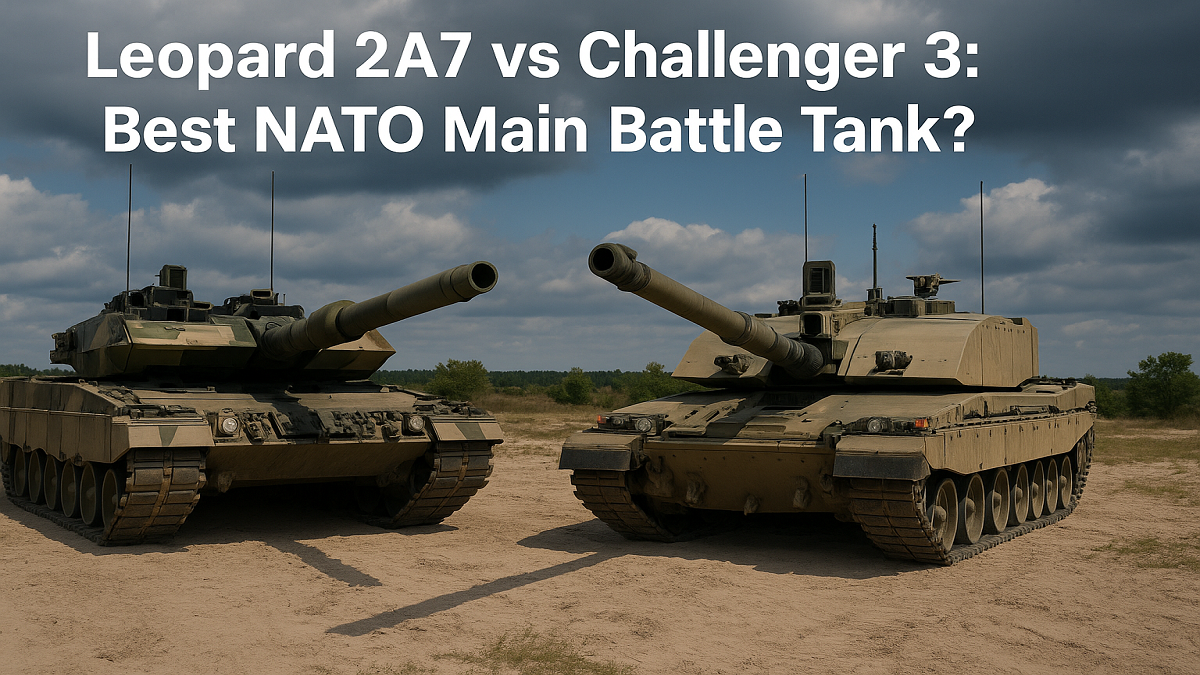
Modern warfare demands heavily armed, highly mobile, and well-protected tanks capable of surviving in intense combat. Within NATO forces, two of the most advanced main battle tanks (MBTs) are the German Leopard 2A7 and the British Challenger 3. Both are cutting-edge armored vehicles designed for frontline superiority, but they have different design philosophies and strengths.
1. Overview of the Leopard 2A7
1.1 Background
The Leopard 2A7 is the latest evolution of Germany’s legendary Leopard 2 series, first introduced in the late 1970s. This version is heavily upgraded for modern high-intensity conflict, with improved armor, mobility, and firepower. It is already in service with the German Bundeswehr and several NATO allies.
1.2 Key Features
- Main Armament: 120mm Rheinmetall L/55 smoothbore gun
- Engine: MTU MB 873 Ka-501 diesel engine (1,500 hp)
- Weight: ~64 tons
- Top Speed: ~68 km/h
- Armor: Composite and modular armor with passive and reactive protection
The Leopard 2A7 is known for balanced performance – it combines firepower, mobility, and survivability with proven combat reliability.
2. Overview of the Challenger 3
2.1 Background
The Challenger 3 is the British Army’s next-generation MBT, set to replace the Challenger 2 in the 2030s. It is a major modernization program aimed at keeping the UK’s tank fleet competitive against advanced adversaries like Russia’s T-14 Armata.
2.2 Key Features
-
Main Armament: 120mm Rheinmetall L55A1 smoothbore gun (same caliber as Leopard but improved barrel life)
-
Engine: Perkins CV12 diesel engine (1,500 hp)
-
Weight: ~66 tons
-
Top Speed: ~60 km/h
-
Armor: Enhanced modular armor with advanced active protection systems (APS)
The Challenger 3 focuses on survivability and long-range fire accuracy, making it a tank designed to outlast and outgun enemies in defensive and offensive operations.
3. Firepower Comparison
3.1 Leopard 2A7
The Leopard 2A7’s 120mm L/55 smoothbore gun is highly accurate and compatible with a wide range of NATO ammunition, including armor-piercing fin-stabilized discarding sabot (APFSDS) and programmable high-explosive rounds. It can destroy modern tanks at over 4 km.
3.2 Challenger 3
The Challenger 3 will also use a 120mm smoothbore gun, but with upgraded fire control systems for better target tracking. It’s expected to match or even surpass the Leopard in first-round hit probability. British tanks are also optimized for longer-range engagements.
4. Armor Protection
4.1 Leopard 2A7
The Leopard uses modular composite armor with the option to add reactive armor for extra protection. Its armor is well-tested in NATO missions, offering strong defense against kinetic and chemical energy rounds.
4.2 Challenger 3
The Challenger 3 will feature enhanced modular armor combined with an Active Protection System (APS) capable of detecting and intercepting incoming missiles and rockets. This gives it a technological edge in protection over most tanks in service today.
5. Mobility and Endurance
5.1 Leopard 2A7
The Leopard 2A7 is slightly faster and has excellent cross-country mobility. It can handle harsh terrain while maintaining a high level of comfort for the crew. Its operational range is around 450 km without refueling.
5.2 Challenger 3
The Challenger 3 is slightly slower due to its heavier armor and configuration. However, it is designed for rugged battlefield endurance, with a focus on operating in diverse combat conditions, including desert and urban environments.
6. Battlefield Role
6.1 Leopard 2A7
Best suited for rapid offensive maneuvers and combined arms operations. It’s a versatile tank that NATO can deploy in fast-moving battlefronts.
6.2 Challenger 3
Optimized for defensive and long-range precision combat. While still mobile, its strength lies in holding key positions and engaging the enemy from superior range.
7. Which One is Better for NATO?
Choosing between the Leopard 2A7 and the Challenger 3 depends on NATO’s operational needs:
-
If mobility and versatility are the priority → Leopard 2A7
-
If protection and long-range accuracy are more important → Challenger 3
Both tanks will complement each other in NATO’s arsenal. The Leopard 2A7 offers proven battlefield success and speed, while the Challenger 3 will bring unmatched armor and targeting technology once it enters service.


 Weekly Current Affairs One Liners (30th ...
 Who is known as the Father of Mobile Pho...
 Which is the Highest Airport in the Worl...











