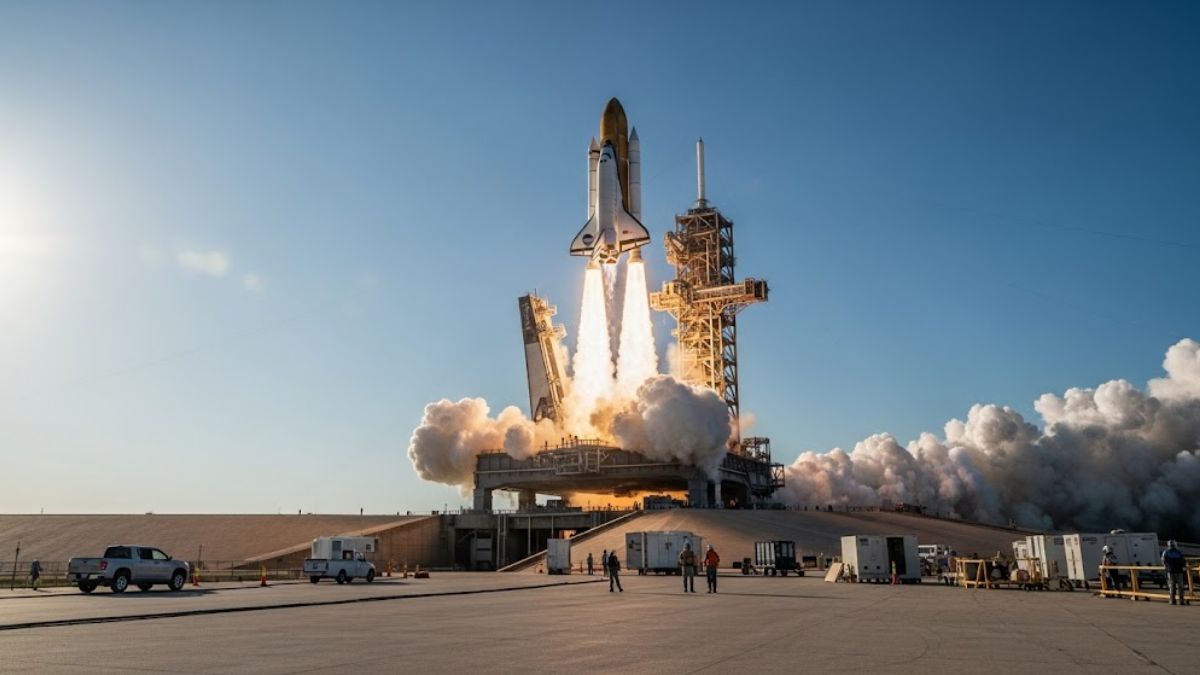
NASA has launched the TRACERS mission (Tandem Reconnection and Cusp Electrodynamics Reconnaissance Satellites) to better understand how Earth’s magnetic field protects the planet from solar storms and space weather. The mission is aimed at studying magnetic reconnection—a process where the Sun’s magnetic field interacts with Earth’s magnetic shield, causing energy bursts that can impact satellites, power grids, and communications.
Background
The TRACERS mission was launched aboard a SpaceX Falcon 9 rocket from Vandenberg Space Force Base, California. It includes two small satellites flying closely together to study the polar cusp—a region near the North Pole where the Earth’s magnetic field is most directly affected by solar activity.
Objectives
The primary aim of TRACERS is to observe and measure magnetic reconnection and energy transfer in the polar cusp region. These insights will help scientists understand how solar particles and energy enter Earth’s upper atmosphere, impacting crucial systems on Earth and in space.
Key Features
- Two satellites flying just 10 seconds apart
- Collecting over 3,000 measurements within a year
- Real-time monitoring of solar energy impacts on Earth’s atmosphere
- Investigating space weather effects on communication systems, GPS navigation, and electric grids
Additional Payloads on the Same Launch
- Athena EPIC: Focuses on reducing future satellite costs and studying Earth’s radiation.
- PExT: Demonstrates a new roaming-style signal system for dual-network satellite communication.
- REAL: A small CubeSat studying the escape of harmful electrons from the Van Allen radiation belts.
Global and Indian Significance
For countries like India, which depend heavily on satellite-based navigation, communication, and weather forecasting, understanding space weather is vital. TRACERS will help reduce the risk posed by solar storms to ISRO missions, national infrastructure, and future space exploration.
Collaborations
The mission is led by David Miles of the University of Iowa and includes partners like NASA Goddard Space Centre, UCLA, UC Berkeley, and Southwest Research Institute. Other projects involve the U.S. Space Force, Dartmouth College, and Montana State University.


 Meet MAI-Transcribe-1: Microsoft’s Fast,...
 What is Outer Space Treaty 1967? Princip...
 What Is Mission Mitra? ISRO’s New Experi...