
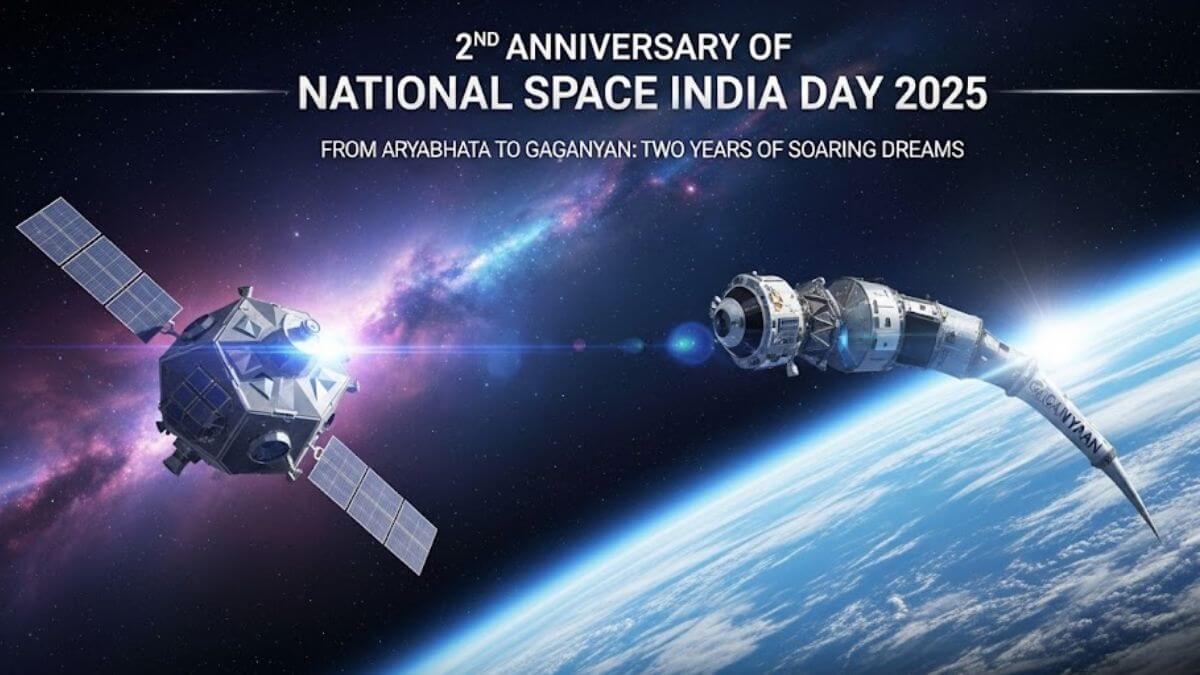
August 23, 2025, marks the second National Space Day in India—a celebration deeply rooted in pride and scientific achievement. Declared by Prime Minister Narendra Modi in 2023, the day commemorates the historic soft landing of Chandrayaan-3 near the Moon’s South Pole. As India reflects on its past accomplishments and charts an ambitious roadmap for the future, National Space Day becomes not only a tribute to the Indian Space Research Organisation (ISRO) but also an inspiration for future scientists and innovators.
Significance of August 23
On August 23, 2023, ISRO’s Chandrayaan-3 mission achieved a successful soft landing near the Moon’s South Pole, making India the first nation to do so and the fourth country overall to land on the Moon. The landing site, now named “Shiva Shakti Point”, became a symbol of India’s growing prowess in space exploration. This momentous achievement laid the foundation for observing National Space Day every year on the same date.
Theme of National Space Day 2025
The theme for 2025 is
“Aryabhatta to Gaganyaan: Ancient Wisdom to Infinite Possibilities”
This theme reflects India’s journey from early astronomical understanding—symbolized by the launch of Aryabhatta, India’s first satellite in 1975—to the upcoming Gaganyaan mission, which aims to launch India’s first crewed spaceflight in 2025. The theme bridges the gap between heritage and cutting-edge technology, highlighting India’s fusion of tradition and innovation.
A parallel initiative, the National Meet 2025, focuses on,
“Leveraging Space Technology and Applications for Viksit Bharat 2047.”
ISRO’s Legacy and Milestones
Early Foundations (1960s–70s)
- 1962: Formation of INCOSPAR by Dr. Vikram Sarabhai.
- 1969: ISRO was established.
- 1975: Aryabhatta, India’s first satellite, launched with Soviet help.
Indigenous Growth (1980s–90s)
- 1980: Rohini Satellite launched by India’s SLV-3.
- 1984: Rakesh Sharma became the first Indian in space.
Technological Maturity (1990s–2000s)
- INSAT and IRS series enhanced communication and remote sensing.
- 1994: Launch of PSLV, ISRO’s reliable satellite carrier.
Space Exploration Era (2000s–2010s)
- 2008: Chandrayaan-1 discovered water on the Moon.
- 2013: Mangalyaan (Mars Orbiter Mission) launched successfully on its first attempt.
- 2017: PSLV-C37 set a world record by launching 104 satellites in one go.
Modern Triumphs (2020s)
- 2019: Chandrayaan-2 orbiter continues to transmit data.
- 2022: Launch of SSLV for small satellites.
- 2023: Chandrayaan-3’s South Pole landing.
- 2023: Aditya-L1 mission to study the Sun.
- 2024: ISRO expands collaboration with private space players.
Gaganyaan: India’s First Human Space Mission (Expected 2025)
- Three astronauts to spend three days in low Earth orbit (300–400 km altitude).
- Mission aims to demonstrate indigenous human spaceflight capability.
- Will use ISRO’s LVM-3 (formerly GSLV Mk-III) for the launch.
Future Vision: Viksit Bharat in Space
India’s space roadmap includes,
- Establishing a permanent Indian space station by 2035.
- Sending Indian astronauts to the Moon by 2040.
- Promoting sustainable development through space applications in agriculture, disaster management, weather forecasting, and navigation.
Educational and National Importance
National Space Day serves multiple objectives,
- Inspiring STEM careers among youth.
- Honoring ISRO’s scientific achievements and its transformation into a global space power.
- Promoting space applications that contribute to India’s socio-economic development.
- Fostering national pride in India’s technological journey from Aryabhatta to Chandrayaan and beyond.


 National Safe Motherhood Day 2026: Why M...
 Jyotirao Phule Jayanti 2026: India Begin...
 World Homoeopathy Day 2026: Advancing Ho...











