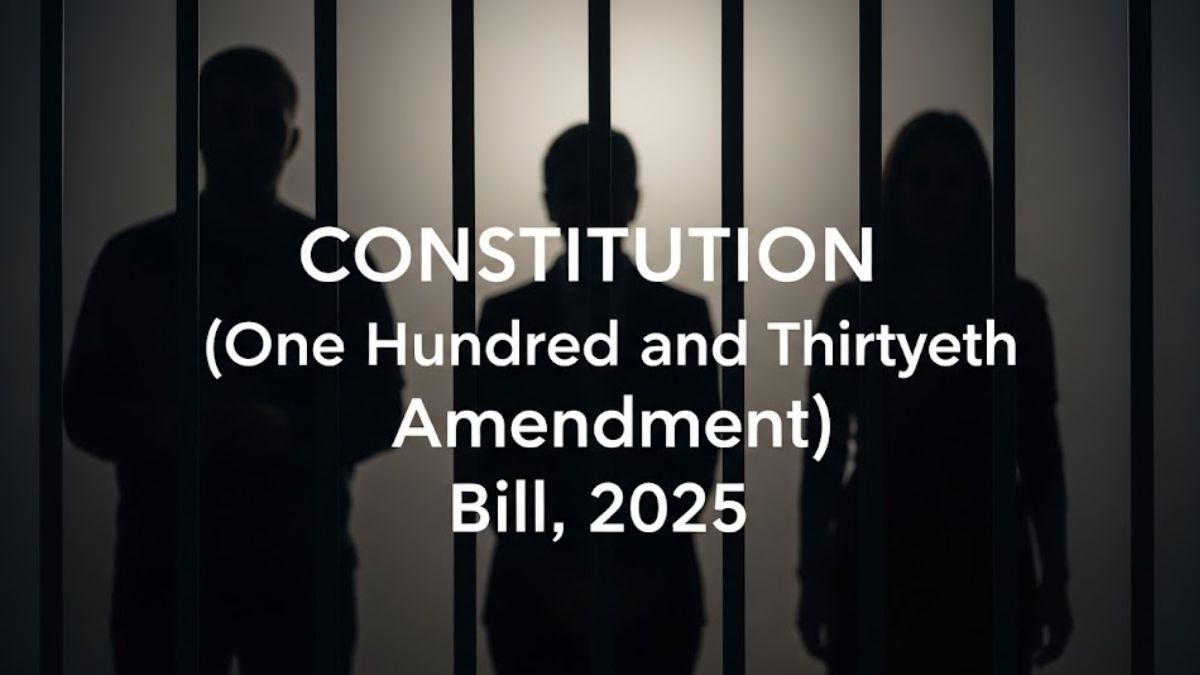
On 20 August 2025, Union Home Minister Amit Shah introduced the Constitution (One Hundred and Thirtieth Amendment) Bill, 2025 in Lok Sabha. This bill empowers automatic removal of the Prime Minister, Chief Ministers, and other ministers if detained for 30 consecutive days on charges carrying a minimum sentence of five years, even without conviction. This moment marks a significant shift in constitutional and political discourse, balancing accountability against fears of political misuse.
What the Bill Proposes
Key Constitutional Amendments
The Bill aims to amend the following articles,
Article 75 (Union Council of Ministers)
Introduces clause 5A, stating that any minister detained for 30 consecutive days on serious criminal charges must be removed by the President on the Prime Minister’s advice. If the Prime Minister fails to advise removal by the 31st day, the minister automatically ceases to hold office. The same applies to the Prime Minister, who must resign by the 31st day or else automatically ceases; reappointment post-release is permitted.
Article 164 (State Council of Ministers)
Adds clause 4A, empowering the Governor, on the Chief Minister’s advice, to remove detained ministers after 30 days. The Chief Minister also must resign by the 31st day or automatically ceases. Reappointment is allowed after release.
Article 239AA (Delhi’s Executive)
Incorporates parallel provisions for ministers and the Chief Minister of Delhi, applying the same resignation or removal mechanism with reappointment allowed post-release.
Implementation Mechanism
- The detained minister must either be removed through official action or automatically cease after 30 continuous days in custody.
- The Bill also includes a bail timeline—if bail is not secured within 30 days, removal or automatic cessation happens on the 31st day.
- The Bill has been referred to a Joint Parliamentary Committee for further examination.
Why It Matters
Sought Objectives
- The amendment aims to uphold constitutional morality, ensure clean governance, and protect public trust by preventing detained individuals from continuing in executive roles.
- It also brings ministers in line with civil servants, who are typically suspended upon arrest.
- It attempts to fill a legal vacuum, as the Representation of the People Act only disqualifies upon conviction, not detention.
Controversies and Criticisms
- The Bill has triggered widespread opposition criticism, with concerns that it could be politically weaponised against rivals.
- It is feared that selective arrests could be used to remove opposition leaders through central agencies without legal convictions.
- Critics argue that the Bill undermines key constitutional principles like presumption of innocence, separation of powers, and federalism.
- The issue has sparked heated protests in Parliament, reflecting the seriousness of the political divide.
Nuanced Support
Some lawmakers have welcomed the Bill as a reasonable reform to enhance accountability, especially in light of the prolonged detention of some leaders who continued in office despite criminal proceedings.


 ECINet KYC Feature Explained: How Voters...
 BIRAC-BioNEST Incubation Centre Inaugura...
 E20 Petrol India 2026: Nationwide Rollou...