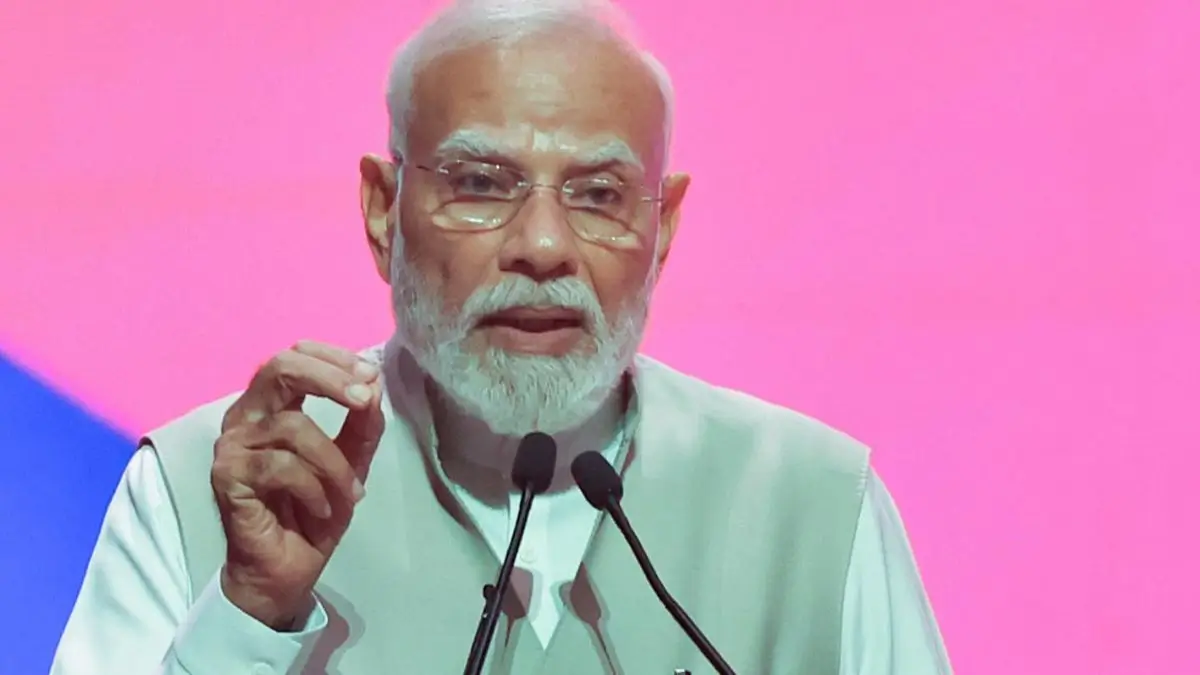
Prime Minister Narendra Modi launched the Global Fintech Fest 2026 in Mumbai on September 8, making next generation technology, financial inclusion, and consumer trust the focus of India’s fintech policy. While addressing the leaders and investors of global fintech industry, PM Modi made an emphatic call to go beyond payments into credit, insurance, savings, and pensions and spoke about the impact of UPI on the digital payments system. He mentioned agentic artificial intelligence, tokenization, and quantum computing as some of the key technologies of the future.
PM Modi Highlights India’s Fintech Progress
Prime Minister Modi has talked about India’s fintech system being one of the driving factors of financial and technological development. He drew attention to economic progress amid global uncertainties with India’s 7.8% economic growth in the April-June period.
The Prime Minister also emphasized India’s recent sovereign rating upgrade to the A- category by a Japanese credit rating agency, crediting structural reforms and macroeconomic stability.
UPI Driving India’s Fintech Development
The Unified Payments Interface (UPI) was also a core topic of the Prime Minister’s speech. The Prime Minister underlined the 10-year anniversary of UPI on August 25 and how the service has changed the way Indians use financial services.
UPI has processed more than 24 billion transactions in August 2026 and operates in 11 different countries, according to the Prime Minister.
UPI should be better linked to payment solutions in other countries, especially in countries with large numbers of Indian immigrants and trade. The linkage will decrease remittance costs and ensure that money gets to Indian families faster, according to the Prime Minister.
The Prime Minister appealed to Indian fintechs to create global standards and protocols instead of relying on solutions from abroad.
What Is Global Fintech Fest 2026?
Global Fintech Fest has evolved into a significant global fintech conference from its inception in 2020. It serves as an excellent venue to discuss financial technology, promote Indian innovations, and create partnerships between developed countries and emerging markets of the world.
The event is organized by PCI, NPCI, and FCC. The participating governmental and regulatory organizations include MeitY, Department of Financial Services, NITI Aayog, RBI, SEBI, IFSCA, and PFRDA.
Theme of GFF 2026: AI, Tokenisation and Quantum
The theme encompasses three technologies which have immense impact on financial services sector.
Agentic AI would allow financial systems to analyze situations, make decisions and perform tasks in real-time, while governance and human oversight would continue to be important.
Tokenization could enable the transformation of assets into programmable digital units, thus facilitating fractional ownership, quick settlement and interoperability.
Quantum technology would not only boost the security of finances with quantum-safe cryptography but would also help in solving intricate risk and optimization problems.
India’s Fintech Foundation
India’s rise as a fintech powerhouse has been possible due to the Digital Public Infrastructure (DPI), comprising of Aadhaar, UPI, mobile connectivity and the JAM Trinity.
As of August 26, 2026, Jan Dhan accounts opened had exceeded 59.15 crore, whereas Aadhaar registrations had surpassed 144 crore till March 2026.
UPI has made 24,509 million transactions in August 2026, showing the scale of interoperable payment infrastructure in India. The Aadhaar e-KYC has also made more than 2,458 crore transactions till June 29, 2026.
Importance of Fintech
There could be a lot of benefits of fintech. In the case of India, Financial Inclusion Index of the country rose from 43.4 in March 2017 to 70.0 in March 2026 because of more access to financial services through Fintech.
Other digital technologies like DigiLocker, DBT and ONDC add value to the ecosystem.








 UNESCO Adds Three Indian Sites to World ...
 PM-VBRY Scheme: EPFO Offers Up to ₹15,...
 Global Hunger Index 2026: India Ranks 10...