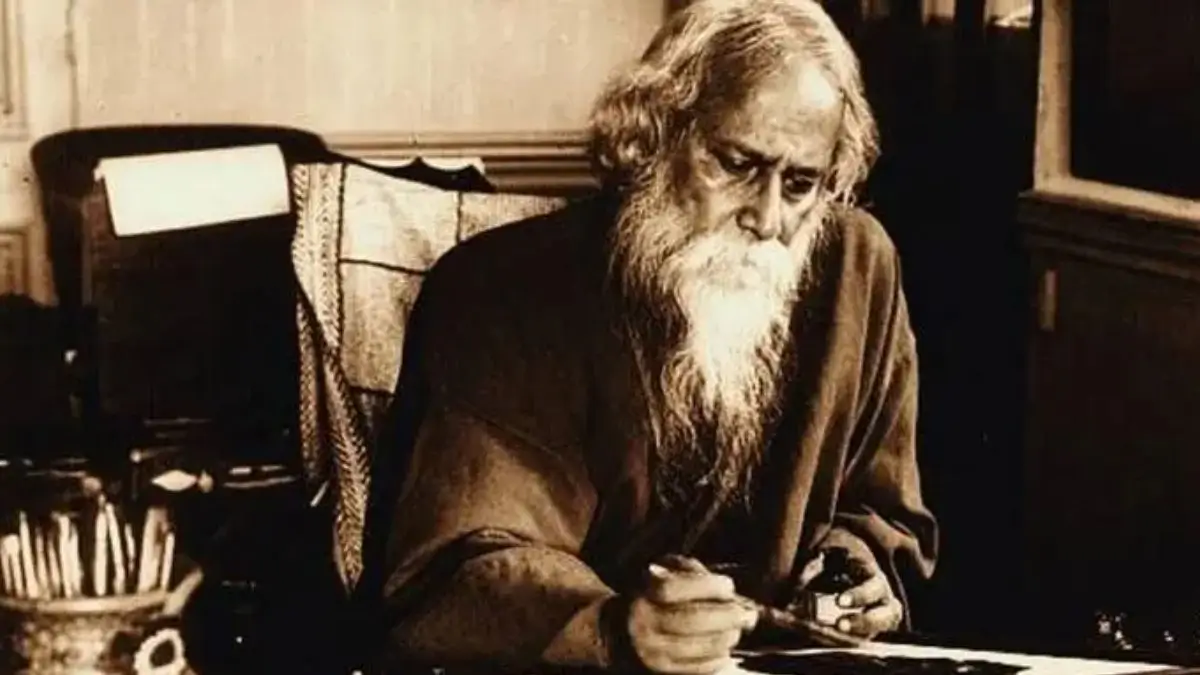
The connection of the Rabindranath Tagore with the festival of Raksha Bandhan in the year 1905 is regarded as one of the important episodes in the history of India’s struggle for independence. During the time when the Partition of Bengal brought about to certain political and social disturbances, Tagore utilized the custom of tying a rakhi as a means of fostering unity among people.
On October 16, 1905, on which the official Partition took place, people were advised to exchange their rakhis with each other as a symbol of unity. Thus, the celebration was transformed from cultural tradition into a peaceful manifestation of common belonging.
Why Was Bengal Partitioned in 1905?
In 1905, the government of British India led by Lord Curzon declared the Partition of Bengal based on the difficulty of administering such vast territory.
However, this decision was highly criticized by Indian nationalists who regarded it as an attempt to disrupt the process of developing the nationalist movement in India.
How Did Tagore Make Use of Rakhi as a Symbol of Unity?
Tagore took a peaceful stand. He did not limit himself to political meetings and rallies but suggested using rakhi as a symbol of unity.
On 16th October, the people joined together in rakhi ceremonies, tying threads with each other, with neighbours, and with the members of other communities. The idea was to show that despite all the political differences, social and cultural ties could be sustained.
Tagore also appealed to the people through songs, poetry and other ways of peaceful demonstration of his ideas.
Rakhi and the Swadeshi Movement
The agitation took place in the context of the larger Swadeshi Movement which arose after the Partition of Bengal.
The movement suggested that Indians should prefer their domestic products and create their own industries. Tagore helped this cause with his literature, music, and participation in the life of the public, thinking that cultural events could also unite the people.
It is interesting to note that Tagore showed that resistance could have various forms. A popular cultural tradition could become one of them.
Why is the Rakhi Movement Important for Tagore?
By the time of Tagore’s movement in 1905, the festival of Rakhi had acquired a greater social significance. Besides being the bond between siblings, rakhi could be seen as symbolizing the trust, unity and joint responsibility of communities.
The division of Bengal was revoked in 1911 due to many political events. But Tagore’s rakhi movement continues to be a good example of the usage of cultural tradition in the national movement.








 Who Is Navi Pillay? Nobel Peace Prize 20...
 Vande Bharat vs Amrit Bharat Express: Ke...
 Asian Games to LA28: Which Sports Earned...