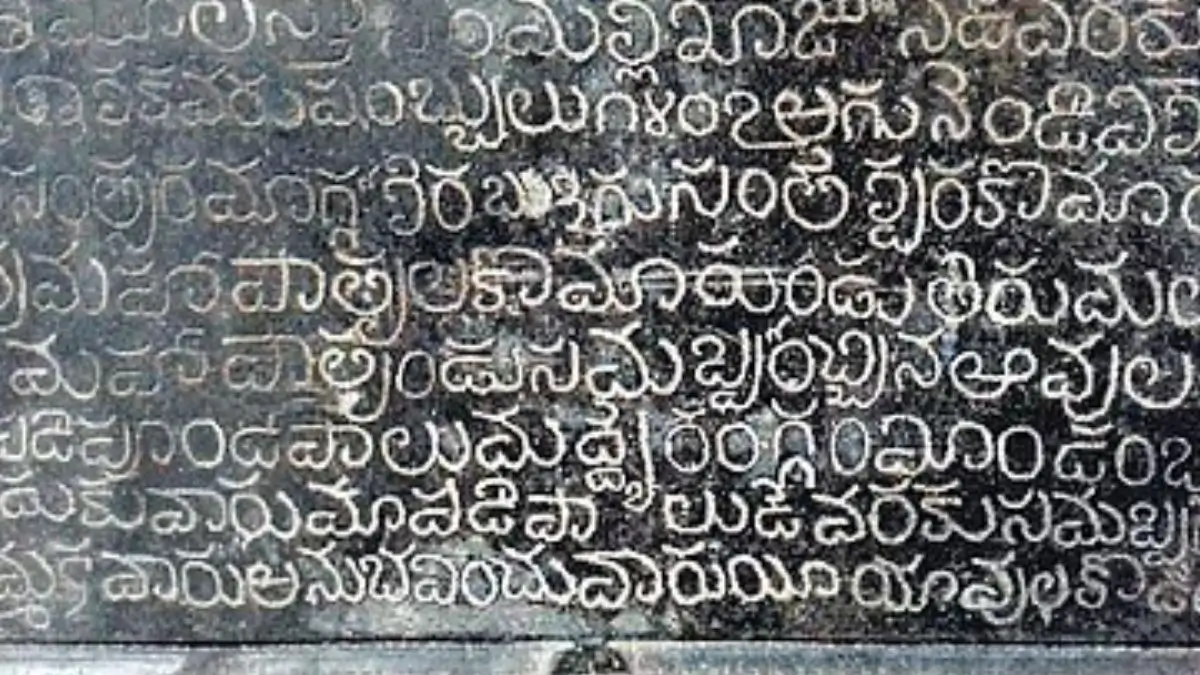
The medieval Gajapathi inscription has been discovered at the Lakshmi Narasimha Swamy Temple in Ramachandrapura Agraharam in Guntur city, Andhra Pradesh. This inscription was written in the Telugu and engraved on a stone pillar. It is believed that is ti date back to the 15th century CE. Various historians and epigraphists say the record is associated with Gajapathi King Purushottama Deva. Who was one of the prominent rulers of the Gajapathi dynasty of Odisha.
Medieval Gajapathi Inscription Found in Guntur Temple
This newly discovered Gajapathi inscription in the Guntur temple is engraved on both sides of a stone pillar located inside the temple’s mandapa (hall).
According to technical experts studying the inscription and it provides important information about the administrative system during the rule of the Gajapathi dynasty.
This inscription mentions Kumaraguru Mahapatra who has served as a steward officer under Gajapathi King Purushottama Deva.
This record indicates that the administrative influence of the Gajapathi rulers extended into the Andhra region and also demonstrating the political reach of the kingdom during the late medieval period.
Connection with Gajapathi King Purushottama Deva
The Gajapathi inscription was discovered in Guntur is believed to be linked directly to the reign of King Purushottama Deva.
King Purushottama Deva ruled the powerful Gajapathi kingdom in the 15th century CE.
During his rule the kingdom has expanded across large parts of eastern India and also including regions of modern day Odisha and Andhra Pradesh.
The inscription mentioning Kumaraguru Mahapatra suggests the presence of a structured administrative network operating under the Gajapathi rulers.
Temple Artefacts Linked to Kondaveedu Fort
Various local traditions associated with the Lakshmi Narasimha Swamy Temple in Guntur suggest that the temple’s idol and architectural components were brought from Kondaveedu Fort.
Temple authorities believes that the idol of Lord Narasimha was relocated from Kondaveedu during a period of regional invasions.
According to temple records and oral traditions the stone pillars of the temple mandapa were also transported from Kondaveedu after a divine instruction received by temple priests.
Details of Temple Worship and Cattle Management
The Gajapathi inscription discovered in Guntur also contained detailed instructions related to temple rituals and management practices.
It mentions that the inscription was originally dedicated to Lord Mulasthana Mallikarjuna of Kondaveedu before the temple structure was relocated.
This inscription specifies that milk should be offered to the deity during evening worship rituals.
Historical Importance of the Gajapathi Inscription
The discovery of the medieval Gajapathi inscription in Guntur is historically significant.
Becuae it highlights the political and cultural connections between Odisha and coastal Andhra during the medieval era.
This type of such inscriptions provide valuable information about governance, religious patronage and regional interactions of that period.
Question
Q. A medieval Gajapathi inscription was recently discovered in which city of Andhra Pradesh?
A. Visakhapatnam
B. Vijayawada
C. Guntur
D. Nellore


 Easter Sunday 2026: Meaning, History &am...
 Weekly Current Affairs One Liners (30th ...
 ECINet KYC Feature Explained: How Voters...