
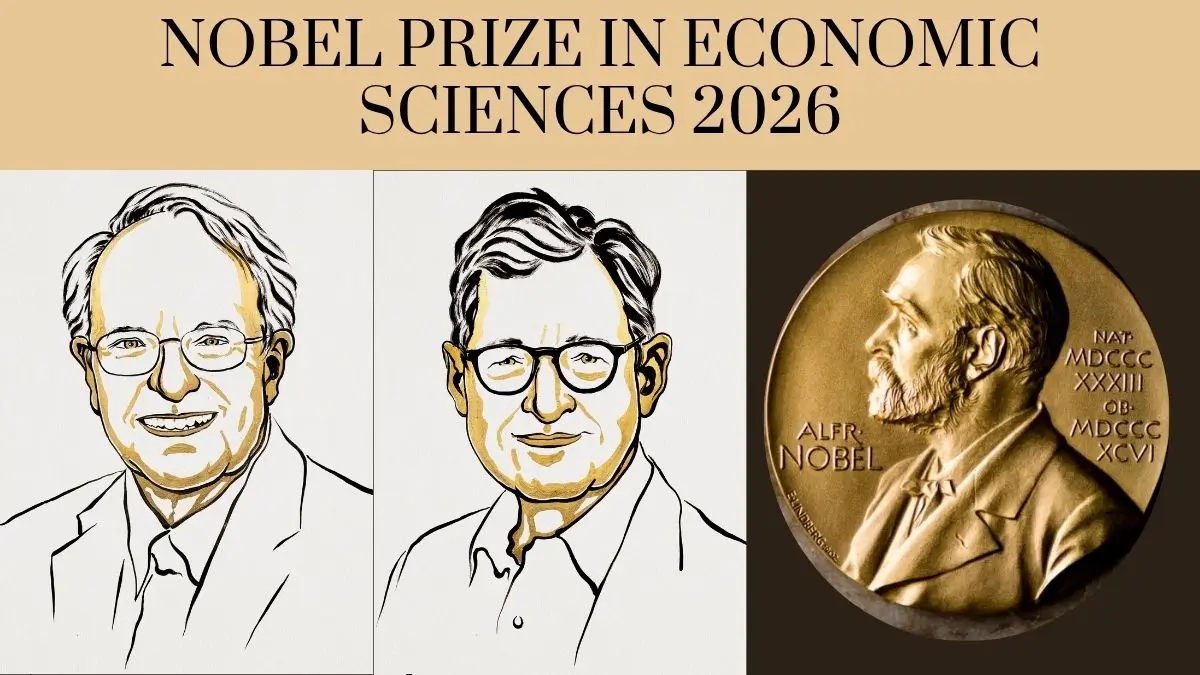
The Nobel Prize in Economics for 2026 has been conferred upon two American economists, Robert E. Hall and Michael Woodford, for their contribution to the field of the “microeconomic foundations of macroeconomic stabilization.” Their contributions have enabled a better understanding of the economic models related to fluctuations in output, employment, and inflation. These models form the theoretical basis for monetary and fiscal policy. This Nobel Prize is a recognition of the impact that household and business decisions have on the overall economy and the government responses to such economic shocks.
Who Won the Nobel Prize in Economics 2026?
Robert E. Hall
- Sveriges Riksbank Prize in Economic Sciences in Memory of Alfred Nobel 2026
- Born: 1943, Palo Alto, CA, USA
- Affiliation at the time of the award: Stanford University, Stanford, CA, USA
Prize motivation: “for microeconomic foundations of macroeconomic stabilisation”
Michael Woodford
- Sveriges Riksbank Prize in Economic Sciences in Memory of Alfred Nobel 2026
- Born: 1955, Chicopee, MA, USA
- Affiliation at the time of the award: Columbia University, New York, NY, USA
Prize motivation: “for microeconomic foundations of macroeconomic stabilisation”
Both economists have been chosen by the Royal Swedish Academy of Sciences for their work on the microeconomic foundations of macroeconomic stabilization. Both economists will share the prize money equally.
What Is the Microeconomic Foundation of Macroeconomic Stabilization?
The study of macroeconomics involves looking at the entire economy in terms of such factors as inflation, unemployment, output and growth of the national economy. The microeconomy is focused on the decision-making of individual consumers, households and enterprises.
The microeconomic basis of macroeconomics refers to the connection between these aspects. It explains how the individual decisions regarding consumption, savings, investments, wages and prices are related to economic performance as a whole.
According to Hall and Woodford’s research, the theory of economics developed in a way that included the impact of the expectations of households and companies about the future on their decisions and actions.
For instance, when the central bank announces certain future changes in the policy of the bank, the consumers and the companies can respond to the announcement even before the change occurs.
How does Macroeconomic Stabilization Take Place?
The process of expansion and contraction is natural for any economy. The main purpose of stabilization policy is to make these cycles less severe and ensure economic stability.
- Policy tool: How it can help with stabilization
- Monetary policy: Central banks regulate interest rates and other monetary instruments in order to affect inflation, credit, and demand.
- Fiscal policy: The government alters its tax, expenditure, and debt levels to affect economic activity.
- Forward guidance: Communications from central banks help influence expectations and decisions of businesses.
- Economic forecasts: Economic models help policymakers identify potential risks in the economy and the impact of their policy actions.
In the case of a recession, lower interest rates or higher government expenditures might increase demand, depending on the conditions of the economy. If there are strong inflationary pressures, tighter monetary or fiscal policies can help decrease demand.
However, the effects of policy measures depend on many factors such as the nature of the shock, the current economic environment, and the responses of households and businesses. The research of laureates helps to understand all these relations.
Why was This Research Significant?
The economic crises in the 1970s undermined conventional strategies of stabilization. There were a lot of countries in which stagflation emerged. Stagflation meant that there was high inflation and slow growth, and high unemployment in an economy.
This situation revealed the drawbacks of some current models and theories.
Research involving choices and expectations of individuals has allowed developing the more precise model that can predict how people will behave after some changes in government spending or in the interest rate that is announced by a central bank.
The research can be applied if an economy faces some shocks like an increase in the price of energy, a change in the level of spending of consumers or changes in the financial environment.








 Sunil Bharti Mittal to Receive France’...
 2026 Nobel Prize Winners: Categories Wis...
 Nobel Peace Prize 2026: Navi Pillay Wins...