
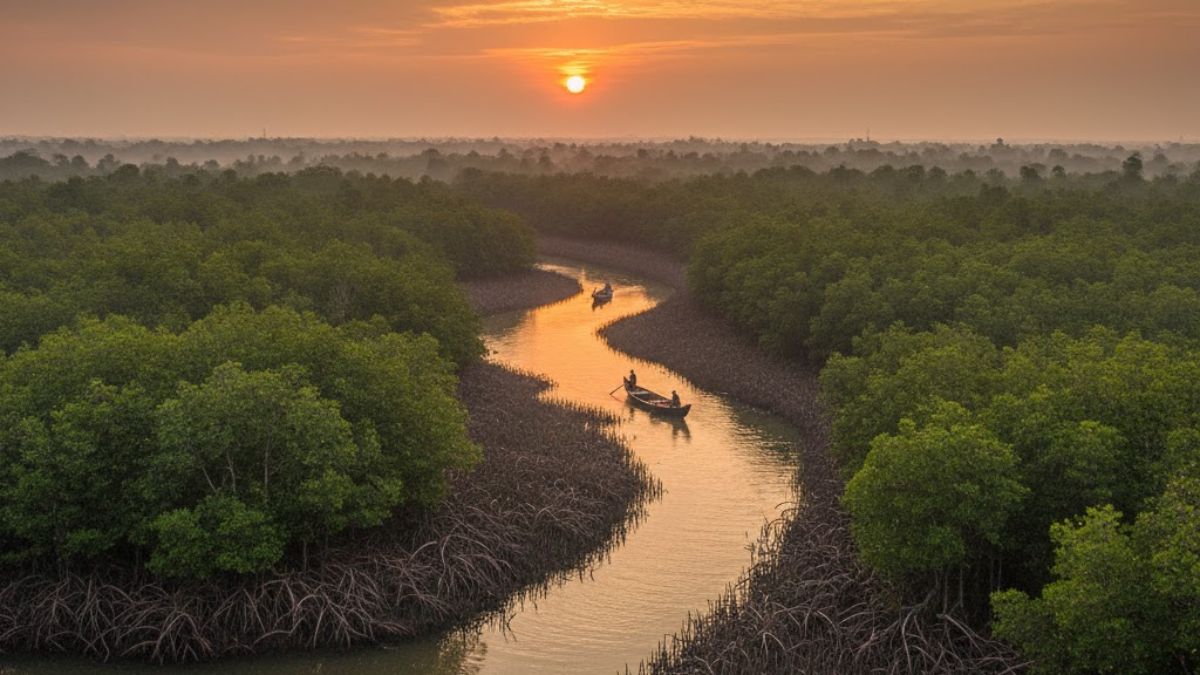
In a prestigious endorsement of India’s green innovation, the Sustainable Aquaculture in Mangrove Ecosystems (SAIME) model—developed by the Nature Environment and Wildlife Society (NEWS)—has received Global Technical Recognition from the Food and Agriculture Organization (FAO) of the United Nations. This award places the Sundarbans region on the global map for pioneering a climate-adaptive, conservation-linked aquaculture model that balances ecological preservation with rural livelihoods, particularly through the cultivation of native black tiger shrimp.
What is the SAIME Model?
The SAIME initiative is a multi-stakeholder partnership (MSP) that transforms shrimp aquaculture in mangrove-rich regions of South Asia. It aims to create an ecosystem-based standard that protects mangroves while enhancing farmer incomes through sustainable shrimp farming.
Key Features
- Focus Species: Integrates native black tiger shrimp in brackish water aquaculture.
- Approach: Ecosystem-based, climate-resilient, and conservation-driven.
Objectives
- Strengthen rural livelihoods in mangrove zones
- Reduce blue carbon emissions by integrating mangroves as natural carbon sinks
- Improve market access through branding, certification, and farmer institutions
- Encourage low-input aquaculture through Integrated Mangrove Aquaculture (IMA)
IMA Principle
The Integrated Mangrove Aquaculture (IMA) model, operational under SAIME, advocates,
- Extensive culture with low stocking densities
- No additional feed or fertilizer inputs
- Promotion of natural productivity through healthy mangrove ecosystems
- This zero-chemical, zero-waste approach aligns perfectly with global sustainability goals and blue economy priorities.
Global Recognition and Support
SAIME’s technical framework and ecological outcomes led to its global acknowledgment by FAO in October 2025, recognizing it as a model for sustainable aquaculture in fragile ecosystems.
Funding and Collaborators
The SAIME initiative is backed by international partnerships including,
- Global Nature Fund (GNF)
- Naturland e.V.
- Mercedes Benz (CSR-linked environmental investment)
- This combination of grassroots implementation and global funding adds to its scalability across South Asia and beyond.
Why the Sundarbans?
The Sundarbans, shared between India and Bangladesh, is the world’s largest mangrove forest, located at the delta of the Ganges, Brahmaputra, and Meghna rivers.
Key Facts for Exam Use,
- UNESCO World Heritage Site
- Known for tiger population in a mangrove ecosystem
- Intersected by tidal rivers, mudflats, and salt-tolerant flora
- West Bengal has 42.45% of India’s mangrove cover (highest in the country)
- India’s total mangrove area: 4,991.68 km² (~0.15% of total land area) (ISFR 2023)
The region’s ecological fragility, coupled with the dependence of local communities on aquaculture, makes it an ideal testing ground for climate-smart livelihood models like SAIME.


 International Booker Prize 2026 Shortlis...
 19-Year-Old Sheetal Devi Honoured as Wor...
 Ramnath Goenka Awards 2026 Winners List:...











