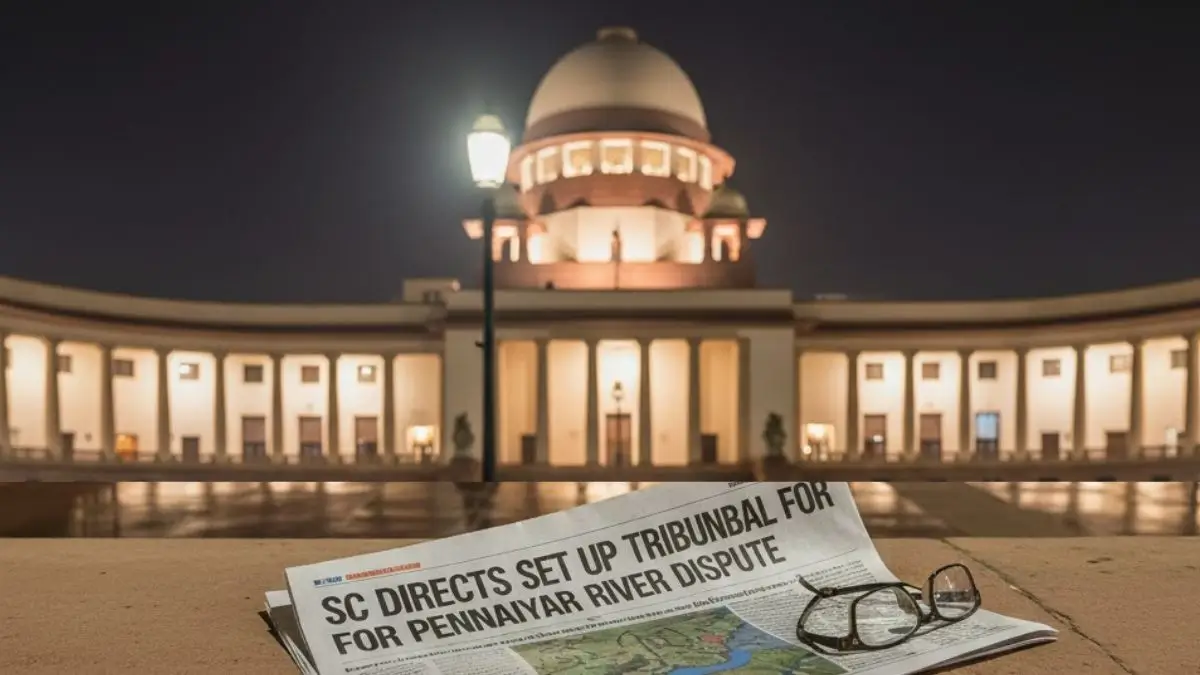
India’s long-running interstate water disputes returned to focus as the Supreme Court intervened in the Pennaiyar river water conflict between Tamil Nadu and Karnataka. On 2 February 2026, the apex court directed the Union government to constitute a dedicated water disputes tribunal within a month. The decision underscores the constitutional mechanism for resolving inter-state river disputes and highlights the judiciary’s role in preserving cooperative federalism.
Abput Pennaiyar River Water Dispute
- The Pennaiyar river flows through Karnataka and Tamil Nadu, making it an interstate river.
- The dispute arose over Karnataka’s construction of check dams and diversion structures on the river.
- Tamil Nadu argues that such unilateral actions reduce downstream water flow and violate long-standing agreements.
- The river’s waters are critical for agriculture and drinking needs in parts of Tamil Nadu, making the dispute both economically and socially sensitive.
Why Did Tamil Nadu Approach the Supreme Court?
- Tamil Nadu moved the Supreme Court in 2018 through an original suit, invoking the Court’s jurisdiction in inter-state disputes.
- The state contended that interstate river waters are national assets, and no single state can claim exclusive ownership.
- It argued that Karnataka failed to provide details of the constructions and did not seek the consent of the downstream riparian state, thereby breaching established legal and federal norms.
Role of the 1892 Agreement
- A key legal argument by Tamil Nadu rests on the 1892 agreement governing the Pennaiyar river waters.
- Tamil Nadu maintains that this agreement is binding on both states and restricts Karnataka from undertaking major water diversion projects without mutual consent.
Supreme Court’s Direction and Legal Basis
- A bench comprising Justice Vikram Nath and Justice N V Anjaria ordered the Centre to issue a notification in the official gazette and establish a tribunal within one month.
- The direction aligns with Article 262 of the Constitution and the Inter-State River Water Disputes Act, 1956, which provide for tribunal-based resolution of water conflicts instead of judicial adjudication.
Why Water Disputes Tribunals Matter
- Tribunals are designed to offer specialized, evidence-based resolution of technical water-sharing disputes.
- They help reduce prolonged litigation and political friction between states.
- The Pennaiyar tribunal adds to India’s list of river water tribunals, such as those for Cauvery, Krishna, and Mahadayi, reinforcing institutional mechanisms for cooperative federalism.
About Pennaiyar (Thenpennai) River
| Origin and Geological Composition |
|
| Tributaries |
|
| Important Sites along the Basin | Mentioned in Sangam literature for lush vegetation
Important temples,
Srivilliputhur Grizzled Squirrel Wildlife Sanctuary: key protected area |
Inter-State Water Disputes: Constitutional & Legal Framework
| Provision/Law | Description & Significance |
| Article 262 of Constitution | Empowers Parliament to legislate on adjudication of inter-state river disputes and bars judicial intervention once such laws are enacted. |
| Entry 17 (State List) | Grants states authority over water supply, irrigation, canals, drainage, and hydropower, subject to Union powers. |
| Entry 56 (Union List) | Enables Parliament to regulate and develop inter-state rivers in public interest, forming the constitutional basis for central intervention. |
| Inter-State River Water Disputes Act, 1956 | Allows states to request the Union government to constitute tribunals for binding adjudication of water disputes. |
| River Boards Act, 1956 | Provides for river basin-level boards for coordinated planning and management, though none have been effectively operationalised. |
| Dispute Resolution Committees | Mandated pre-tribunal negotiation mechanism to encourage amicable settlement between states. |
| ISRWD Act Amendment, 2002 | Introduced timelines of one year for tribunal constitution and three years for award delivery, based on Sarkaria Commission recommendations. |
| ISRWD Amendment Bill, 2019 | Proposes a permanent tribunal with multiple benches, fixed timelines, and a centralised water data bank. |
Major Inter-State Water Disputes in India
| River | Basin States Involved | Nature of Dispute/Current Status |
| Cauvery | Karnataka, Tamil Nadu, Kerala, Puducherry | Allocation disputes managed through CWMA and CWRC following Supreme Court verdict. |
| Krishna | Maharashtra, Karnataka, Telangana, Andhra Pradesh | Tribunal awards exist; disputes continue over project utilisation and water sharing. |
| Ravi-Beas | Punjab, Haryana, Rajasthan | Dispute centred on Sutlej–Yamuna Link (SYL) Canal; strong political resistance despite tribunal awards. |
| Mahanadi | Odisha, Chhattisgarh | Dispute over dam operations and non-monsoon releases |
| Godavari | Maharashtra, Telangana, Andhra Pradesh, others | Largely resolved through tribunal awards and inter-state agreements.` |
| Mahadayi (Mandovi) | Karnataka, Goa, Maharashtra | Dispute over diversion projects; tribunal award still contested. |
| Narmada | Madhya Pradesh, Gujarat, Maharashtra, Rajasthan | Resolved through Narmada Water Disputes Tribunal after nine years. |
| Vamsadhara | Andhra Pradesh, Odisha | Dispute over dam height and water sharing; tribunal award with judicial intervention. |
Question
Q. The Pennaiyar river water dispute is between which two states?
A. Tamil Nadu and Kerala
B. Karnataka and Andhra Pradesh
C. Tamil Nadu and Karnataka
D. Karnataka and Telangana


 ECINet KYC Feature Explained: How Voters...
 BIRAC-BioNEST Incubation Centre Inaugura...
 E20 Petrol India 2026: Nationwide Rollou...