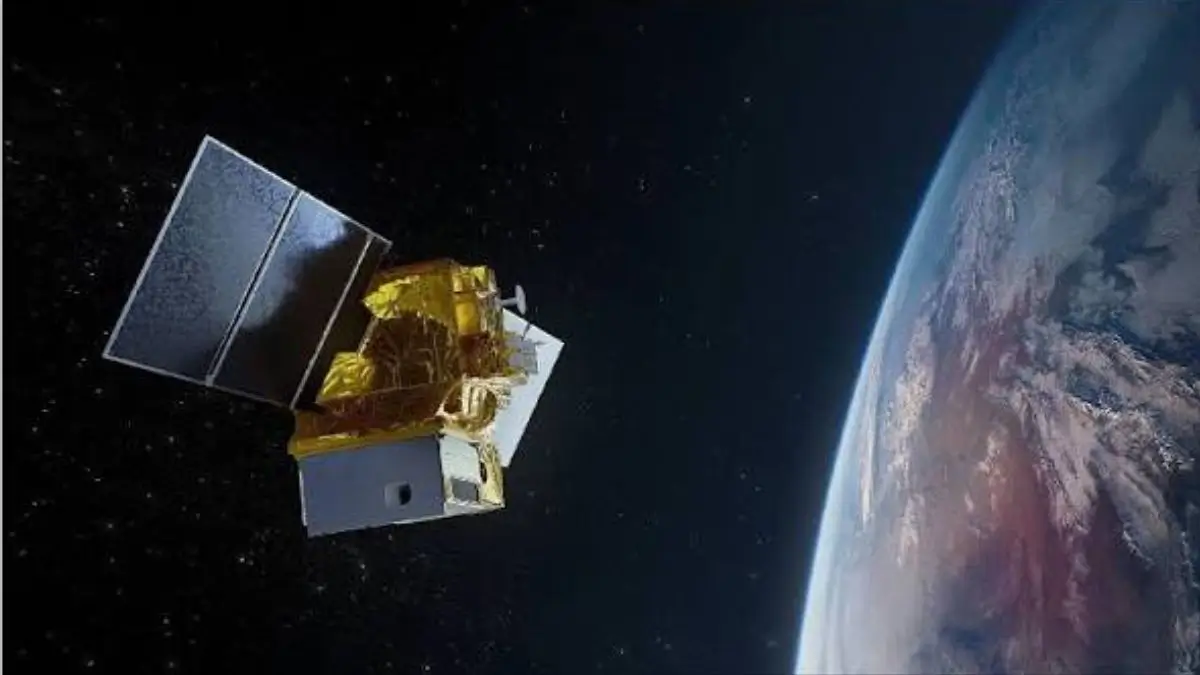
The TRISHNA mission is a joint India-France Earth observation initiative being developed by ISRO and the French space agency CNES that is set for launch by the Indian Polar Satellite Launch Vehicle (PSLV) in 2024. It will provide observations of high resolution of Earth’s surface temperature, emissivity and other environmental factors. Using thermal infrared and visible/short-wave infrared imaging techniques, TRISHNA will aid in the investigation of such phenomena as water stress, energy budget, coastal and inland waterways, urban heat islands, glaciers and others.
What Is the TRISHNA Mission?
TRISHNA is the Thermal Infra-Red Imaging Satellite for High-resolution Natural Resource Assessment.
It was created to provide high spatial and temporal resolution Earth surface data.
It is designed to observe the energy and water budgets of the continental biosphere, which will allow the estimation of terrestrial water stress and usage.
Key Scientific and Environmental Objectives of TRISHNA Mission
Some of the major scientific and environmental objectives of the mission are as follows,
- Monitoring of terrestrial water stress and water usage.
- Studying the quality and dynamics of inland and coastal waters.
- Detecting and quantifying the urban heat island effect.
- Determination of thermal anomalies of volcano and geothermal areas.
- Snow-melt runoff and glacier dynamics monitoring.
- Atmospheric parameters like aerosol optical depth, water vapour and cloud detection.
Such observation could be useful for climatic studies, agriculture, water management, and disaster studies.
Two Major Payloads on TRISHNA Mission
There would be two major payloads on TRISHNA Mission, developed collaboratively between India and France.
TIR Payload
- The TIR payload has been provided by CNES. It has a 4-channel long-wave infra-red imaging sensor that will provide mapping of surface temperature and emissivity in high resolution.
VNIR-SWIR Payload
- The VNIR-SWIR payload has been developed by ISRO.
- This payload has seven bands of spectral channels that will help in determination of surface reflectance and radiation budget variables.
TRISHNA Orbit and Spatial Resolution
The satellite will be placed into a sun-synchronous orbit, 761 kilometers above the Earth.
The planned spatial resolution will be,
- 57 meters on land and coast
- 1 kilometer on ocean and polar zones
The mission will have a design life of five years.
Importance of TRISHNA Mission
TRISHNA’s high-resolution thermal observations may be useful in addressing emerging issues like water shortages, agriculture, urban heating and glaciers melting.
It will also be a contributor to some of the international initiatives that include GEOGLAM, UN Sustainable Development Goals and Global Water Watch.
Some of the mission products are anticipated to act as Essential Agricultural Variables (EAVs) and Essential Climate Variables (ECVs).
Space Cooperation between India and France
There is yet another significant area of cooperation between ISRO and CNES, which is the TRISHNA mission. In this cooperation, India’s strengths in satellite and launch capabilities combine with France’s strength in thermal infrared Earth observation.
This mission is highly significant since land-surface temperature and other variables measurements can lead to better knowledge about water-energy interaction.








 NASA’s PUFFINS Mission: Indian-Origin ...
 ISRO Successfully Completes Crew Moduleâ...
 Elon Musk Shows Tesla Roadster Performin...